The Blog
See more of Flint’s blog here.

Your Custom Text Here
The Blog
See more of Flint’s blog here.
Dear Ones,
As I finish packing and preparing to travel back home, I wanted to add just a few final thoughts and reflections. The arc of this pilgrimage was artfully crafted and beautifully curated beyond my expectations. We began with the busyness that is Tokyo but almost immediately plunged into the world of ancient Japan at Sensō-ji temple. Remember the small golden statue of Kannon that was discovered by fishermen and enshrined at Sensō-ji in the 7th Century? That statue was hidden from public view and has not been openly displayed nor seen by the monks tending the temple for all of these centuries. It is cherished and protected, just like the golden seed of compassion in each of our hearts, the life-light of goodness. This seed is what we cherish and care for with our practices and through our relationships with each other. Then yesterday, on our final day, we met the necessary counterpoint. We entered a space in which 1001 life-size statues of Kannon stood upright, facing us at Sanjūsangen-dō. I was overwhelmed by the power of these images and the force of goodness turned toward the world. We were reminded of the deep seed of mercy and kindness as exemplified by the small Kannon brought up from the sea so long ago. Then our commitment and vows were reflected back to us by the many upright Kannons waiting for us to join them. We do our best to respond to the suffering of the world despite our limitations and fears. We are never perfect, but we can be wholehearted. These two powerful images marked the beginning and the end of our journey. They are, in some ways, the essential through-line of the entire pilgrimage.
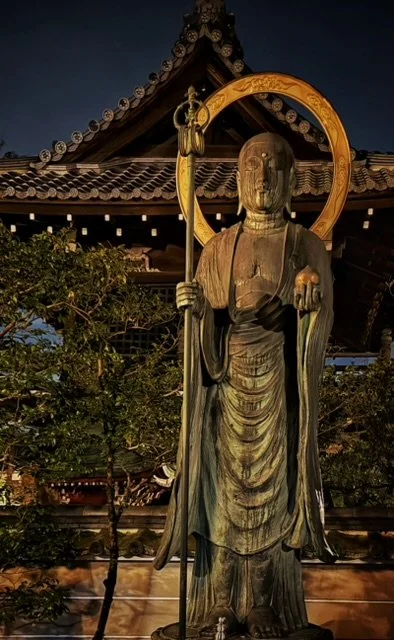
Kannon, standing even in the dark
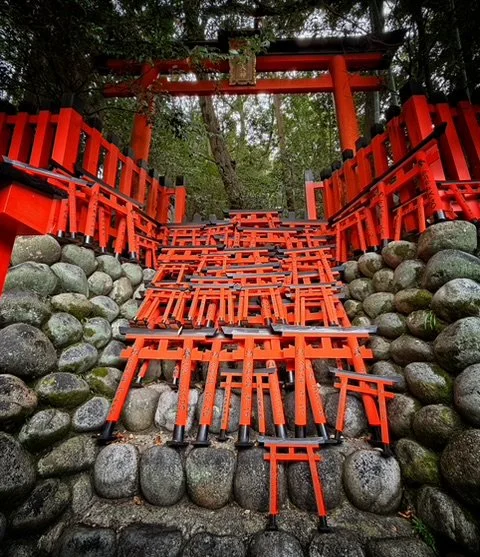
When we walked through the many vermillion torii gates later in the pilgrimage we were enacting the reality of a life of practice — that we are always meeting a threshold and we are challenged to continually step through. As we do, paying careful attention helps. Sometimes with considerable effort we ascend up through the gates of awakening in order to better serve the world in need. At other times we descend into the dark places that require our care. As we go along our compassion practices shore up our courage to continue to do so, gate after endless dharma gate.
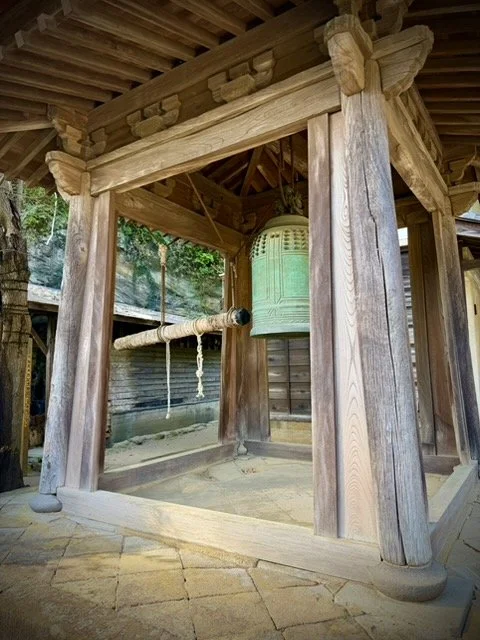
Each of the large Buddhas — at Kamakura and Nara — reminded us of the boundlessness of our own nature as buddhas in the world. The many huge bells both call us to practice and, at the same time, send out a call into the world, announcing that we are here, willing and available. The overpowering beauty of the many gardens and temples reminds us of all that humans are actually capable of, even in a world that can seem cruel and dark at times. So much of what we witnessed each day had either survived or was rebuilt after terrible wars. Many had been resurrected after the inevitable fires that have destroyed so many of the ancient wooden structures. This spirit of restoration is the embodiment of vow; we return again and again; we continue, knowing that things are impermanent; we remain committed to care in a world that does not always return our kindness. As Louise Glück wrote in her poem, From the Japanese: “Why love what you will lose?/Because there is nothing else to love.”
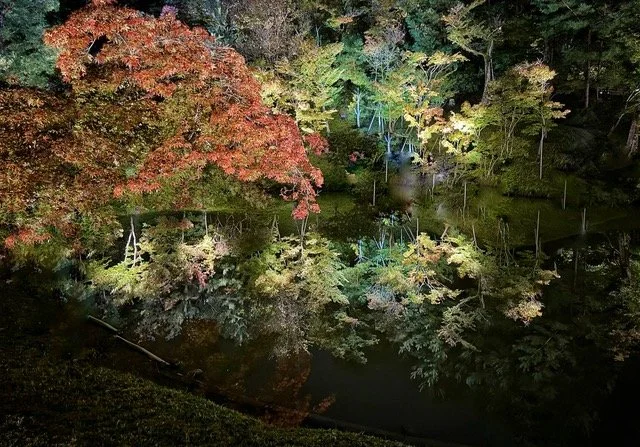
Pond reflections in the garden at night
And in the middle there was Eihei-ji, a pivot point in the pilgrimage. We returned to the source of our lineage, the place where Dogen laid down its roots in the 13th century, and where it is still held in its most elegant and powerful form, even as we shape and shade it into new expressions in the modern world. To actually be there and sit in the zendo together, to walk the hallways and endless stairways where centuries of monks have walked, to enter the Buddha Hall with hundreds of training monks and teachers, and to offer incense and bow to our ancestors in that place, was an immense privilege and a great grace. I will carry it in my body and in my robes for the rest of my life.
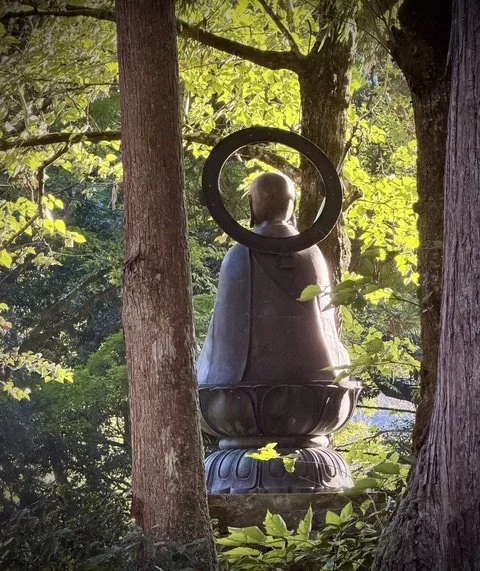
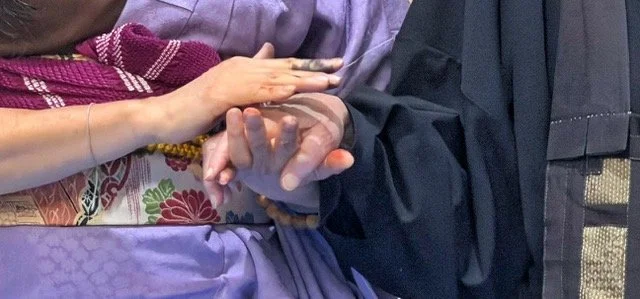
This pilgrimage came with a name which appears on the front cover of a 60-page document we were given as we first stepped onto the path. The title is: "The Japan Pilgrimage: The Living Way of Zen, Joy, and Beauty." These last two weeks have certainly reflected all that is named in that title — and more. I also want to clearly acknowledge that I drew generously from this document in crafting my daily posts. This was the source of much of the history and the teachings that I offered along with my own reflections and daily photographs. I thank everyone who participated in creating this very detailed document and for curating an amazing pilgrimage experience. I especially want to thank Roshi Joan Halifax, for inviting me to participate and for her teachings every day. Having led a pilgrimage to Japan with Kaz for so many years, they each contributed to our pilgrimage companion document and the lived experience each day. I am particularly grateful to Kimiko Bokura who was our logistics leader, translator, and "ox herder." As Americans we joked that we were like a small herd of buffalo in the refined world of ancient Japanese temples. None of this could have happened without her. Our young and energetic supporter, Jen, also provided translation and kind direction. He was also Kaz's attendant. We witnessed a beautiful daily ballet between our oldest and youngest members.
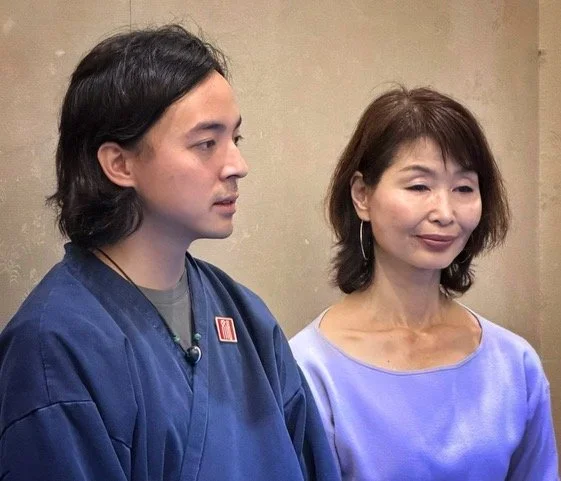
Jen and Kimiko
I arrived in Japan with a lingering memory of my practice period here almost 30 years ago. I was carrying the memory of my teachers on that trip who have now died, and who so generously accompanied me on that pilgrimage. I brought Erin with me on this trip as well, tucked into the broken part of my heart where he always resides, like the small golden Kannon at Sensō-ji, cherished and protected. I offered him a view of the joy and beauty he would have loved, using my eyes. I also fell in love with every wonderful person in our group and I now have new friends and the unexpected gifts that I could not have anticipated.
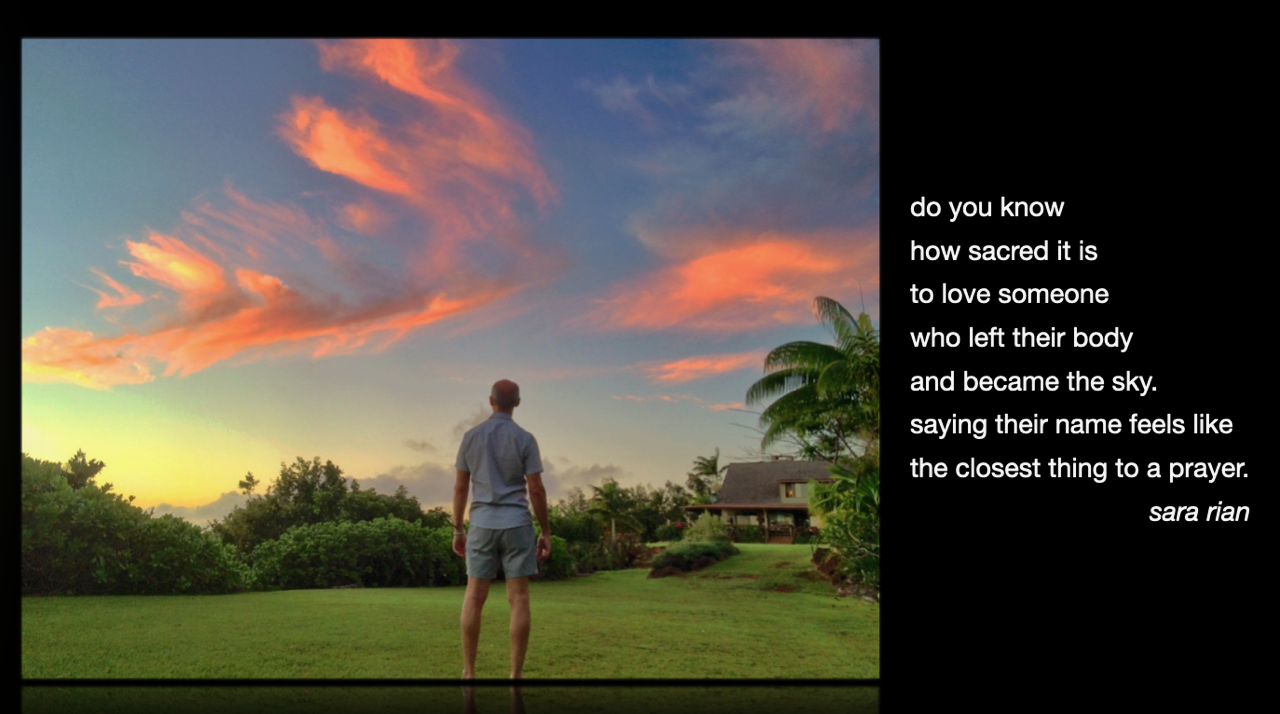
Erin in Hawaii
There is so much more I could say but I have written enough. Now it is time to return and integrate this amazing experience. If we are fortunate, this is what a pilgrimage does — it transforms the pilgrim. This is no ordinary transformation, but comes as the embodied inconceivable. There is no way to hold it all in my mind or understand what happened in a conventional way, but I can continue to live it out to the extent that I have absorbed and integrated the experience — embodied and yet inconceivable.
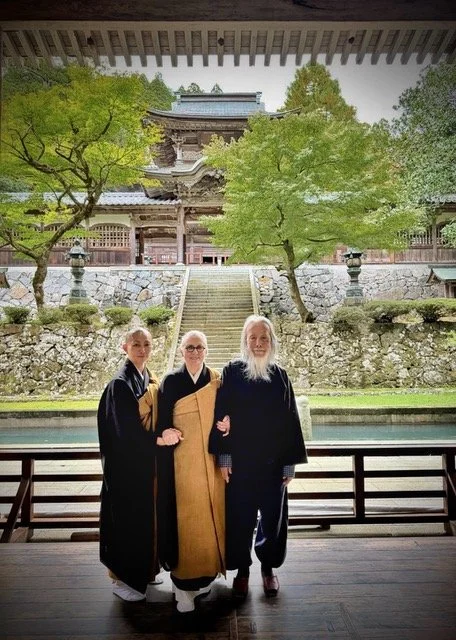
At Eihei-ji: Kaz Tanahashi, Roshi Joan Halifax and Wendy Dainen Lau, our senior teachers
So I bow and step back. It is time to walk on.
With love,
Flint
Dear Ones,
We are saying goodbye to Japan tomorrow. Today (Sunday) is our last full day and the day is divided into two beautiful experiences. In the morning is a calligraphy demonstration and in the afternoon we are going to Sanjūsangen-dō, the temple of 1,001 Kanzeons (Avalokiteshvara). This may be my favorite temple because of the experience that it evokes.
The morning calligraphy demonstration featured both Kaz Tanahashi and Yoko Keisho Nishina. Many of you know Kaz and his work. He is a national treasure himself. Yoko is truly remarkable and will be coming to Upaya early next year with Kaz and they will be teaching together. In the primary demonstration they used a process in which one of them would write something, usually a noun, and then pass the little 4x4 shikishi board to the other person and they would write an action verb or description in response to what they had received. They went back and forth — sometimes Kaz would begin and Yoko would finish. Then they would reverse, ultimately making one calligraphy for every person to take with them. The calligraphers were working from inside, calling forward the thing they wanted to write and responding intimately in the moment to what their partner offered them. When they were finished and the calligraphy shikishi were all laid out each participant could choose which one they would like to keep.
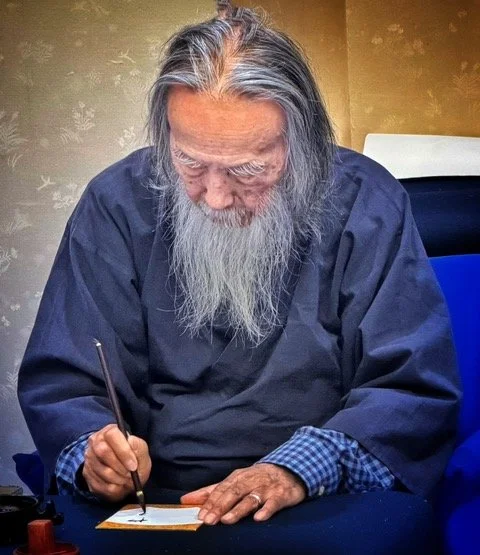
Kaz
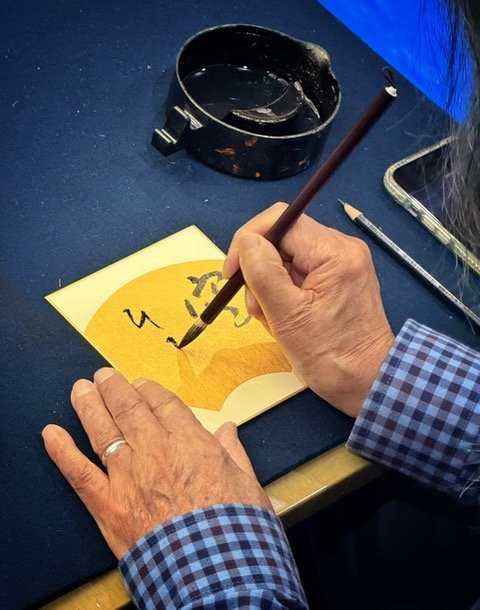
Kaz

Yoko
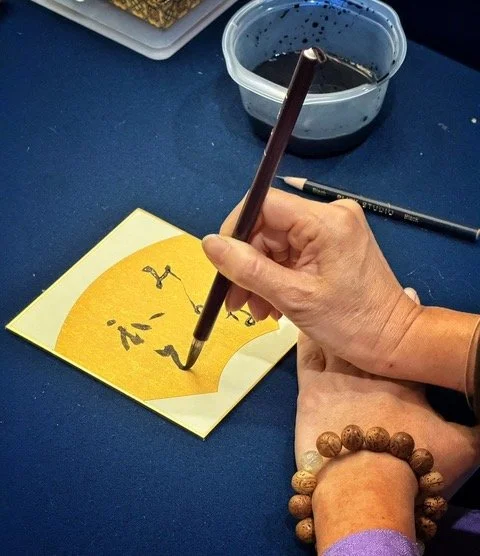
Yoko
Late in the demonstration they asked if there were any special requests. I came forward and showed them the title of my poetry collection, Flowers Fall, and asked if they would produce something related. Yoko began and wrote "falling petals." She passed the piece to Kaz and he thought for a moment and wrote, "climbs the tree." I was surprised and confused. What could this mean? There are, of course, the images of falling and rising, birth and death, in and out breath, all of which work poetically. There are even old stories of broken branches flowering magically in the Spring. Then it hit me. Erin had so many stories of climbing the huge cottonwood tree in front of the ranch house. There was a treehouse which I have seen and actually been in. In addition, his older brother had made the urn for his ashes from a branch of another tree in their childhood home that had fallen in a storm. It was a cedar branch and his brother said this was a branch that Erin would swing on as a kid. Esoteric, historic, poetic — all moved together and then moved me very deeply. You never know how these things will appear and then how they will land when they do. A mystery in response to the mystery.
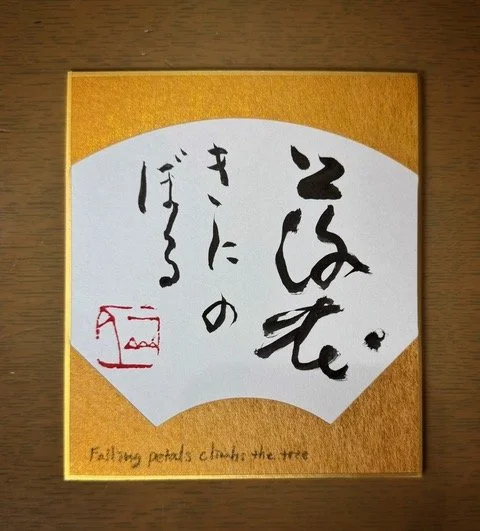
Here is a picture of the card with the calligraphy.
Afterwards the two calligraphers each produced a large piece. I don't actually remember what they represent because I was so captivated by watching them move along the floor working with the bigger brushes and the long strips of paper. If you ever get a chance to participate in a calligraphy workshop with either of them don't hesitate.
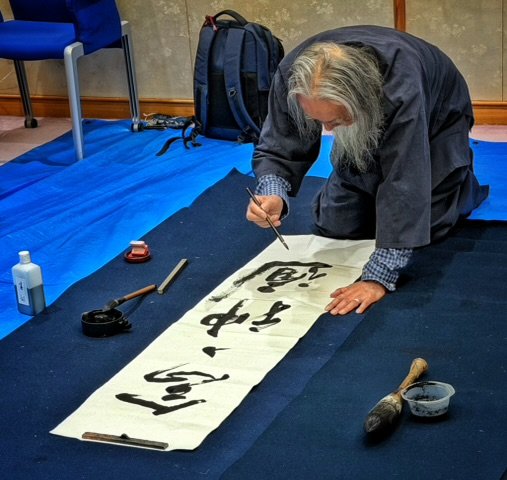
Kaz
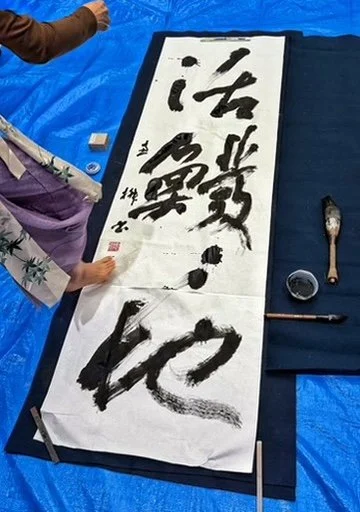
Yoko
After lunch and a rest, we traveled to Sanjūsangen-dō as a group and entered one of the most extraordinary places I have ever visited. The building is the longest wooden building in Japan. Photography is not allowed inside, so here are some images from the exterior to give you a feel for what it is like in the temple surroundings. Founded in 1164, the original burned in 1249. The present hall was rebuilt in 1266 and has stood for over 750 years.
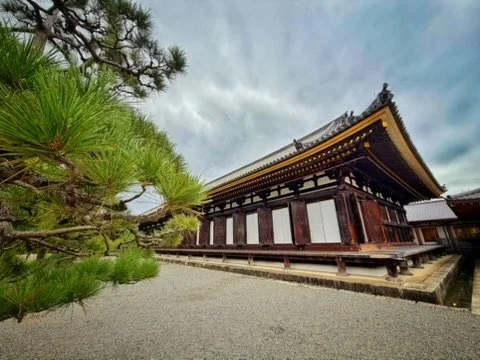
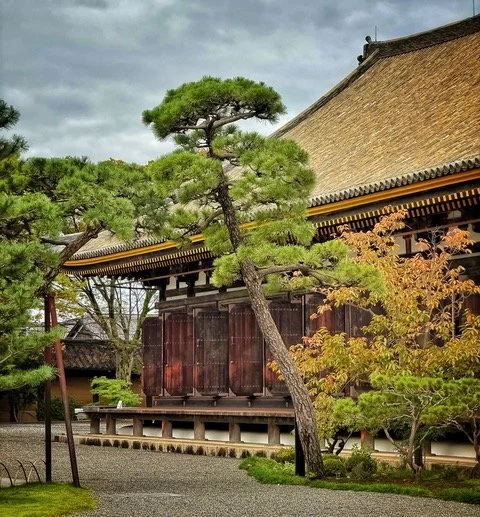
Counting the spaces between the supporting pillars on the inside you come up with thirty-three, because in the Lotus Sutra, Kanzeon manifests in thirty-three forms to reach beings who are in need: a monk, a child, an emperor, a woman, a merchant, or a god. The list goes on. The building represents this part of the Lotus Sutra constructed out of wood.
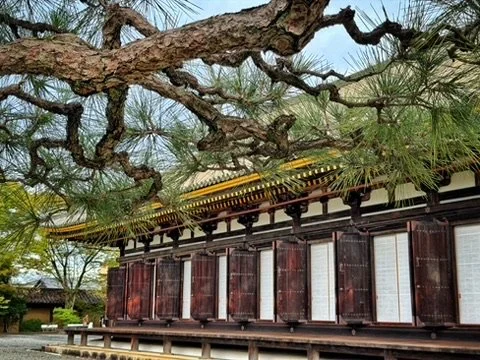
What I could not photograph, and I would have had trouble capturing anyway, are the astonishing, life-size Kanzeons with a large seated Kannon bodhisattva in the center, called the Thousand-Armed Kannon. This large piece was carved by the head of the school associated with the temple when he was eighty-two years old. On either side of the huge central figure are ten tiered rows. Imagine a huge choir standing on risers all facing in the same direction. Each figure was carved from cypress and covered in gold leaf. About 124 of them survived the 1249 fire and the remainder were carved by special craftsmen, each statue bearing the signature of the artist who made them.
I don't think I have used any screenshots in this record of the journey thus far. However, this one is worth sharing. You enter through the back of the long gallery. Turning the corner into the main part of the building this is what you see, and what you are seeing in this image is basically half of the figures. You come face to face with an army of mercy.
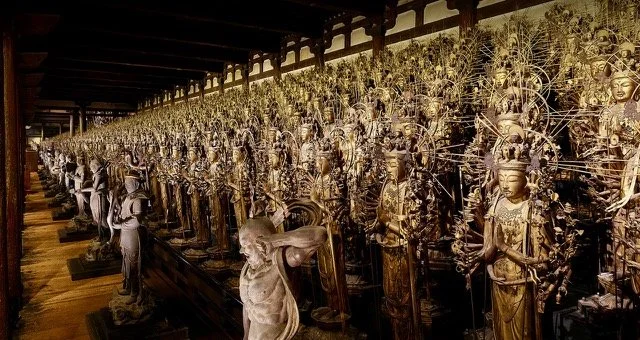
Each figure has forty-two arms. Two are joined in prayer, and each of the other forty saves twenty-five worlds. Forty times twenty-five is one thousand, the number associated with the serving arms of the Bodhisattva of Compassion. Each hand holds various implements — a rope, a wheel, a skull, a bow, a lotus, a sun, a moon, a jar. None of them are identical. Every face was carved by a specific person in the thirteenth century, and each one is different. It is said that among the 1001 faces, you will find the face of someone you have lost. You can imagine who I saw. And I wept with overwhelming love.
Moving back and forth along the building is a wonderful way to do slow walking meditation. No need to appear special or conspicuous. The place is full of tourists, but they are shockingly quiet. There seems to be no defense against this army. You might remember that at Ryōan-ji something was hidden. There was always one stone you could not see, no matter which perspective you took. But here the effect is reversed. Rather than something being withheld (the one stone), you are confronted with more than you can hold, infinitely receding into gold dimness at both ends. A thousand and one figures is this tradition's way of saying uncountable or innumerable.
You can also see the guardian protectors in front of the figures and each of them has a story. The bodhisattvas need protecting so they can do their work, just like we all do. And, like all of the temples and shrines we have visited, they have beautiful gardens and grounds.
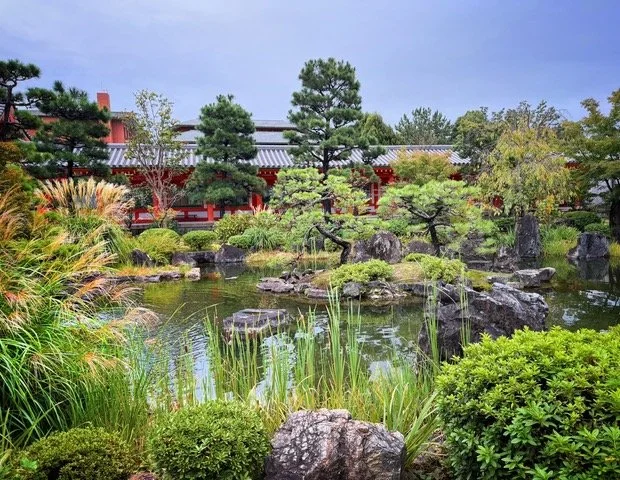
Best wishes from here. I hope to be home with ease and safety. Thank you for following along. There will be another farewell and integration post tomorrow so stay tuned.
With love,
Flint
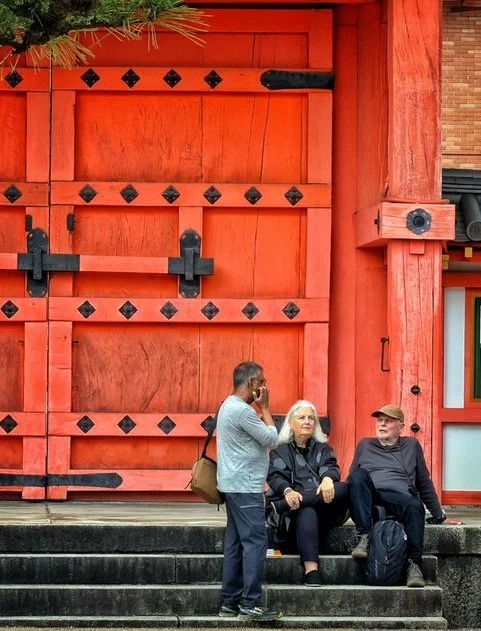
Parting shots… because the orange doors were so wonderful in the evening light.
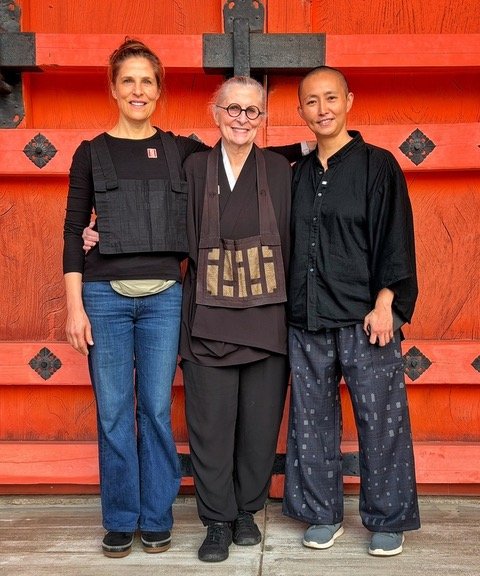
Rajnit, Terry and Brooke hanging out before leaving the temple.
Dear Ones,
I have never been to the city of Nara and have only heard about The Great Buddha there. I had no idea about any of the history of the city and the temple where the Buddha is housed. In certain ways, it was like nothing else we have seen on this trip. Everything here was before the samurai and before Zen. Everything at Tōdai-ji is older than everything else we have seen by four to five hundred years.
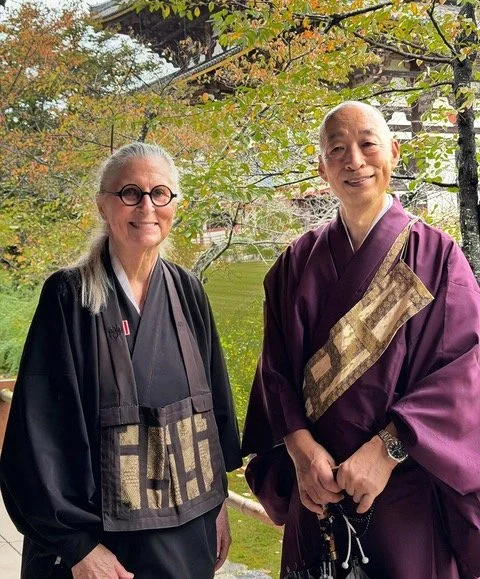
We were met by the Chief Abbot of Tōdai-ji, Rev. Hashimura, and we were invited to sit zazen in a hall that contained immense figures, some of them quite fierce, surrounding the altar. Sitting on the tan facing these figures was a powerful experience. Of course they did not move. Their stillness supported ours, and yet they were dynamic energetically, as we are in our practice. We could not take photographs in that part of the building.
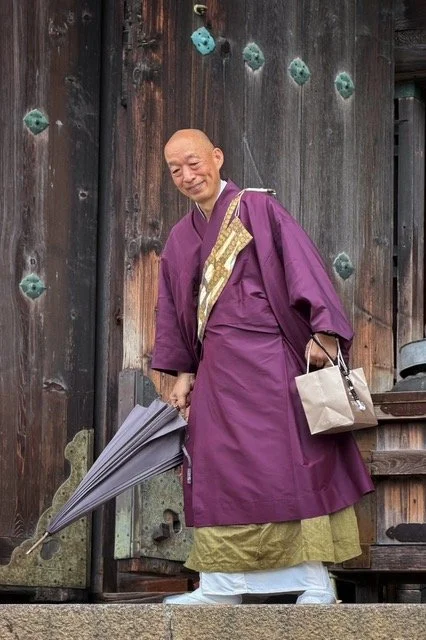
I hope you can see the kindness and humble nature in his face. He is a very important abbot and cares for a huge temple complex.
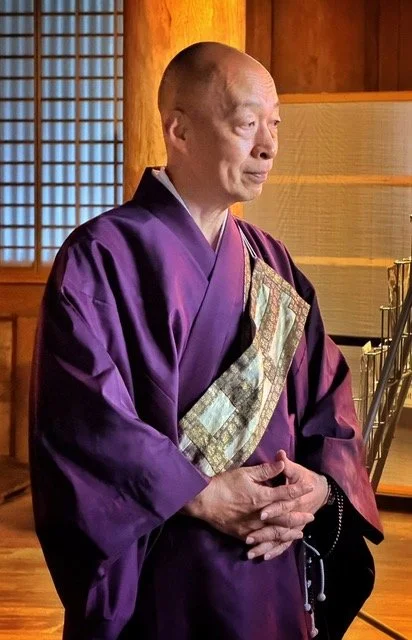
After sitting zazen we chanted the Enmei Jikku Kannon Gyo followed by the Heart Sutra. We then took a long walk to the great hall and were ushered into a side door by the Abbot.
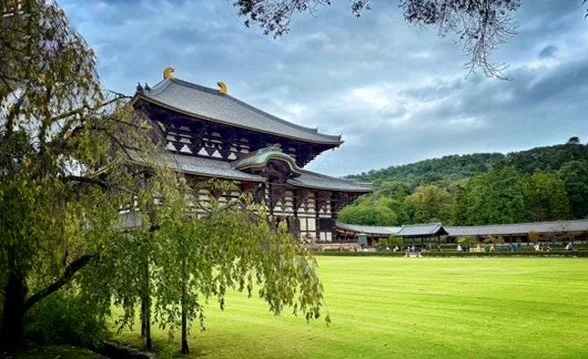
Rev. Hashimura took us personally to the upper platform surrounding the Buddha. Most people do not get to go up to this level and are not allowed to be this close to the Buddha statue. We were allowed to take a few pictures which you will see here. I felt overwhelmed and dwarfed by the figure. I will say more about the meaning of this experience below. We were each invited to offer incense at the altar and, as a group, we circumambulated the statue chanting one of the chants of the Kegon sect. It was also odd to look down and see hundreds of people below taking pictures of the Buddha statue.
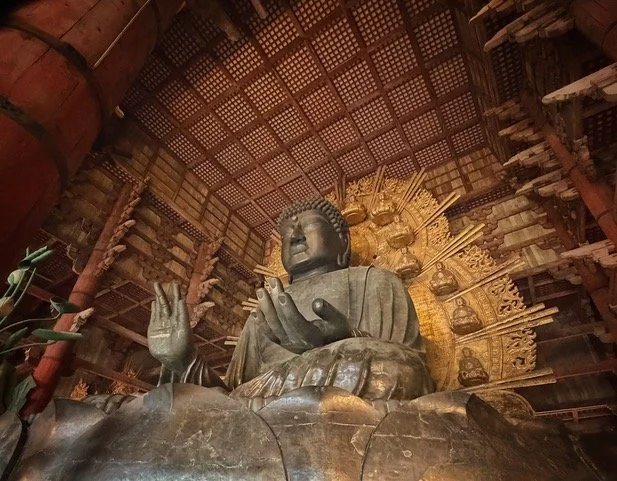
Some history: The Great Buddha of Nara was cast between 747 and 751, making it nearly 1,300 years old. It was commissioned by the Emperor after a devastating smallpox outbreak, a failed rebellion, famine and drought. This shared effort - with hundreds of thousands of people contributing to its creation - began to reunite the country and make Tōdai-ji a very important temple and Nara a powerful city.
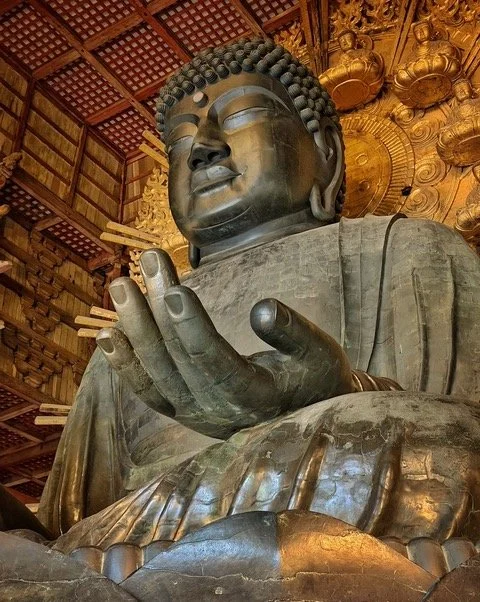
The image is not of Shakyamuni Buddha, but Vairocana Buddha of universal light. It is 49 feet tall and weighs about 500 tons. This is the cosmic buddha of the Kegon school and it is the central image in Indra's Net, the infinite net with a jewel at every knotted juncture, reflecting all the other jewels, endlessly. It is an image of profound interconnection. Nothing exists independently. Everything is constituted out of everything else. This means that one of the largest religious statues in the world was built to embody the notion that nothing has a separate self. Religious leaders came from all over the eastern world to participate in the "eye opening" ceremony in 752.
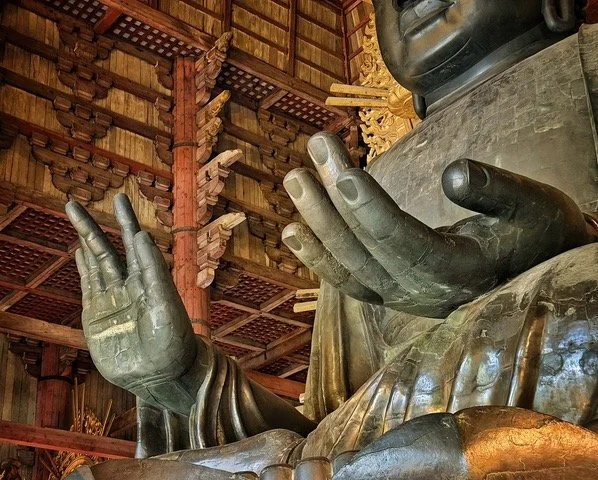
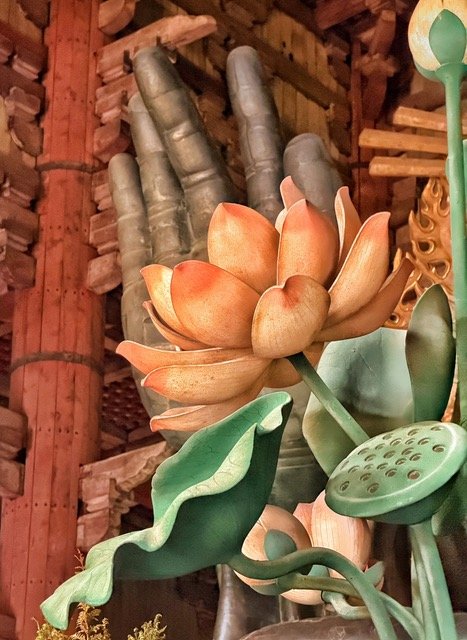
The Daibutsuden - the great hall - remains one of the largest wooden buildings on earth. It is hard to describe the scale of these grounds and the buildings. This is a very tiny peek at a vast complex of buildings and lakes and parks.
The gate leading to the building that holds one of the largest bells in the world, cast at the same time as the Buddha. It has hung here for nearly 1,300 years and weighs 26.3 tons.
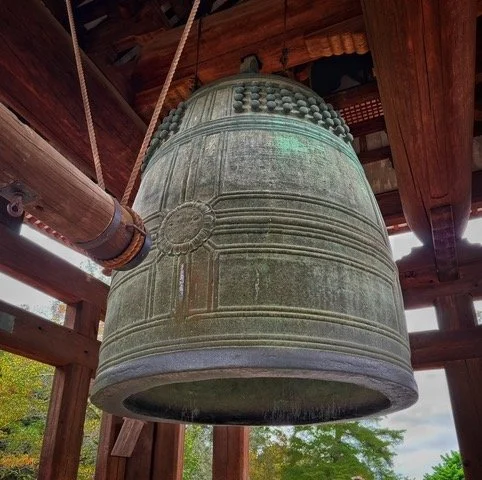
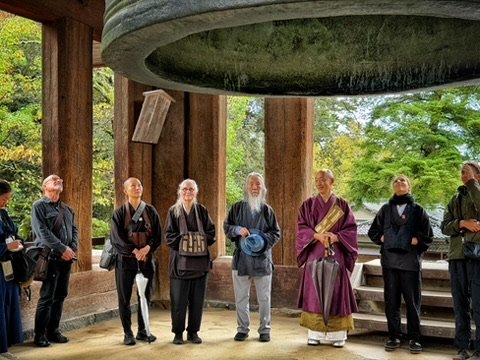
This may give you a feel for the size of the bell.
All of these descriptions and photos are not just to sound impressive (although it is!), but to point out something more important. The Kegon school is founded on the Avatamsaka Sutra, one of the most important Mahayana scriptures in Asia. In English translation it is over 1,600 pages long, another very big number. It is extravagant and almost psychedelic in its description of reality, a reality that is inconceivable and vast, so the imagery is designed to be beyond anything you could hold in your awareness so it literally blows your mind. This temple embodies that teaching. Everything about it is beyond comprehension and opens a person to the vast, interdependent scope of ultimate reality. Now back to the human scale.
After our time together, Rev. Hashimura said goodbye and we headed into old Nara for an art gallery experience.
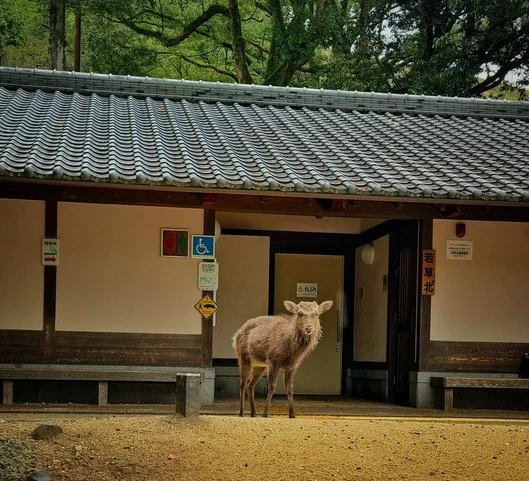
One more thing to know about Nara, which we encountered as soon as we arrived, is the presence of sika deer. They are everywhere. Like pigeons in a square in Venice or squirrels in a Chicago park, they are right there with humans, begging for food. They are fed well and completely protected, but they kind of overrun things. When we got off the bus to have a bio break and something to drink before going to see the Buddha, we couldn't even get to the bathroom without encountering these ubiquitous animals.
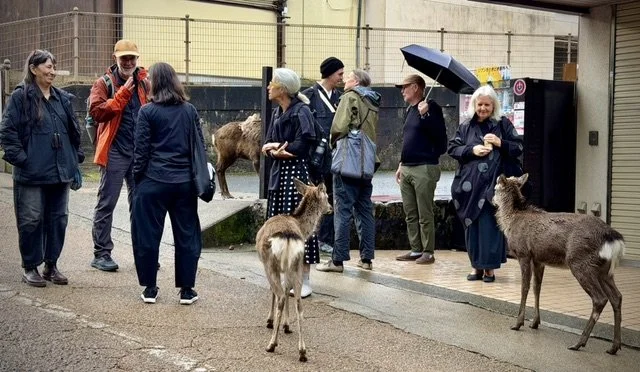
They hang around as if they hoped to get a latte or a soft drink.
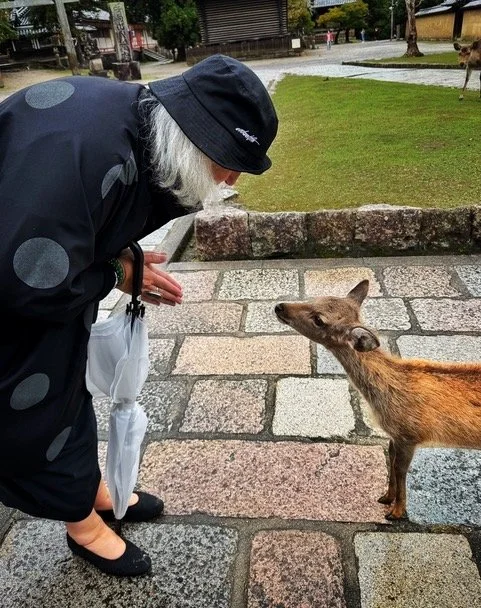
Terry loved them and bowed to each one if they approached her.
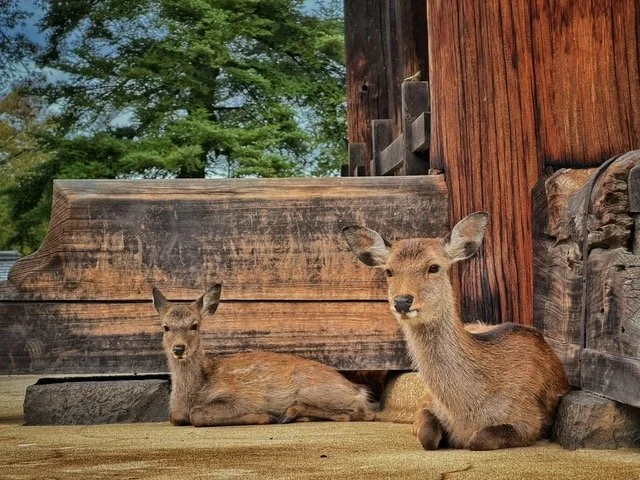
They lounge everywhere, including the platform for the large bell.
We finally left the temple grounds and visited a gallery owned by a friend of Roshi's. Among other artists, he had many prints by Mayumi Oda, whose work some of you may know. There was also an exhibit of very special tea bowls. We were all enjoying looking at everything when another old friend of Roshi, Rebecca, and Terry showed up — Pico Iyer. If you have not read anything by him I would suggest it. You will sometimes see his essays in popular Buddhist magazines like Tricycle. He has lived in Nara for many years.
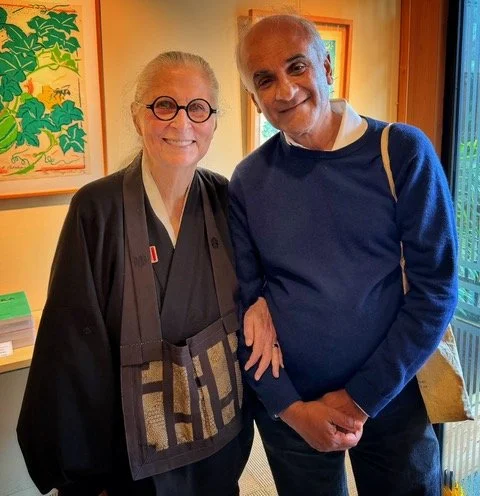
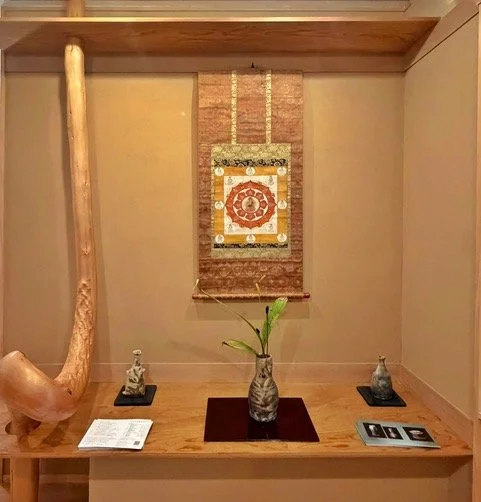
Following our time at the gallery and old Nara, we went into the countryside to a place called Toyouke no Mori, a sustainable farm and retreat environment. It was founded by Mayumi Oda and Hiro Minato, the gallery owner. There is also a small gallery space there and three rooms that guests can rent, beautifully designed in a contemporary Japanese style. You can see some of the style in this beautiful tokonoma. Usually found in a tea house, a tokonoma is “a slightly raised, built-in recessed alcove that serves as the spiritual and aesthetic focal point of the entire room. Rather than being a functional storage space, it functions as a curated sanctuary where the host subtly communicates the season, theme, and underlying intent of the tea gathering.” Here it is a place to display examples of the particular ceramic art being featured at the time.
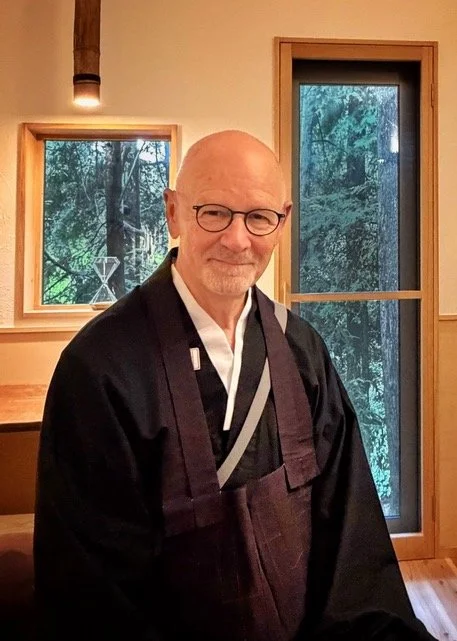
As I sat in one of the guest rooms quietly relaxing, Rebecca Solnit did what I have been doing for two weeks. She took my picture. So there is one of me.
The staff and volunteers had prepared a banquet for us, so we ate our lunch and enjoyed the day in the country. We had a circle check-in before returning to Kyoto by bus. Tomorrow is our last full day so now I am going to get some rest.
With love,
Flint
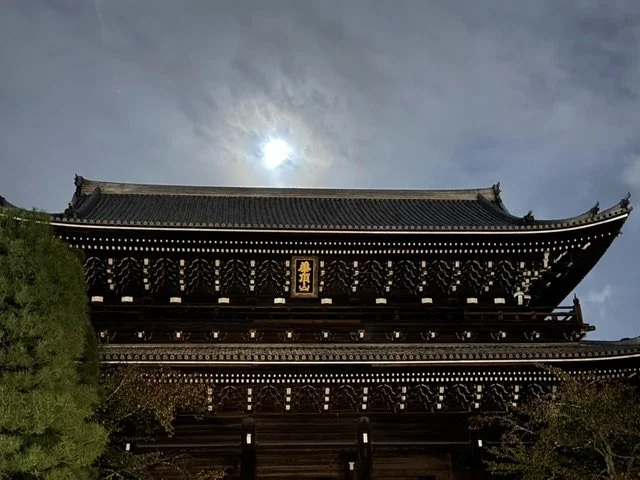
P.S. As a few of us walked to dinner in Kyoto this evening I noticed the moon rising behind the clouds and over a temple we were passing…
Dear Ones,
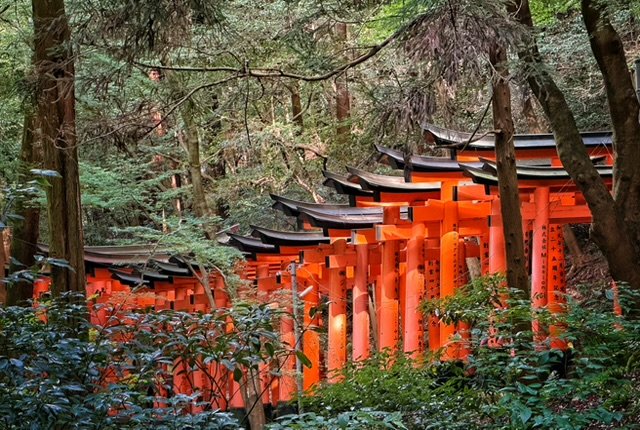
Today we visited two iconic sites in Kyoto — Fushimi Inari Taisha with the thousands of bright orange torii gates snaking up and down the hillside, and the powerfully understated rock garden at Ryōan-ji. Very different places, each with its own potency and challenges.
These first two images are from the entrance to Mount Inari and I have placed them here just to show you how many people visit this site. It is packed. Sometimes it is even hard to move forward, a human traffic jam walking through a true wonder. The full circuit is around 2.5 miles and takes two to three hours at a normal pace. We had all morning. There is a stopping place midway along the trail with a great view of Kyoto below. Most people stop here, enjoy the view and go back. We did the whole thing which was quite a workout. You go up, up, up seemingly forever, heart beating and breathing heavily. And then you come down, down, down with increasingly aching knees, pounding away on the stone steps.
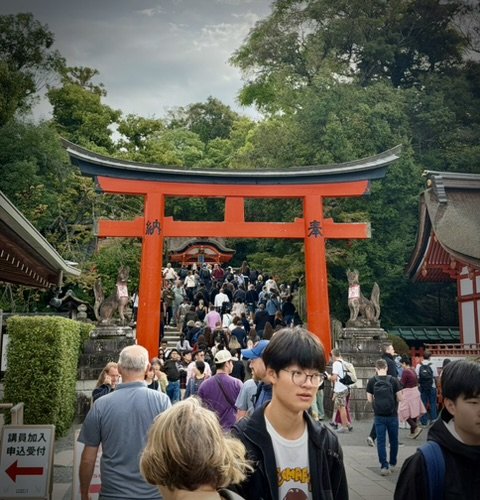
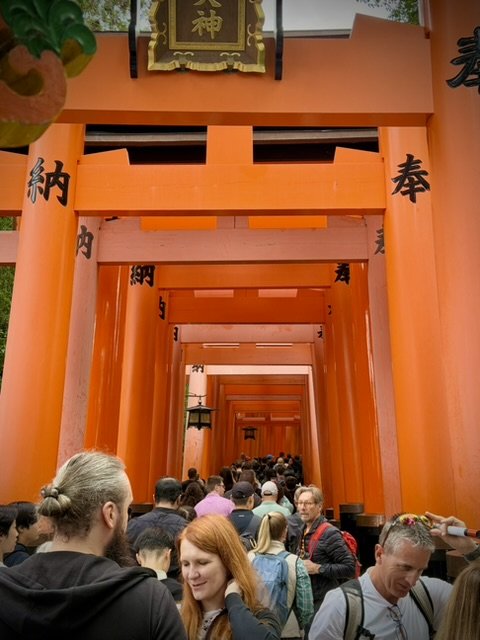
The experience reminds us that walking is a practice, and the unending gates remind us that repetition is an important part of practice. Ten thousand gates is not ten thousand different things. It is one thing, ten thousand times, and after a while the counting stops, and you just continue. Just like sitting and walking practice in the zendo.
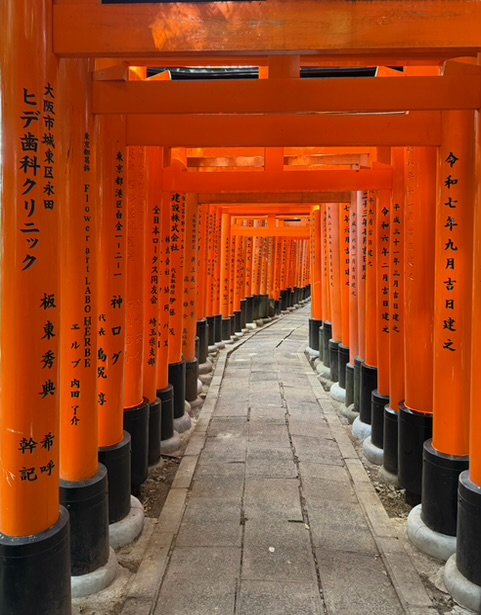
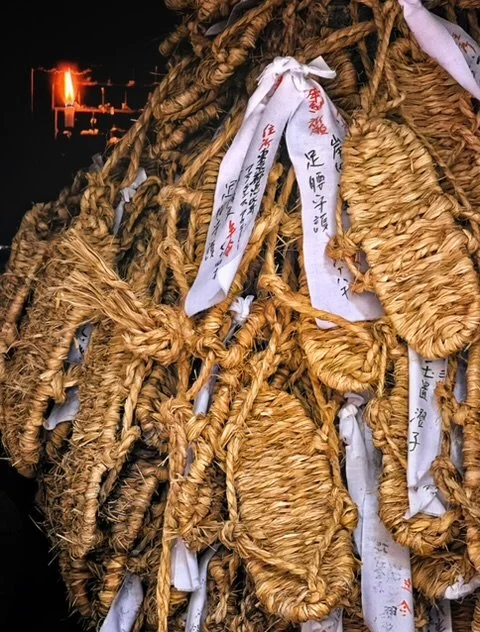
Sandals of former pilgrims walking the mountain.
There are also thousands of private altars along the way tended by families. The kitsune, or foxes, are the spirit guides of the mountain and you see stone images everywhere. In other places, all over Japan, you see Jizo bodhisattva statues with their caps and bibs. Here you see foxes and each holds something in its mouth or under its paw. They vary and have meaning. They are not decorative.
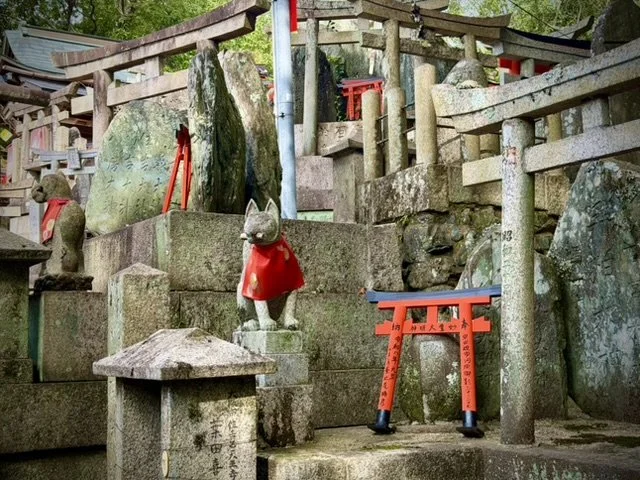
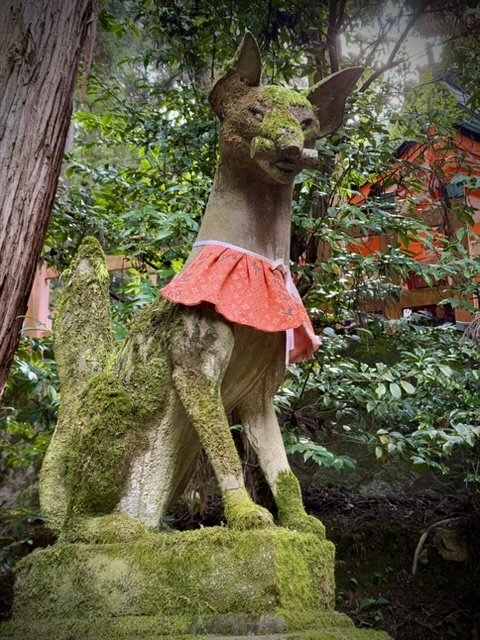
Every one of the gates (Senbon Torii) was donated by an individual or a business, and the donor’s name and the date are painted in black on the back of each post. Walking up you see the vermillion color. Walking down you see a wall of names: companies, families, sake breweries, some from a hundred years ago and some from last spring. The mountain is made up of gratitude and hope, itemized.
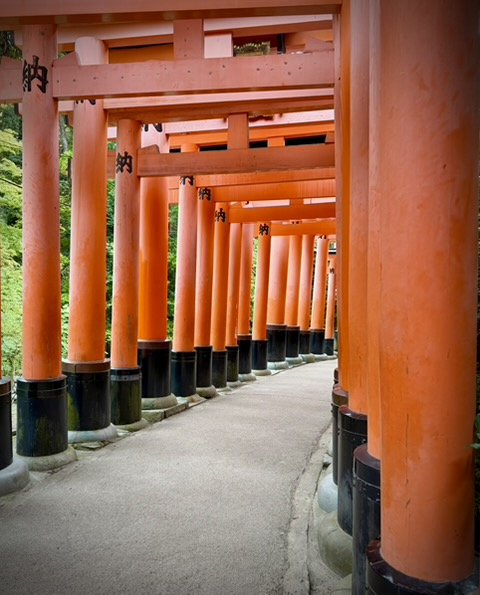
Going up…
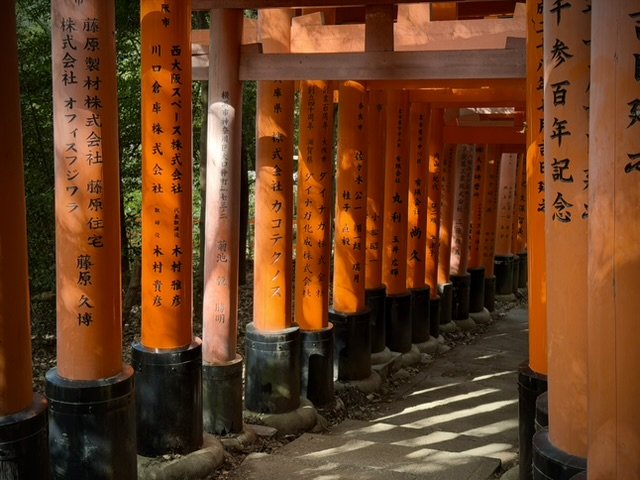
Coming down…
After a shared lunch in the neighborhood just outside of the main gate, we traveled back to the hotel. Some folks chose to rest after what was a challenging morning physically, and others of us decided to go on to Ryōan-ji for the remainder of the afternoon. It is one of the most famous gardens in the world, and as a result, one of the hardest to see. I was there on my first visit in the late 1990s and I was eager to return. The grounds of the temple are extraordinary even though the main attraction is the rock garden. There is a lake, a bridge, mesmerizing paths, rocks and trees, moss and stones.
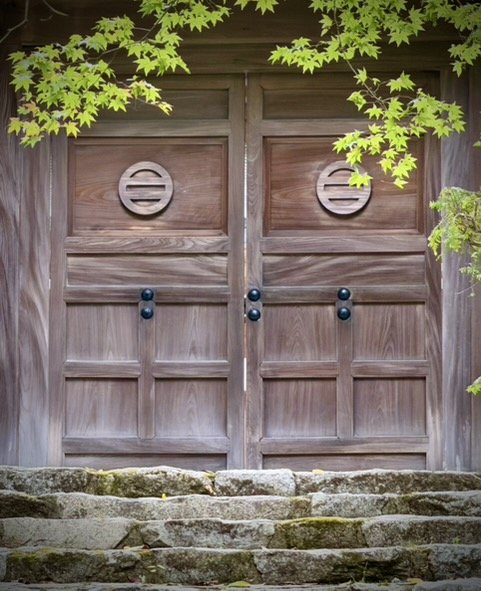
There are lovely gates inviting you in.
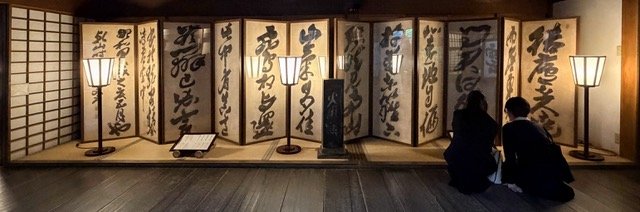
School girls were examining this ancient calligraphy screen as we entered the temple building which is the entrance to the rock garden.
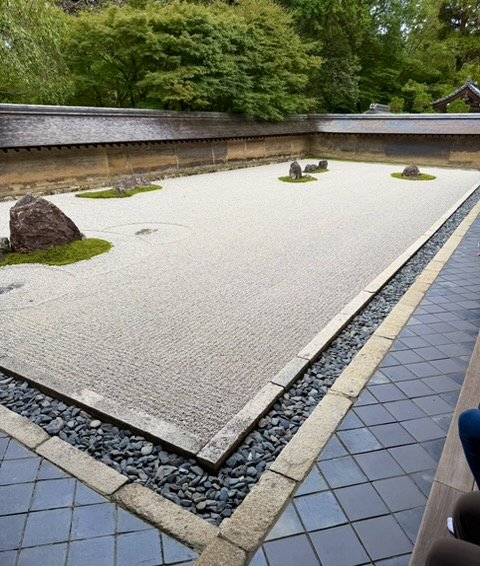
You can see images of the rock garden itself online and in many places. Here are a few views from the gaitan (wood walkway around the temple, above the garden). The prime spot, if you can get it, is to sit on the edge of the gaitan, letting your feet dangle, and essentially sit zazen. People are milling about and are not totally silent, but it is amazing how much people slow down and quiet down once they enter the space. It stops you. Here are a few simple shots of the famous views.
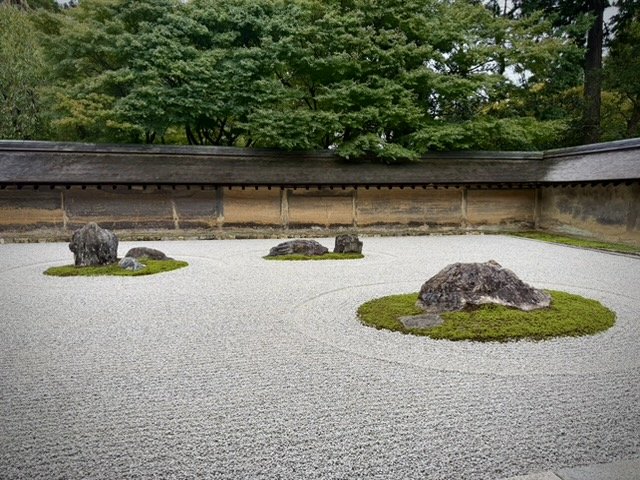
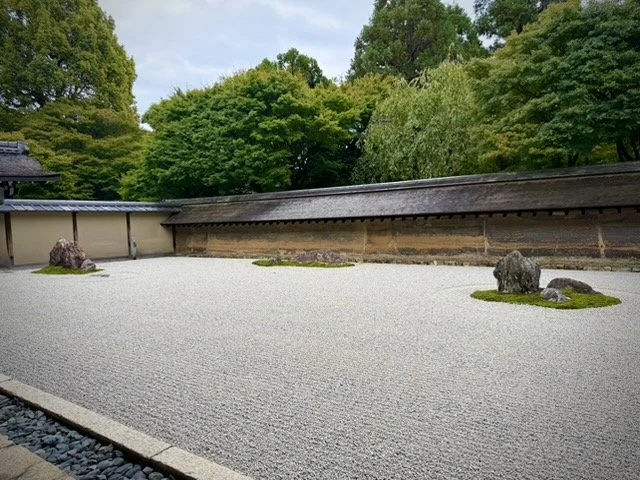
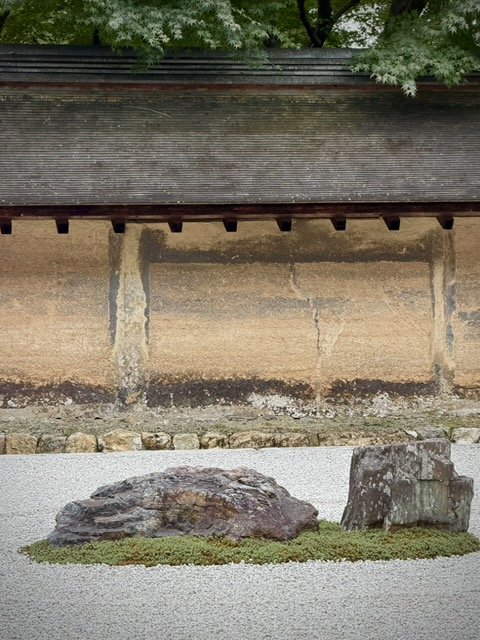
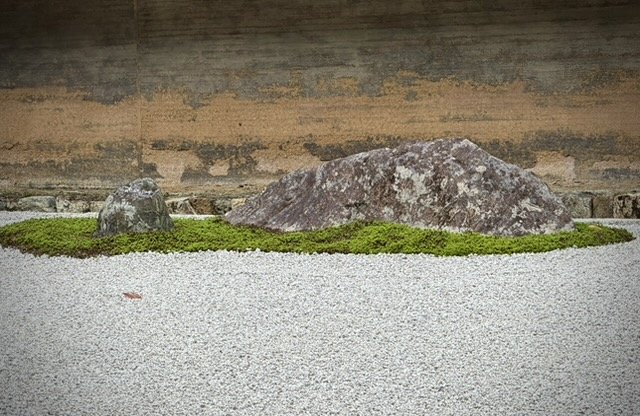
Notice the one leaf in the gravel.
You can see a few knees showing along the gaitan in this one. An important and famous fact that underscores our practice: There are fifteen stones in the garden. From any one position you can only see fourteen. There is no place from which you can see them all. There are many interpretations that have been given over the centuries, but this is the one that Roshi Joan gave which takes us right into the heart of our practice. The garden is not withholding a secret and this is not a trick. It is a small, beautiful demonstration that a complete view is not available from a position, and we are always taking a position. Sit on the edge with that teaching.
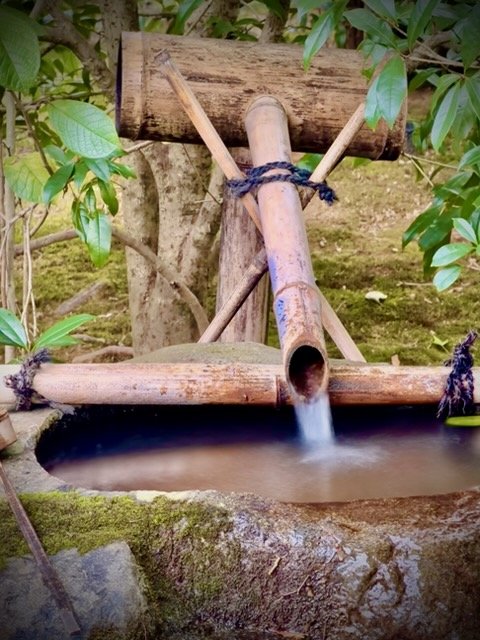
Past the rock gardens there are many beautiful details along the paths.
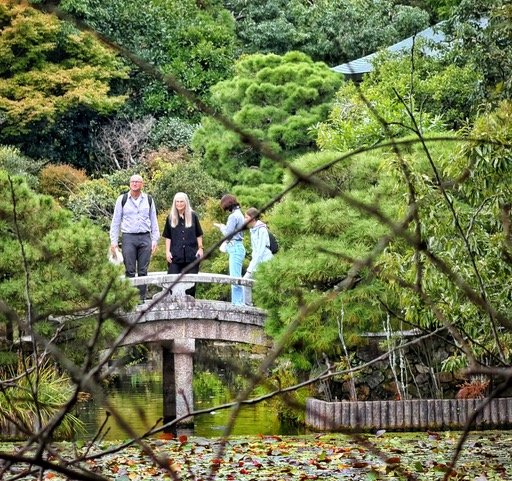
I happened to be on the trail surrounding the lake when I looked up to see Roshi Joan and some others from our group standing on the stone bridge going out to a small island. There were many branches in the way, but I managed something.
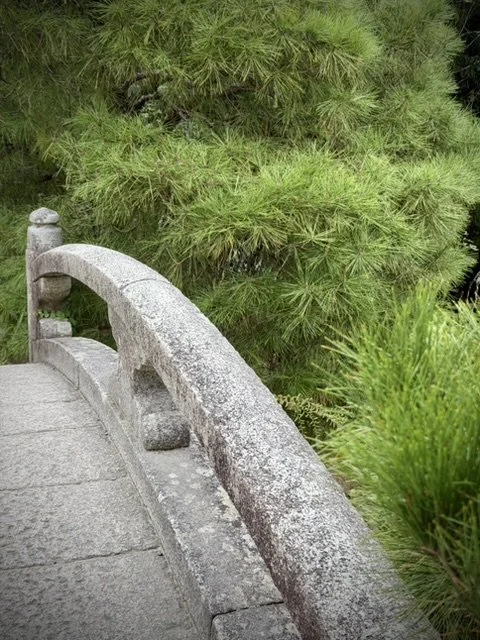
The bridge itself is lovely and invites stopping and looking out over the foliage and the water.
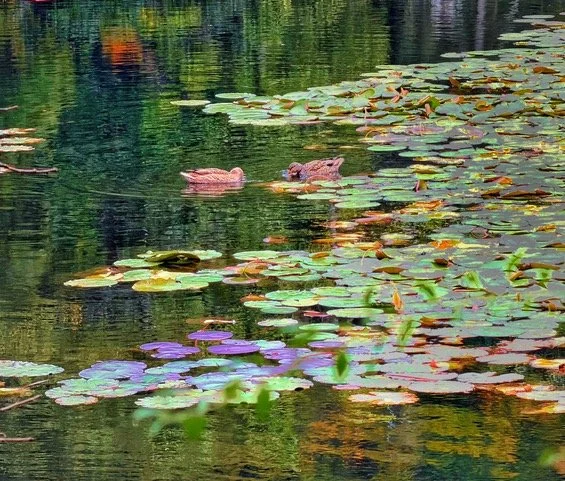
And finally, an homage to DeWitt Jones, my photographer friend who has done amazing impressionistic photographs as an homage to Monet in his gardens in France. Here is mine from Ryōan-ji.
Tomorrow is Nara, and another of Japan's great Buddha statues.
Much love,
Flint
Dear Ones,
Before I get into today’s activities, I want to backtrack a little and offer something new from Eihei-ji. I didn’t know that Roshi Joan and Wendy (Dainen), were able to take pictures inside the monastery. Here are a few glimpses that I said you would not get.
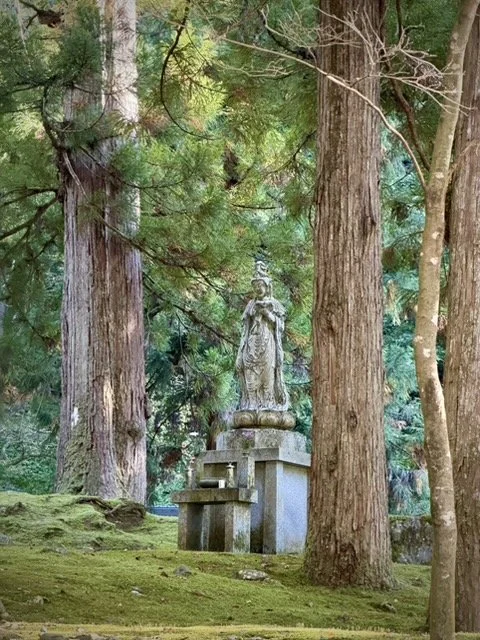
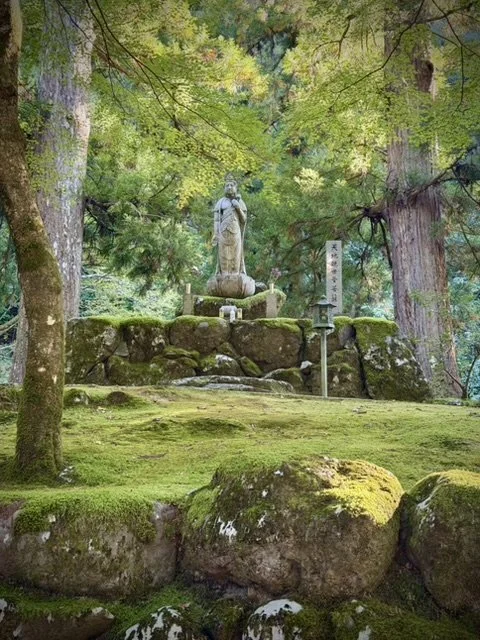
Here are two images that show the kind of landscape you are walking through as you climb from the road up into the monastery.
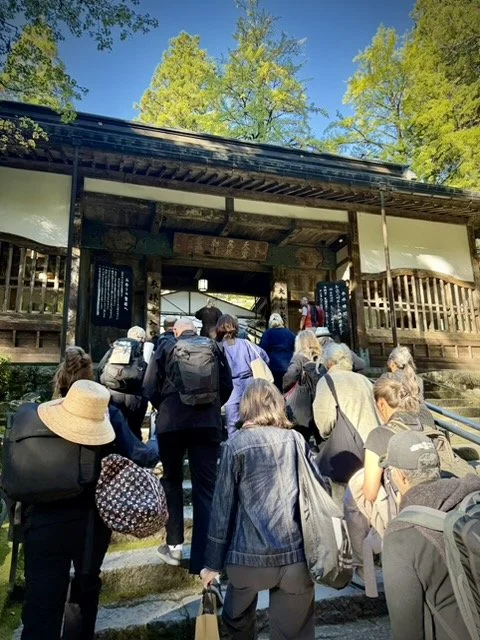
Once we got to the top of the long road up the hill, through the cedars that are over 700 years old, we came through the gate.
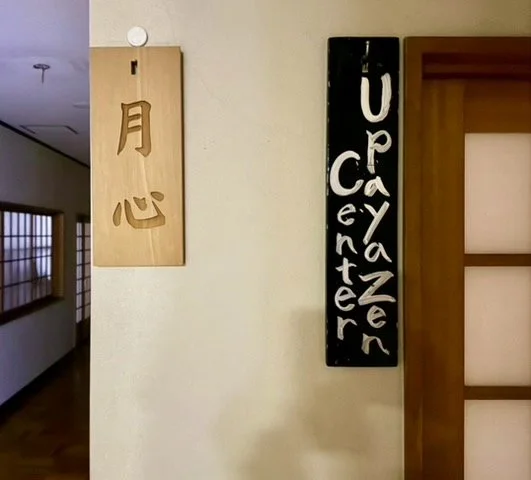
I loved the English signs they put up to mark our dormitories.
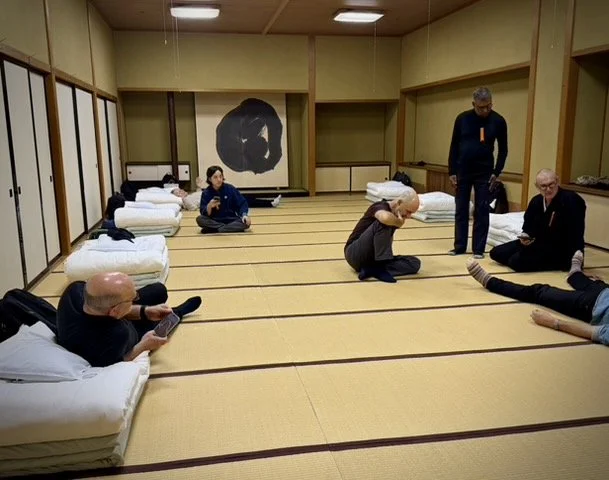
Being weary, us guys crashed for 15 minutes before we met withe the monks who would give us a tour. We had not unpacked or spread out our sleeping mats. We also had to change into robes for evening zazen.
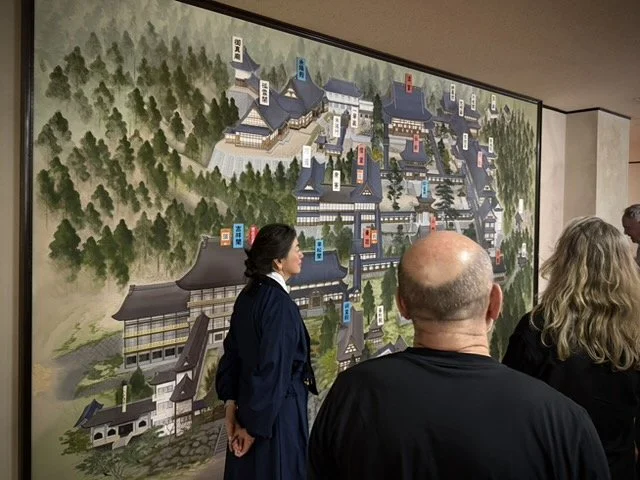
We gather in front of a large map of Eihei-ji ready for our tour.
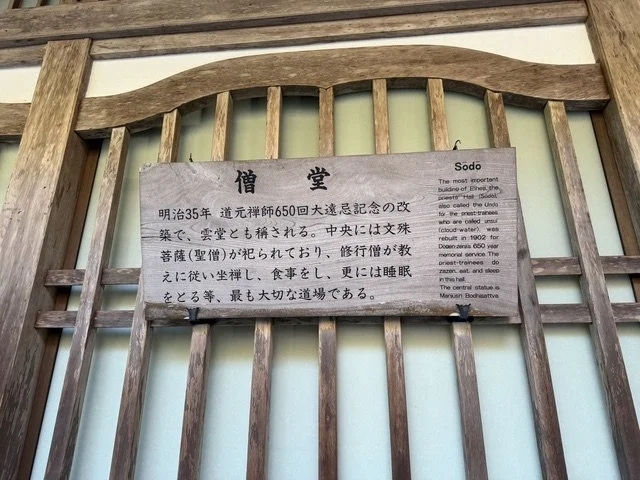
This is the sign over the entrance to the training monk’s living area.
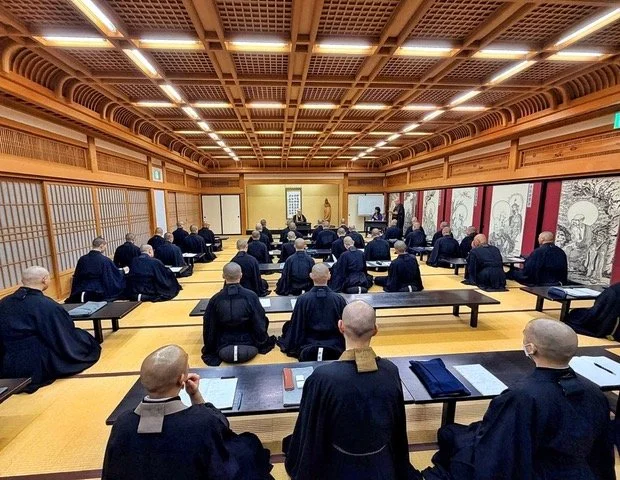
Here is an image in the lecture hall at Eihei-ji where Roshi Joan gave her talk to the monks. She was doing this as we wee sitting zazen for the first time. This was a rare event — a woman addressing all of these men in an institution that has been only men since the 13th century. Interestingly, the perspective of the photograph makes her appear to be very small. An apt metaphor for some.
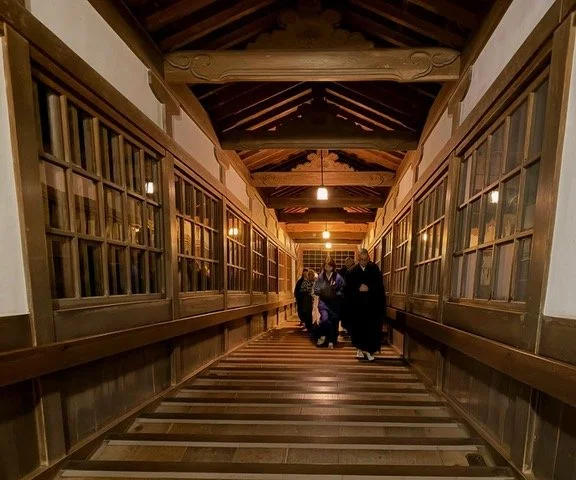
Ushering us to the zendo for our first sitting.
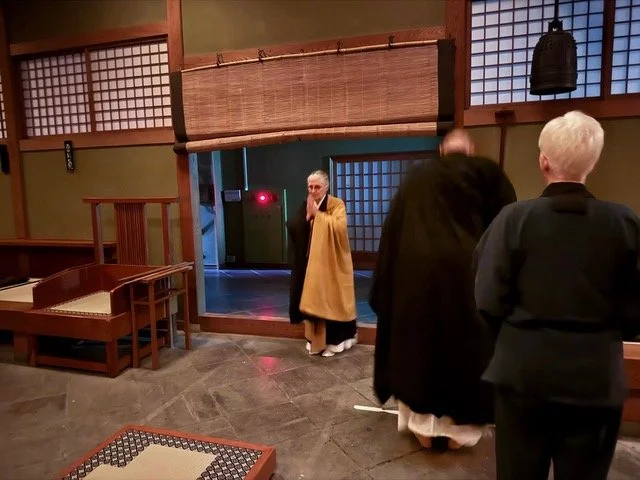
Roshi steps into the zendo in the early morning. It was the first time I had seen her in her robes.
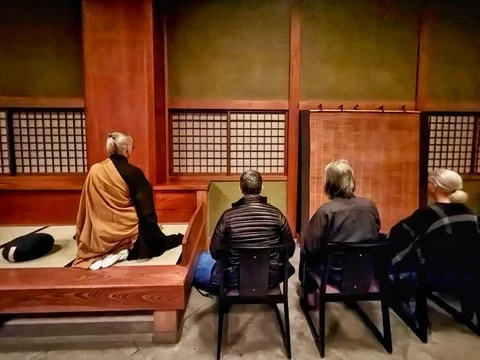
Getting seated. Notice the kyosaku (stick) on the zafu next to Roshi Joan. They didn't use it during that season, but got it back in Kamakura.
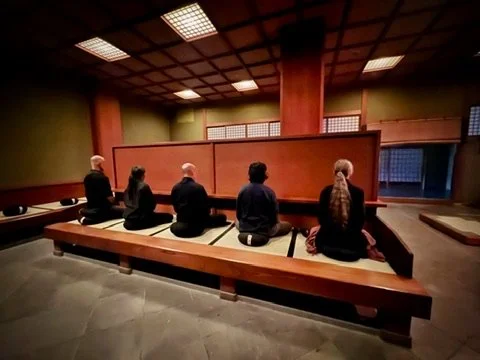
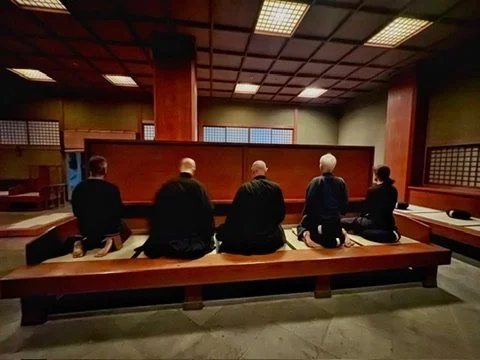
Two more tans with some of us. I'm not in any of these.
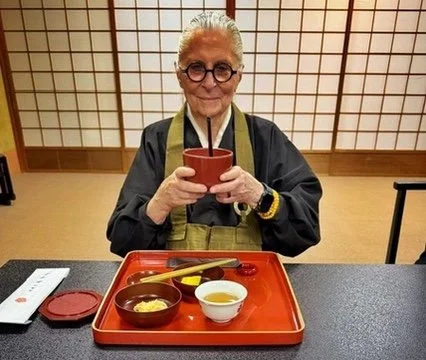
We go to breakfast after zazen and the very long, formal morning service.
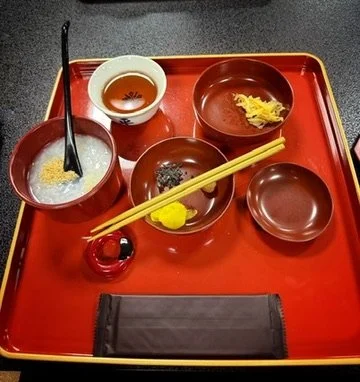
We got to keep our chopsticks with the Eihei-ji logo on them as a souvenir.
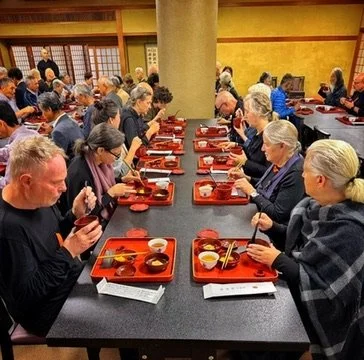
All of us eating breakfast. Notice the monk standing in front of the white shoji screen watching over us.
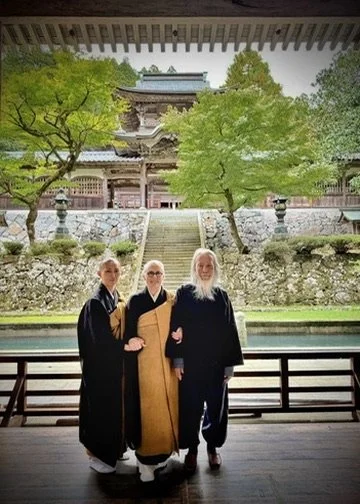
Kaz and Wendy supporting Roshi Joan and each other after the long service.
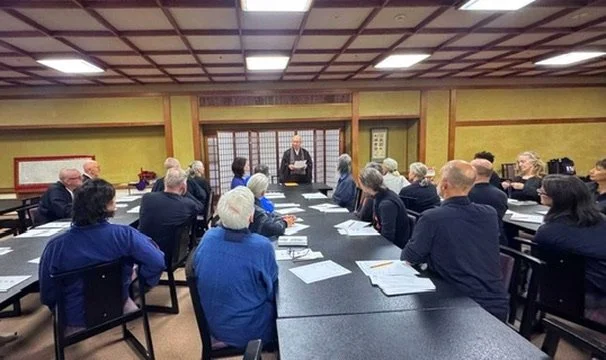
On our last morning we met the Roshi in charge of international relations and learned more about the training.
So that brings us back to Kanazawa and our departure to Kyoto. We will be in Kyoto until the end of the pilgrimage this coming weekend. Our bus ride today was the longest - about 3 hours - with some breaks for snacks and restrooms.
As we made our way along, Kaz gave us a brief orientation to haiku and some of its history. Then, for the first hour going up to our first break, he asked that we write haiku and be prepared to share two of them when we departed for our second hour. It was fun to write and even more enjoyable to share our little poems as we drove along. None of us are seasoned on this form, but there was a lot of joy. Here are three that I shared:
The bus is loaded
Kyoto waits
Turning the key
The last phrase is about starting the bus but more.
Walking in the rain
New friends so close
Completely soaked
It rained steadily and incessantly in Kanazawa. What does it mean to be "totally soaked" when walking with friends?
What Japan would he see
Through his eyes
Now only through mine.
This one was for Erin, of course.
As we drove along, we passed Lake Biwa, Japan's largest lake (over 250 square miles) and one of the oldest on earth (around 4 million years old). This area has been important in many ways, partly because the routes from the coast to the capital run through this region and there are many shrines around the lake. I didn't get any good pictures as we were moving all the time and the morning sun was a bit bright. We did pass by one of the big red torii gates coming right out of the water. I tried, but couldn't get it as we swiftly passed by.
[PHOTO]
We ended up at Hiyoshi Taisha Shrine, an enormous complex of temples, shrines, and sacred grounds. I couldn't even count the number of shrines. The gardens were the most beautiful I have seen to this point, and that is saying something. My pictures won't really capture the scale and mature beauty of the walkways.
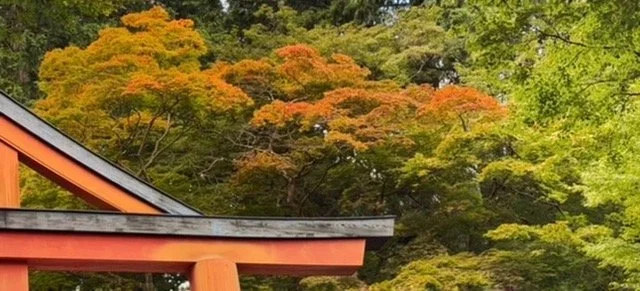
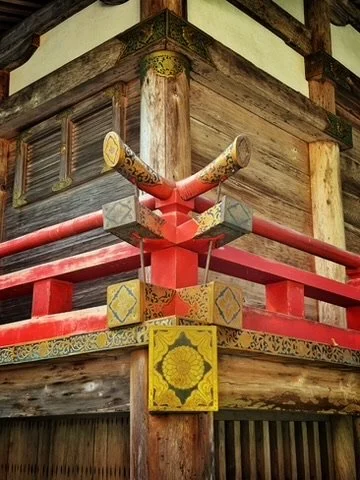
Beautiful details on the old shrines
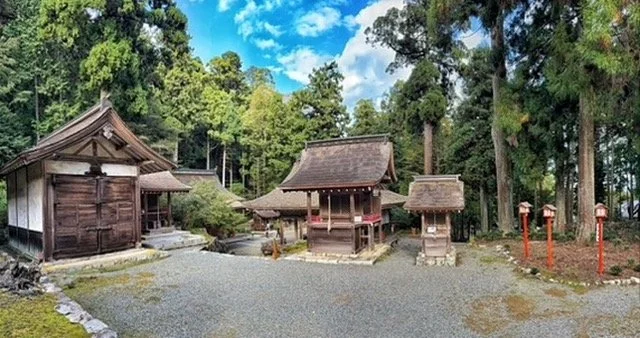
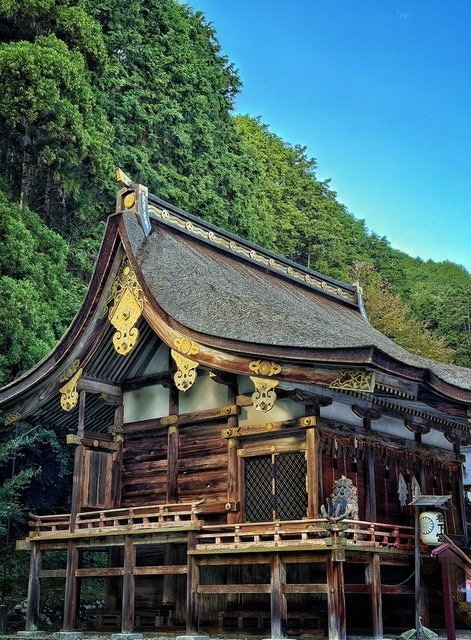
There were clusters of shrines of all sizes throughout the forest of enormous cedars.
We completed the trip into Kyoto and are now at yet another nice hotel, resting, and ready for the final few days.
With love,
Flint
Dear Ones,
This morning (Wednesday the 21st), we took a bus to the neighboring town of Hakusan, where the famous female poet Chiyo-ni was born and is now buried. Our destination in Hakusan was a temple of Shinshū Ōtani-ha (the Higashi Honganji branch) in the Pure Land school of Buddhism. Shin Buddhism had its roots in the 15th century, and the temple we visited was originally built in 1898. The eleven buildings on the grounds are Registered Tangible Cultural Properties of Japan.
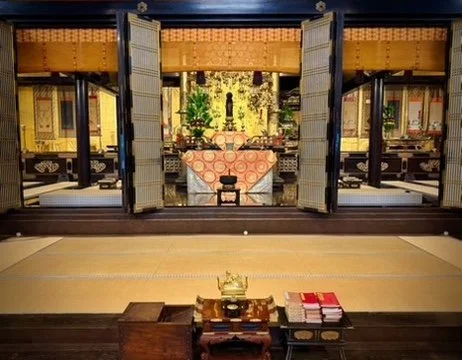
This is the main hall, where we gathered to spend some time with the Abbot, learning a bit about the Pure Land school.
Most of Chiyo-ni's personal effects and a substantial collection of her surviving brushwork are housed here. She lived from 1703 to 1775, and there is a natural stone carved with her death poem, put in place in 1799 on the twenty-fifth anniversary of her death. Her famous death poem translates:
I also saw the moon
as for this world
ah — goodbye.
In her verse, the moon symbolizes spiritual awakening and enlightenment, while her parting words reflect a peaceful, graceful acceptance of death rather than fear.
On the bus over to today's site, Kaz and Roshi Joan read some of her poetry to us. Kaz had translated many of the poems this week, so he read the original in Japanese, and then Roshi read his English translation twice. It was a lovely way to enter Chiyo-ni's former home. One thing I learned is that the death poem ends with the word kashiku. This was a conventional way for a woman of her era to sign off a letter. Here she was, facing the most consequential moment of her life, and she closes it with the ordinary courtesy of everyday correspondence, the way she might end a note to a personal friend.
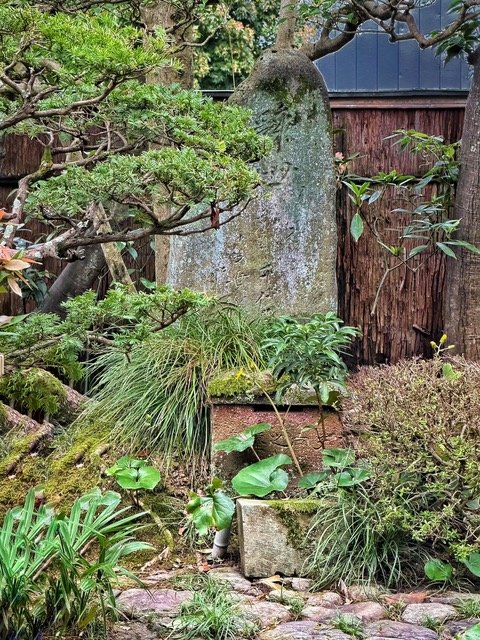
Why she matters: she built a first-rank reputation as a woman, in a form and a literary establishment overwhelmingly run by men. She also did it from the provinces (Kaga), not Kyoto or Edo. Kaz and Roshi wrote, "The work itself has an exactness so unforced that it can make some of her more famous contemporaries look like they are visibly trying."
Her best-known poem is about discovering one morning that a morning glory vine had taken over the well bucket during the night. She ended up going to the neighbor's to ask for water rather than tear away the vine. Again, Roshi: "At first the reader hears sentiment. It isn't. The poem turns entirely on choosing to be inconvenienced, and on the fact the inconvenience is never framed as sacrifice. She just goes and asks for water. Nothing is renounced. Something is noticed, and the noticing rearranges the morning."
The morning glory became her signature, and it is now the official flower of Hakusan City, which holds the Chiyo-ni Morning Glory Festival every year, where citizens compete for the loveliest flower.
One translation of the famous poem:
The morning glory!
It has taken the well bucket,
I must seek elsewhere for water.
The one that speaks to me:
morning glory!
the well bucket entangled,
I ask for water
This is a scroll with an image and the poem, done by an artist at the time it was written. It is not her calligraphy, but it is contemporaneous with the poem and is among her archives. We also saw her monk's bag, in which she carried her writing instruments, some personal effects, and the hat she wore when traveling on foot.
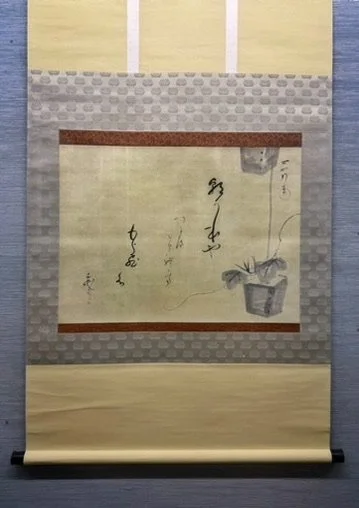
She wrote something like 1,900 poems, a body of work that has never been fully translated into English. Her poems were not officially haiku. That word, I just found out, was coined by Masaoka Shiki in the 1890s and then applied backward to poets writing in a certain style. Chiyo-ni wrote hokku, the word for the opening verse of a linked sequence. She also wrote the sequences themselves, haikai no renga, composed collaboratively with other poets. This is important as well, because we usually think of the solitary nun with a flower, but her work was much more social: linked verse composed in a room with other people, each verse answering the one before it, under strict rules of season and image. She was not alone. She was a professional operating within a network of creativity.
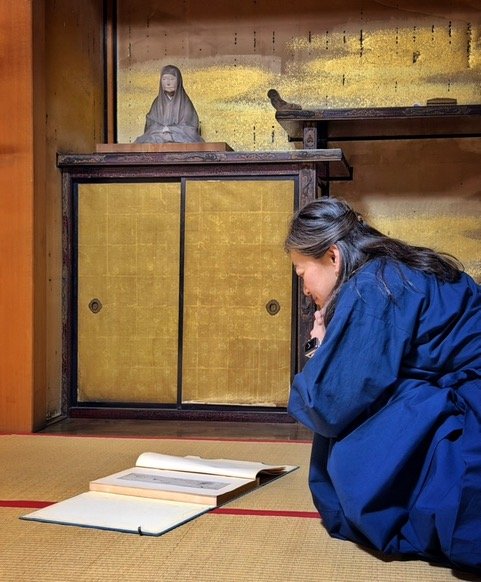
Gayle, one of our pilgrims, looking through ancient texts with the figure of Chiyo-ni sitting above her.
I loved this description of her poems by Roshi Joan: "These are shikantaza with a text. No object, no method, nothing to attain. You put your attention on something and decline to do anything with it." She suggested that if our daily sitting has made any sense to us, then the poems will as well.
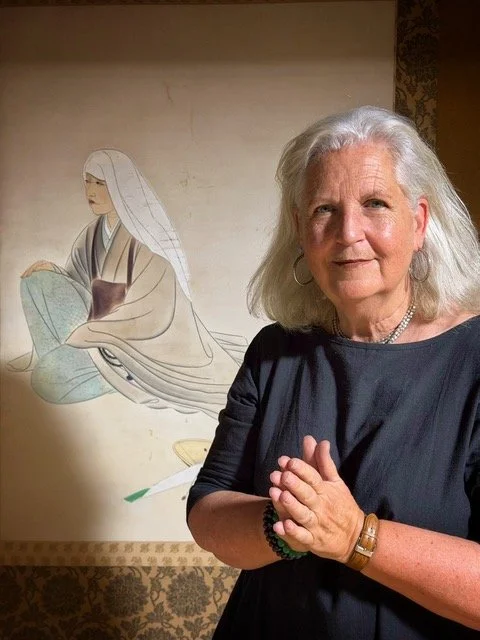
Terry Tempest Williams is here with a famous painting of Chiyo-ni: white hair to white hair. Two important women writers of vastly different times and genres, but their work has resonances. Here is a description of Terry's latest book, The Glorians: "They are not distant deities, but the ordinary, often overlooked presences—animal, plant, memory, moment—that reveal our shared vulnerability and interconnectedness with the natural world." A sister to Chiyo-ni.
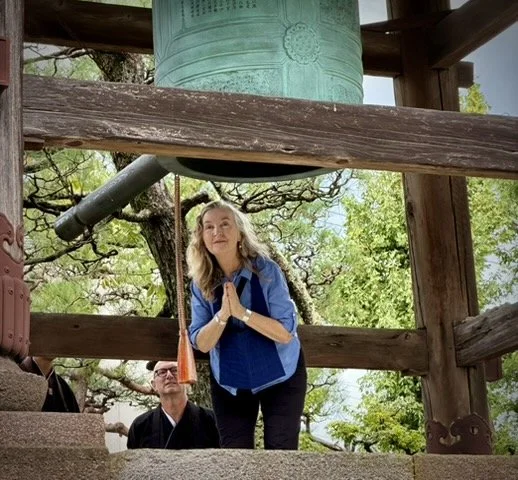
Another influential woman writer is Rebecca Solnit, who pushes outside of tradition and convention, ringing the bell of wakefulness through her writing and speaking. Here at the temple, she literally prepares to ring the bell. Her words and work send out powerful calls. Remember the temple bell poem from Eihei-ji?
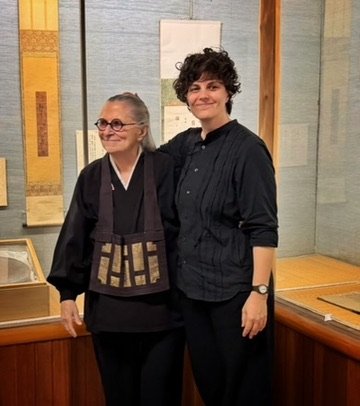
One more important woman, since I am featuring women in this post. Molly Crockett is not a writer in the usual sense but a scientist of the first degree, pushing the envelope in the study of ethics, knowledge, and power, areas that are literally of survival value at the moment. She surpasses any man I know in the cognitive sciences. She is now at Princeton, having trained at Oxford and taught at Yale. Her postdoctoral work was with economists and neuroscientists at the University of Zurich and University College London.
All these women are making a difference, and all were called together by Joan Halifax, another woman still making a difference. I bow to them all.
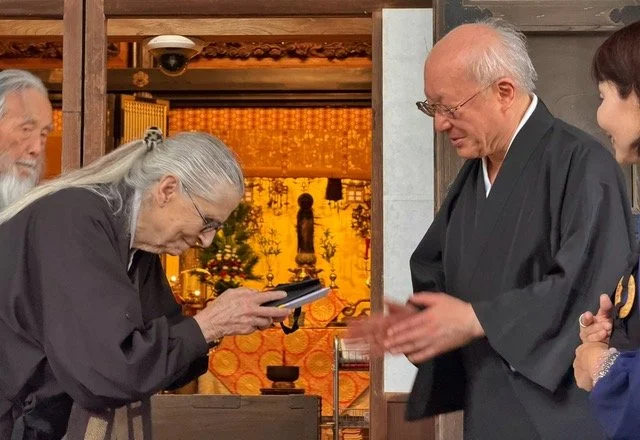
Eventually we finished our visit and had lunch. As we were leaving, there was the requisite Japanese tradition of bestowing gifts on the host. Here we see Kaz and Kimkio Bokra, our trip coordinator and translator, along with Roshi and the Abbot.
Tomorrow we check out of our hotel in Kanazawa and head to Kyoto. There are several stops along the way to take in more beauty and cultural heritage, more history, and as-yet-undiscovered surprises.
With love,
Flint
P.S. from the Upaya website
There are several stories about the powers invested in Chiyo-ni's haiku. According to one, the governor of Kaga had heard about Chiyo-ni's fame and once asked her to write haiku as gifts for some Korean envoys. Later, when he needed her to revive his garden's most beautiful cherry tree, which was ailing, he invited her to the palace. There she spontaneously composed this haiku:
spring will come again—
without flowers
you'll be firewood
To no one's surprise, the tree began to bloom again.
Excerpted from Chiyo-ni: Woman Haiku Master by Patricia Donegan and Yoshie Ishibashi.
Dear Ones,
We got to sleep in! Coming out of Eihei-ji, we needed the rest.
Beginning in Tokyo last week, we visited a very contemporary expression of the dharma at teamLab and then went to the very tourist-oriented temple at Asakusa. We also did a little shopping. Then on to Kamakura, with the Great Buddha, followed by both Kenchō-ji and Engaku-ji temples, where we met several amazing teachers. Finally, we traveled to Eihei-ji. No longer visiting and touring, we stayed overnight at the monastery and followed the schedule with the monks. This is the inflection point of the journey, where we begin coming back out of the mountains and the deep practice experience we had there. Our next stop is Kanazawa.
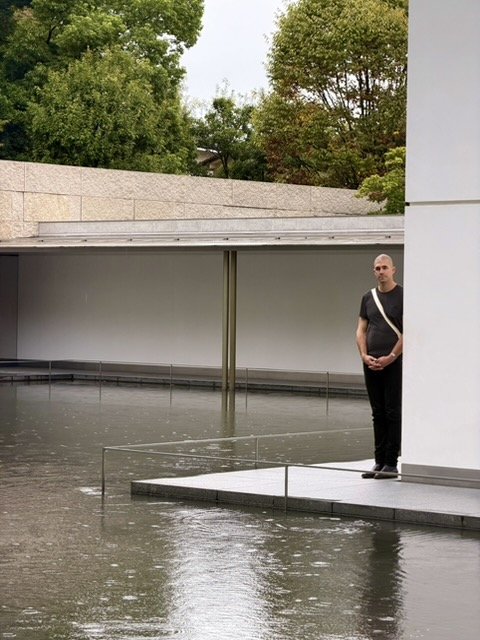
Our group gathered at 1:00 PM to visit the D. T. Suzuki Museum, designed by Yoshio Taniguchi. The architect (Taniguchi) and the man being honored (Suzuki) were both born and raised in Kanazawa. D. T. Suzuki was born in 1870 and moved to the US in 1897 to work for a publisher, translating Chinese texts. He did more than any other person to bring Zen into the English-speaking world. He trained at Engaku-ji in Kamakura, which we visited only a few days ago. His Essays in Zen Buddhism, a series of lectures at Columbia in the 1950s, and the personal relationships he cultivated with people like John Cage, Erich Fromm, Thomas Merton, and many of the Beat writers gave him a broad reach.
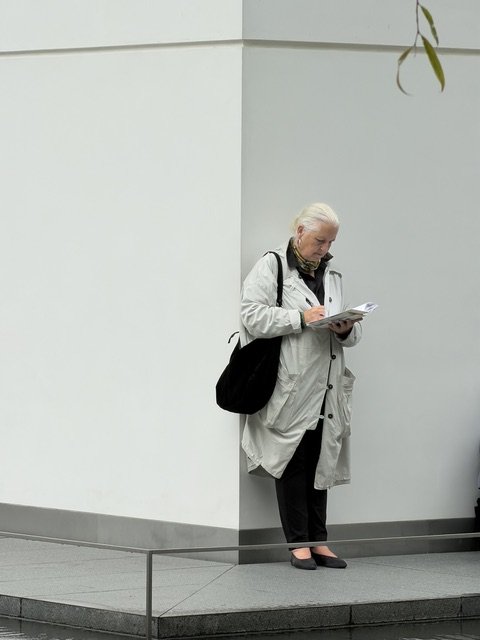
The museum, which opened in 2011, is a marvel. Taniguchi is the architect who was selected to complete a renovation of the Museum of Modern Art in New York, and he has designed many impressive buildings around the world. I said to my fellow travelers that if there had been nothing in the building, I would still have been satisfied with my visit. It is not large, but it is exquisite. Maybe some of my images will give you a small feel for the spaces. We were not allowed to take pictures inside the part of the museum where the Suzuki artifacts and archives were displayed. Here are some images featuring not only the architecture but some of my fellow pilgrims.
With love,
Flint
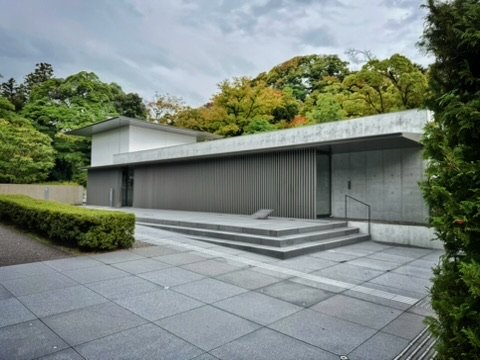
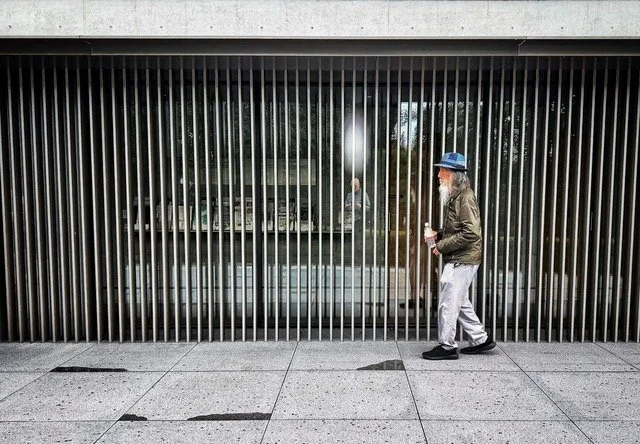
Kaz entering the museum
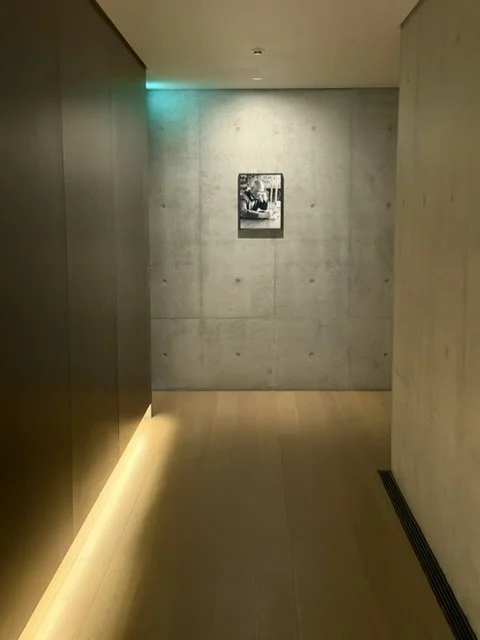
Entry hall
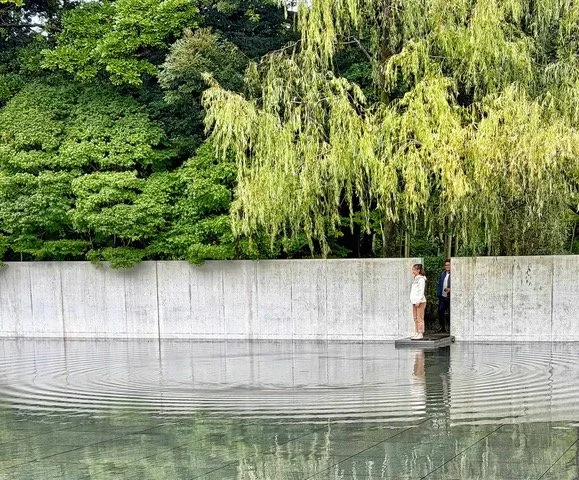
Visitors waiting across the pond
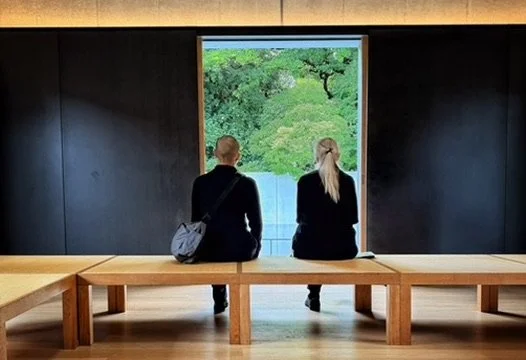
Roshi Joan and Wendy in the contemplative space
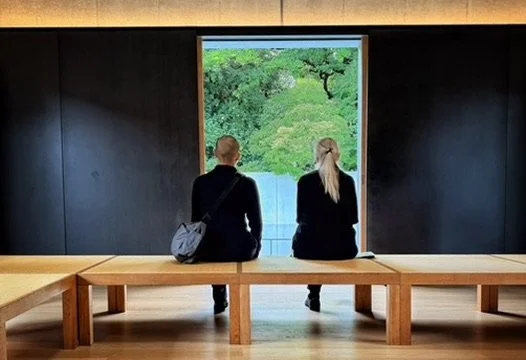
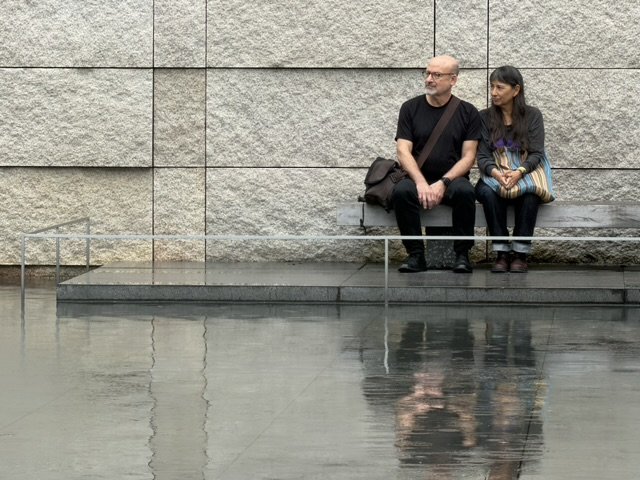
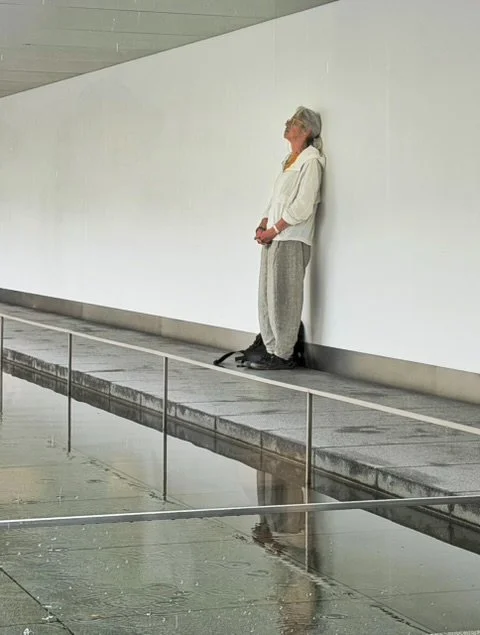
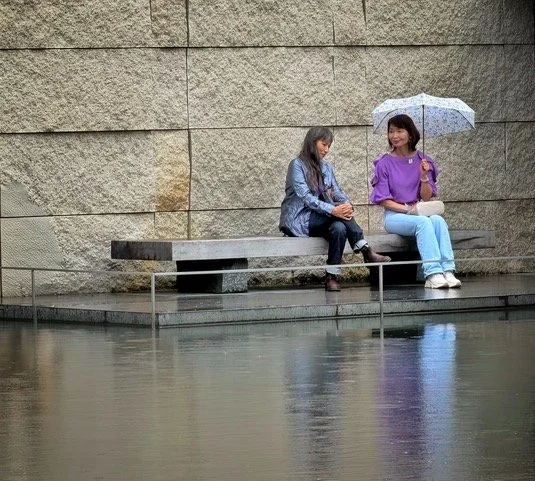
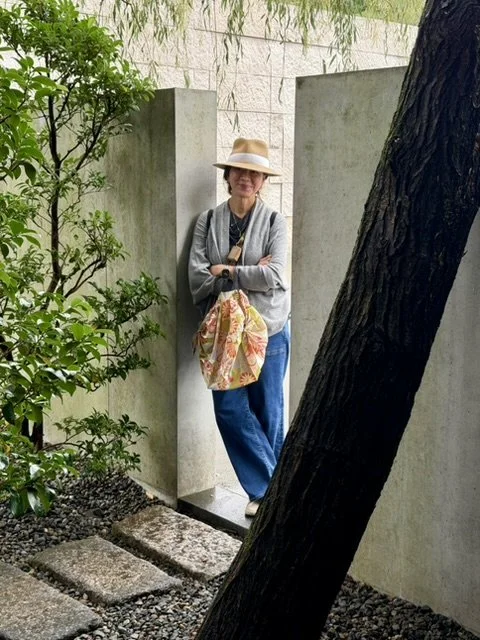
Roshi’s two phrases to describe zazen posture:
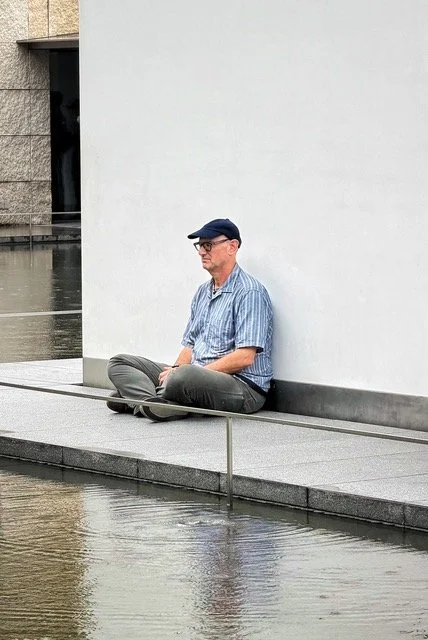
Soft front
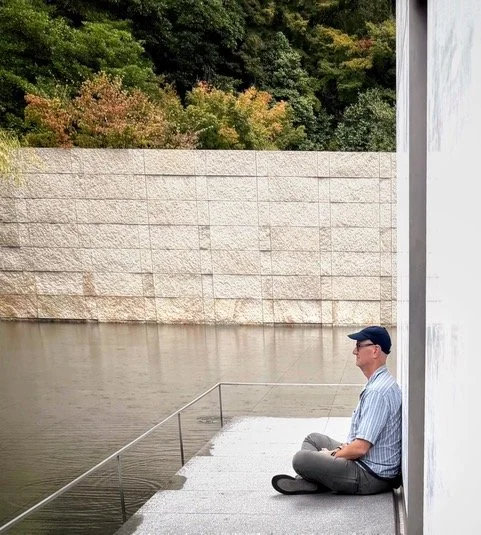
Strong back
Dear Ones,
You may have noticed that there was no message from October 18 or 19. We were at Eihei-ji, following the schedule as guest monks, with no internet, limited phone service, and no time. It was a great honor to be there again after my last visit with Blanche Hartman and Mel Weitzman, led by Hoitsu Suzuki (Suzuki Roshi’s son, who is now Vice Abbot at Eihei-ji). This is home to our Soto lineage. Today we have been in Kanazawa, and I am trying to catch up. It is the halfway point, with Dogen being the inflection point in the middle.
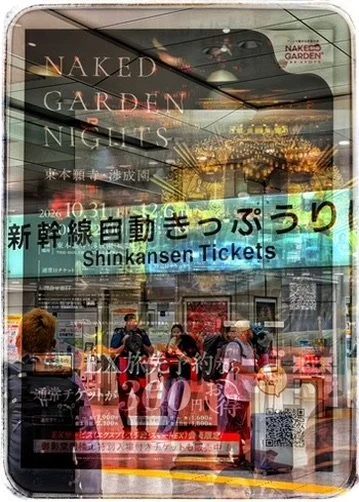
Getting there from Kamakura was a “trip,” literally and figuratively. We took a bus from Kamakura back to the main train station in Tokyo. Those of you who regularly deal with massive train stations (New York, London…) are more familiar with this kind of situation, but it is always a bit overwhelming to me. We rode the Shinkansen, the bullet train, from Tokyo to Fukui Station. I did post a quick impressionistic image from Tokyo Station. This is how it felt to me.
The line we were on ran north through Nagano and the mountains (the Tateyama Range), then down to the Sea of Japan, and finally along the coast through Kanazawa (where I am now trying to finish up on Tuesday afternoon) into Fukui. We boarded yet another bus from Fukui Station to Eihei-ji.
Eihei-ji (Temple of Eternal Peace) was founded by Dogen in 1244. He had returned from China in 1227 and lived and taught near Kyoto. With an invitation from a local lord and pressure from the Tendai establishment, he moved everything to the mountains and spent the last decade of his life there. He was 43 when he came to this mountain site, and he lived to be only 53. He wrote most of the Shobogenzo while living there, but he died in Kyoto in 1253 while being treated for his illness.
There is much to learn about Dogen and the Soto school, so I will not attempt to offer anything comprehensive. Kaz Tanahashi, who is with us and who has translated the entire Shobogenzo, has spent more of his life translating Dogen than anyone currently alive. It is because of him that a great many English speakers have any access to Dogen at all. Roshi wrote to us: “You are walking into the building where these words were written, with the one person who carried them into your language. Whatever else happens on this trip, this is the center of it.”
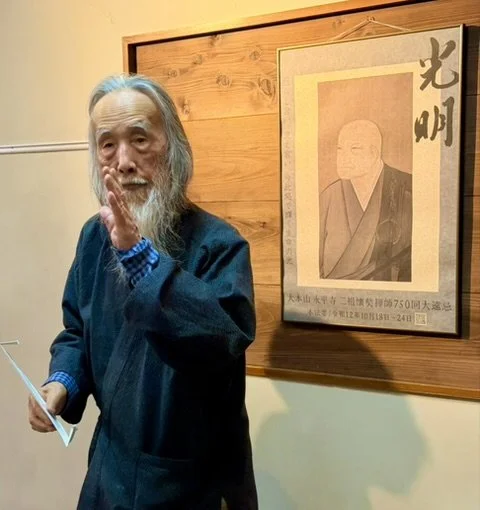
I found Kaz contemplating a poster with Dogen’s portrait while he was waiting for everyone to arrive for the next activity. He then turned to offer instruction for what was next. Kaz is 93 and still going strong.
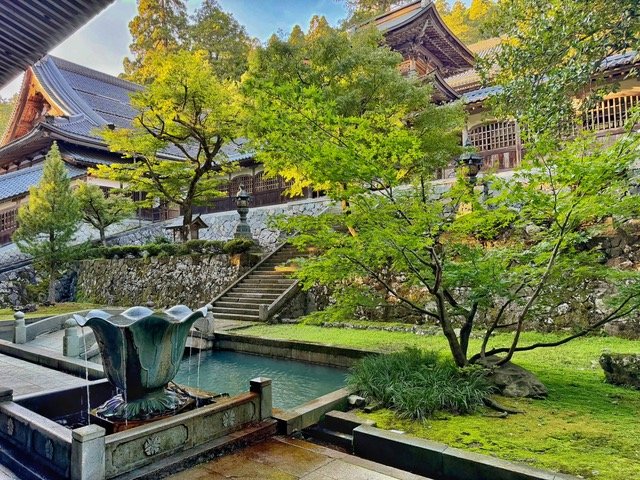
Because the monastery has been built into the hillside for seven centuries, seemingly endless stairways connect the buildings, built in the most beautiful ways.
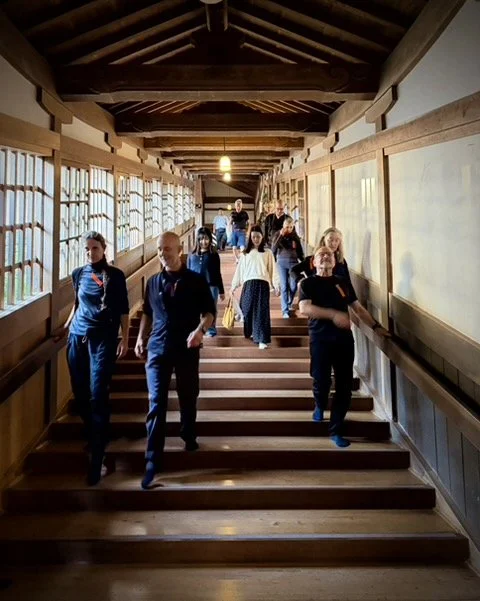
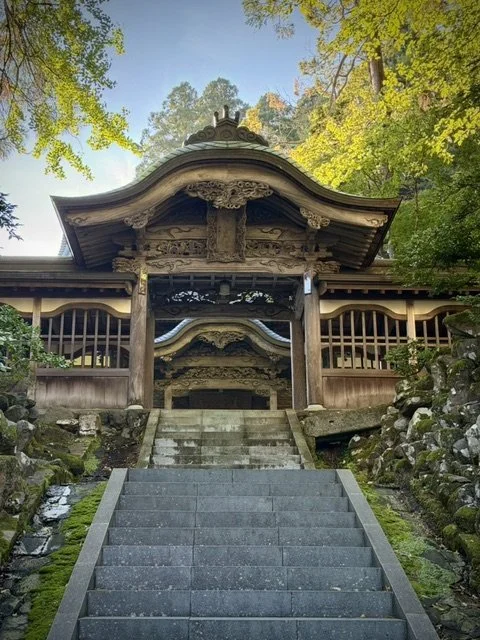
One of the important things to remember is that we are on pilgrimage, sensing deeply what it is like to enter these places and meet these people along the way. Here is one of our group walking in the forest on the Eihei-ji grounds, looking a lot like the pilgrims of old.
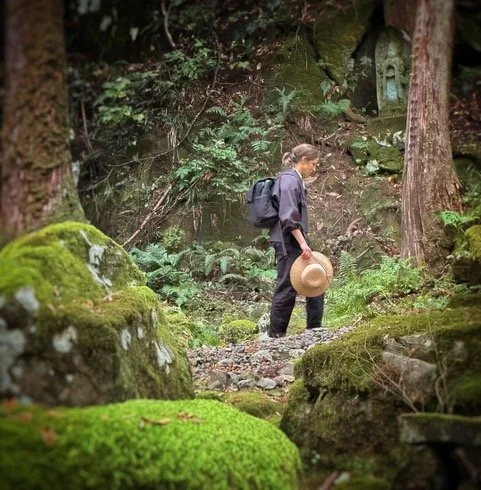
Having arrived, we slept dormitory-style on the floor of a tatami room, with a futon and pillow. The men were in one room together and the women in another. We set our alarms for 4:30 AM for morning zazen, followed by the full Eihei-ji service in the Buddha Hall. Photographs weren’t allowed in that space at that time, but I can say that it was a profound experience.
As a transmitted priest, I was ushered onto the “inner” tatamis in the Buddha Hall during the elaborate, formal service, along with Roshi Joan, Dainen, and three other priests in our group. We were sitting (kneeling, really, for most of an hour-long service, only getting up now and then to do full bows) with the other older priests in brown and gold robes. There were around 150 monks in training, and the many officials and teachers all surrounded us. It was an experience outside of time. It is also done. No need to go back. I was there 28 years ago as a much younger man, and now, at almost 75, I don’t feel I need to return. But this special visit on pilgrimage was a moment I will always remember.
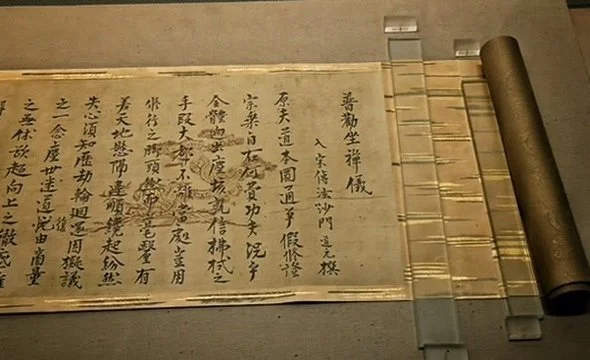
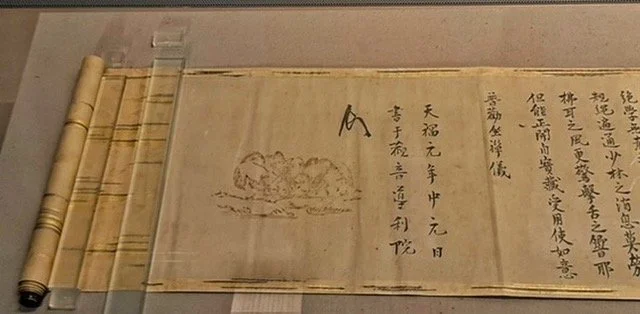
There was a Dogen museum in the visitors’ center. There were many things of interest, but one that brought me to tears was the original Fukanzazengi, written in Dogen’s hand on one long scroll. Seeing it somehow made it real in a way that learning about it and reading translations does not match. Here are images from the two ends of the scroll.
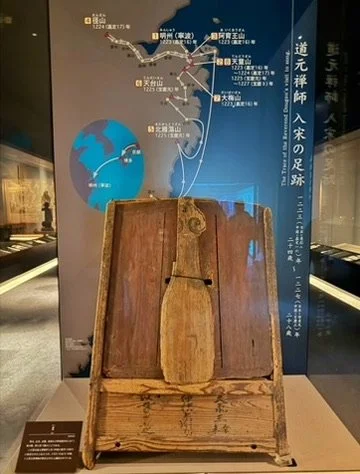
An astonishing piece in the museum was Dogen’s “backpack.” This is the original one he took on his famous, life-changing trip to China. It seems impossible that he could have carried it, but apparently it held what he needed. I wish I had taken another photo from the side so you could get a better sense of its size. It is as deep as it is wide: a very big wooden box. The picture behind the backpack shows the route Dogen took on his pilgrimage to China.
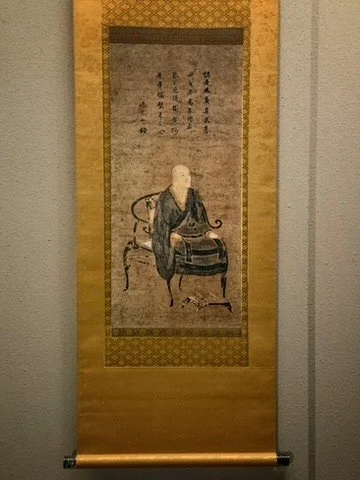
This is the oldest known portrait of Dogen, which I am sure many of you have seen reproduced. It is so amazing to see the original.
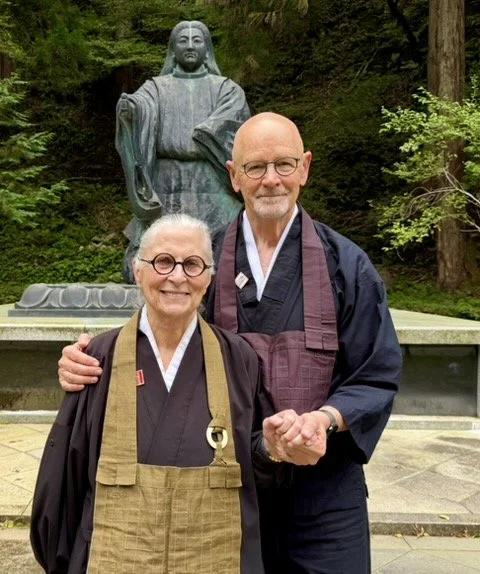
As we were leaving, we walked along the stream that flows through the beautiful gardens and cemetery. I have had the great privilege of practicing at Eihei-ji with two of the most influential women in American Zen: Blanche Hartman Roshi and Joan Halifax Roshi. Roshi Joan was invited to give a lecture to the monks the first night we were there. We were not allowed to attend, but for a woman to address this monastic assembly is a very rare thing. Here the two of us are in front of a rather odd statue of Dogen with hair. I don’t actually know the story.
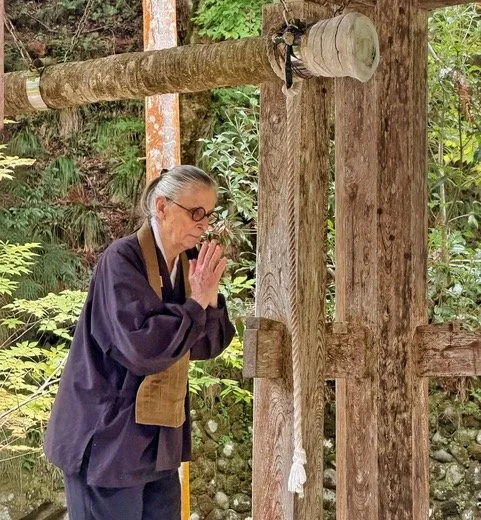
And finally, Roshi Joan approached the large temple bell. Dainen helped her up the steps on the side onto the platform so she could sound the bell.
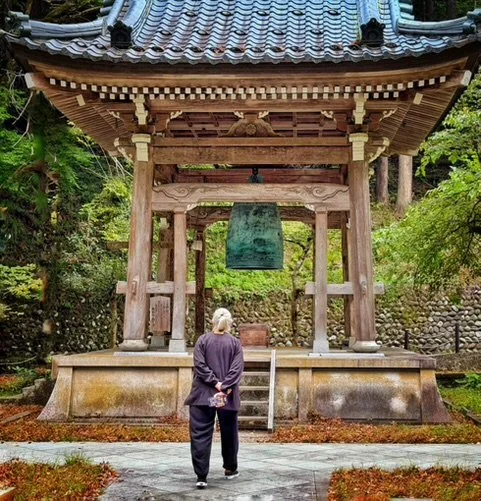
Last night, as I began working on this post, I got a call from Dainen saying everyone was waiting for me in what we call the “Enso,” essentially a check-in circle we convene every few days. I had completely forgotten and was embarrassed to be late. I had been working on a poem inspired by the bell and what it means to be on pilgrimage, especially the edges we meet along the way. Once I arrived in the room with everyone else, Roshi asked us to go around and speak to what was most alive for us and what edges we had encountered so far. This was what I had been writing about! Very strange how these things go. I didn’t share the poem because it was not finished, but here it is for you now.
Much love, as always,
Flint
A great bell waits at the entry gate.
If struck, a deep call is sent out.
A powerful sound,
something more akin to gravity,
invisibly pulling us toward the threshold,
beckoning us to enter the sacred space,
carrying our vulnerable longings
and hidden fears with us.
The bell’s echo penetrates
the deep well of silence
left by those who
have come before us.
The sound goes out further,
nudging the shadows of those
still waiting to arrive.
But if we are still enough
and silent enough,
we might hear
their whispered voices
and feel their tender presence
already abiding in our own hearts.
We are not always able
to simply turn toward the call
and step through
the open gate with ease.
Pausing, we are also unable —
or unwilling — to turn away,
to deny the call of the bell.
No, we’ve arrived at the thin place
between birth and death,
hesitating to enter
the frightening places
that could save us,
knowing we must eventually cross
the turbulent threshold
where love and loss collide,
to face what we must face,
to do what we know we have to do.
No matter, someone must eventually step
onto the platform if the bell is to speak.
Bowing, and with ordinary human effort,
the heavy log must be set in motion.
Finally striking the bell,
the sound is sent out.
What is it signaling?
The willingness to carry on,
even when we know the disturbing truth
of impermanence and uncertainty.
The faith to continue to care for each other —
and ourselves —
even when emptied and discouraged.
The ability to love the life we have,
even as everything changes suddenly
and without warning.
The temple gate remains open.
The great bell waits.
Can you hear it?
Dear Ones,
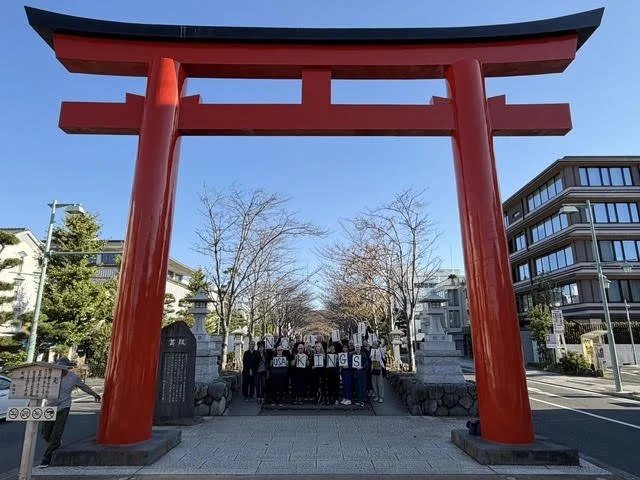
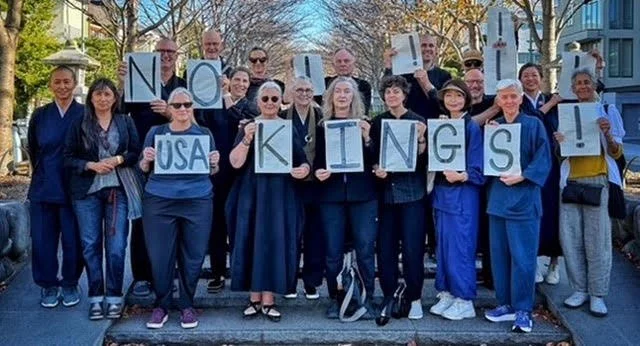
We remained in Kamakura for another day and planned visits to two very old temples led by two very contemporary teachers with innovative ideas. But first, Rebecca Solnit invited all of us to participate in the “No Kings” demonstration from Japan. We met at the large Torii Gate just outside our hotel and took some photos to post back to the US, letting people know we were supporting the activities of the day. Several Japanese people stopped to cheer us on. Rebecca knows how and where to post these things so we followed her lead. These are a couple of the images.
Here is how large the gate is. We are dwarfed under it.
Here we are lined up. Terry Tempest Williams is holding the “K” and Rebecca Solnit is holding the “I.” Roshi Joan is between and just behind them. Molly Crockett is holding the “N” and the “G” is held by Kimiko Bokura, our organizer and teacher of mindful leadership for Google and other companies both in Japan and the US. You can see me peeking above the “O.”
Now, back to the previously scheduled pilgrimage. We began with a walk to Kenchō-ji, the oldest Zen training monastery in Japan. Interestingly, the founding abbot was a Chan master from Sichuan (in China) who came to Japan in 1246 and never went home. So Japan's first proper Zen monastery was founded by a Chinese immigrant, at the invitation of a Japanese warlord, using a Chinese blueprint, in a foreign language. Zen in Japan began as a transplant.
We were told that the layout is the teaching. The temple is built on a strict Song-dynasty axis: the outer gate, then the Sanmon (“Mountain Gate” or main gate within the temple), then the Butsuden (Buddha Hall), then the Hatto (Dharma Hall), then the abbot's quarters, all in a straight line up the valley. Almost every Japanese temple is arranged around a courtyard or scattered on a slope. This one is a spine. We could stand at the bottom and look up at it all before walking it. Something special is met right away as you enter.
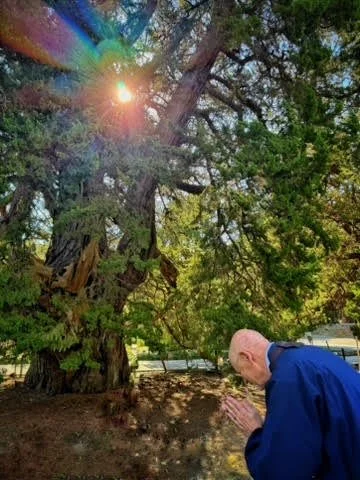
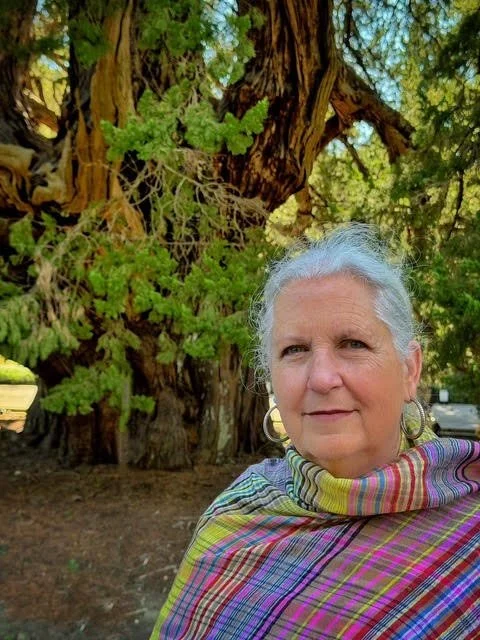
There are juniper trees in front of the Buddha Hall, grown from seeds which were brought from China by the founder in his monk's bag. The trees are around 750 years old and stand as buddhas themselves, hence the bow from me. There is a second photo of the tree with Terry Tempest Williams. Please read her latest book, The Glorians: Visitations from the Holy Ordinary, and you will know why these trees caught her eye (and mine). It has to do with the controversy surrounding the removal of the "Divinity Oak" at Harvard Divinity School where she taught for many years.
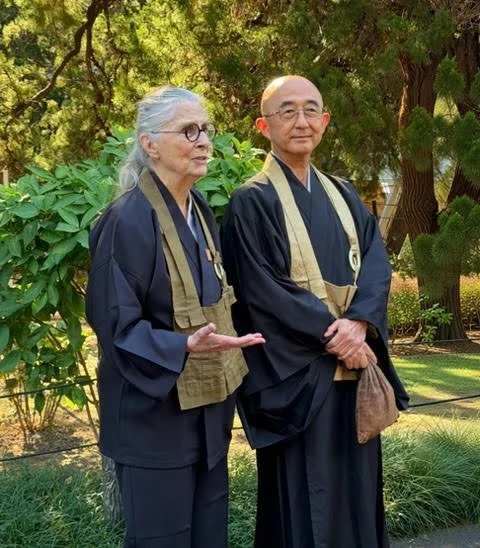
We were there to meet Rev. Fujito, the abbot at a small temple close by and a man revered by Kenchō-ji's own abbot. He is cherished in Japan for sitting with people contemplating suicide. This is important because Kenchō-ji, the monastery, stands on a former execution ground and enshrines Jizō in the Buddha Hall — not Shakyamuni Buddha — as the figure on the main altar. Jizō is the bodhisattva who declines to remain in comfortable heaven and instead walks down into hells, not to remove anyone out of their suffering, but to keep them comfortable inside it. This is a description of the job that is done regularly by the monk who was hosting us. Here is Roshi Joan introducing us to Rev. Fujito.
Rev. Fujito spent most of the morning talking about his work with all kinds of people approaching death, and demonstrating the embodied practices that he uses with these people for whom zazen is not an appropriate or possible practice. Like Issho Fujita the day before, he was about embodiment.
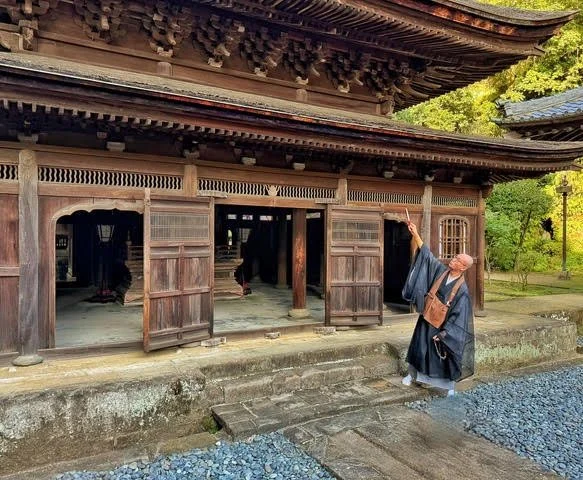
We then walked to Engaku-ji, founded by another Chinese master in 1282. We were taken through the entire complex, with special access to places that not all of the monks are permitted to go. One of those places is the Relics Hall, a National Treasure, and the finest surviving example of the Chinese-derived Zen architecture. Here, one of the senior monks is pointing out details of this very old and very special building.
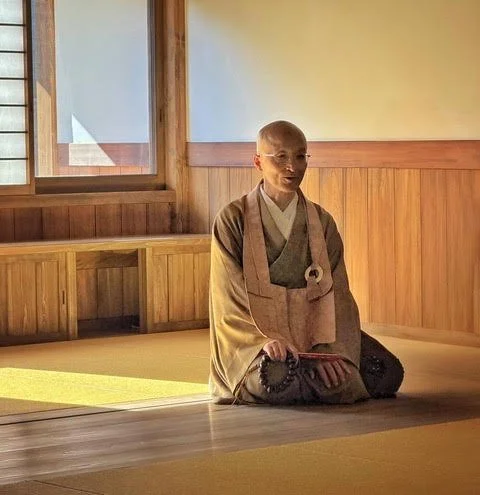
We also were shown the house where D. T. Suzuki and his wife lived. Suzuki is buried on the grounds of the temple as well. The Abbot of Engaku-ji, Nanrei Yokota Roshi, was a delightful man, very flexible in his training methods, open to change, and yet upright and clear about real training. Here he is sitting in a bit of light in the new zendo which is still under construction. I just happened to capture the moment.
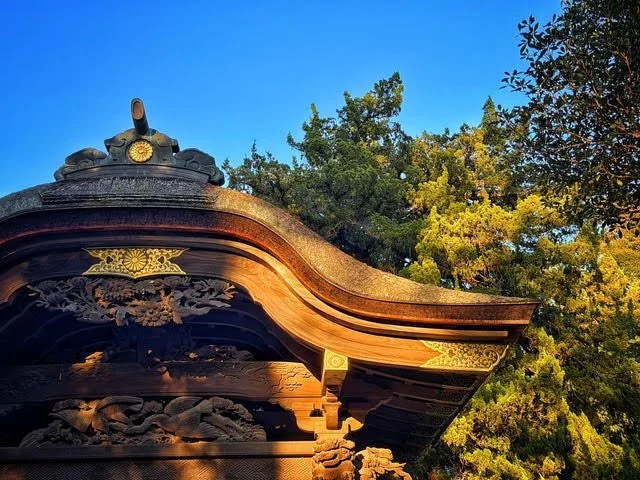
Tomorrow we leave early for Eihei-ji on the Shinkansen — the Bullet Train. When we arrive at Dogen's temple we will join the monks for practice and sleep in the training quarters for one night.
For now, the light is fading as we depart Engaku-ji and it is time to return to the hotel, have dinner and pack for Eihei-ji.
My best to everyone,
Flint
Dear Ones,
Today we left our hotel early in small buses to visit the bronze Amida Buddha of Kamakura, which was cast around 1252, the year before Dogen's death. It is about 44 feet tall and weighs around 121 tons. It was originally housed in a great hall which was destroyed more than once, and around the end of the 15th century the rebuilding stopped and the Buddha has since sat in the open air for over 500 years. As a result, it sits in a magnificent space rather than in a dim building, and has developed a patina that is lovely.
This is how the Buddha appeared today.
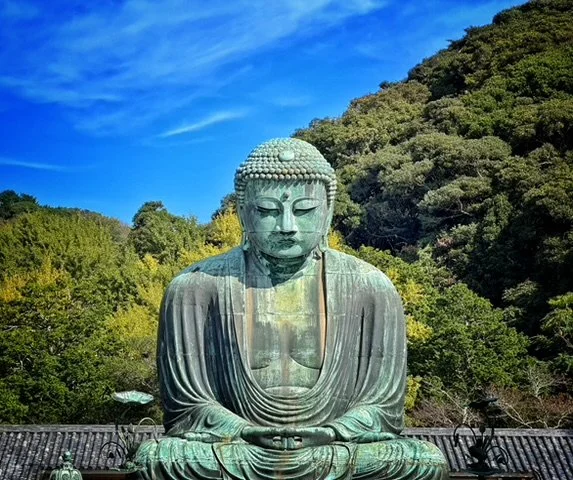
We were invited to notice certain things. The face is angled slightly down, so the gaze meets you at standing height as you approach. The proportions are subtly distorted, with the head being oversized and the torso compressed, corrected for the human view from below. Roshi Joan said, "It is a piece of engineering designed around your body's position, seven hundred years before you got there."
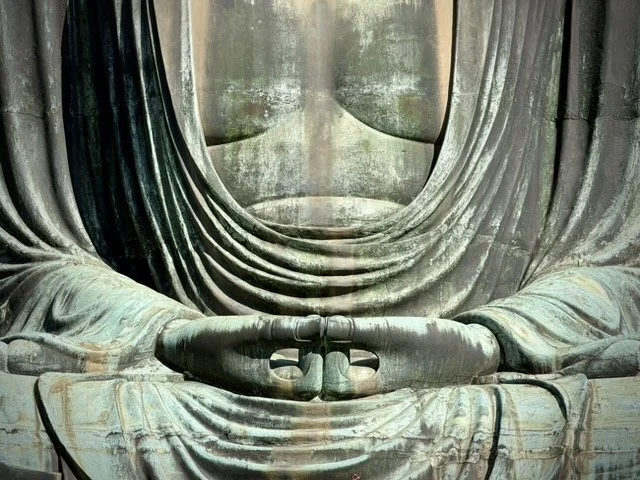
The hands are another thing we were instructed to notice. The mudra is the meditation gesture, thumb tips touching, and the whole posture is one of settled downward weight. This image is not in the act of teaching or doing anything else. It is just sitting, a prelude to what we were to experience in the afternoon.
This is what it looked like as I got closer.
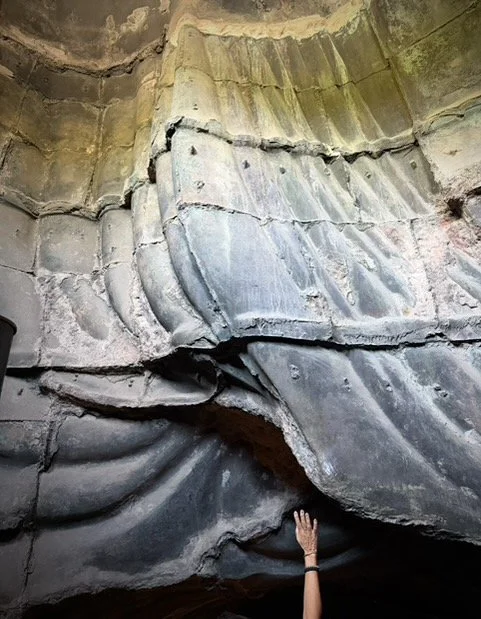
We discovered that you can actually go inside the great statue. It is quite another world inside. Very industrial, and you can see all the seams which were used to piece together all of the sections of the great bronze statue, as well as reinforcements which were added after a major earthquake in 1923. It is a hollow bronze shell, another part of the teaching we received. Roshi Joan said before we scattered to enjoy the entire complex, "You might want to go inside the buddha, although we are always with Buddha, and the Buddha is in us. The image is a shell which you can enter, but you are the living being of the Buddha."
Here is a glimpse inside as one of our group reached up to touch the heavy bronze.
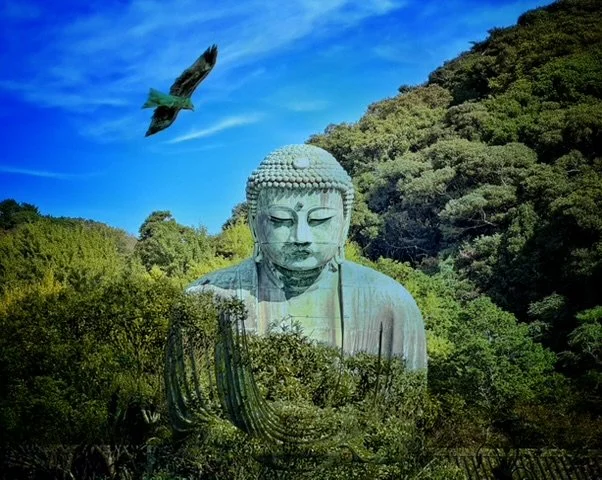
On a very personal note, many of you are aware of the appearance of a hawk that was significant around Erin's death. I will copy my poem about it below if you are not familiar with the stories. As I approached the Great Buddha, a hawk appeared and began circling high above the statue and the adjoining hillside. I was stunned to see it. It made several passes and then departed, an auspicious sign for me. I was able to capture one image of the hawk and I overlaid it with the image of the Buddha (double "exposure"). This is the result:
While we were still in the shadow of the Great Buddha, Kaz Tanahashi explained more of the history of where we were at the moment.
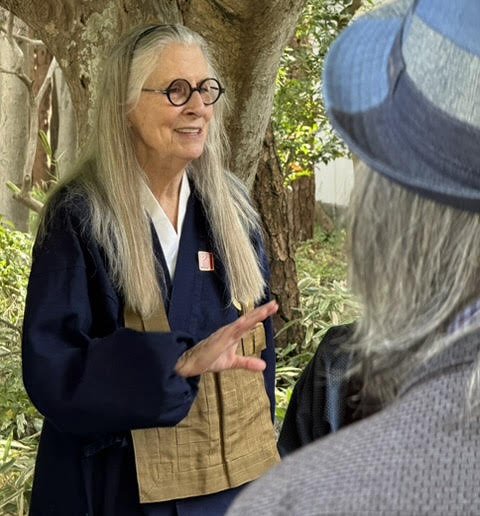
Roshi Joan then gave us a preview of where we were going next and the wonderful monk we were about to meet.
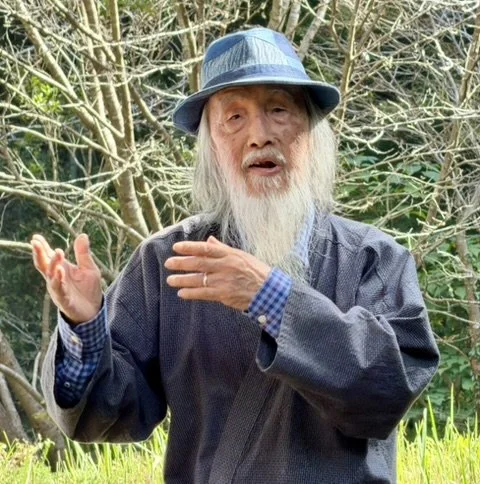
We loaded up again and traveled to a private rural retreat of Rev. Issho Fujita, a dharma brother of Shohaku Okumura, whose work many of you know. They were both students of Uchiyama Roshi, whose book, Opening the Hand of Thought, is very familiar to many of us.
This is what we were told to expect. "The thing to know walking in is that he has spent decades teaching shikantaza to Westerners, which has forced him to articulate things more traditional Japanese teachers don't speak about in an embodied way. He is adamant that zazen is not a method for producing enlightenment; zazen is enlightenment taking the shape of a person sitting. This is straight Dogen. The literal translation of shikantaza is 'hitting the mark of sitting, nothing but.' No object of concentration. No breath counting. No koan. Nothing to do and no way to check whether you are really doing it. It is the most austere practice in Zen and the one most likely to make a new practitioner feel they are likely failing. You are not failing. There is no exam."
Issho-san is lively and funny. Upon arrival, Rebecca Solnit was standing with the group and he looked over and said, "Oh, you are Rebecca Solnit!" She replied, "How did you know who I am?" He immediately said, with a great laugh, "Because you are famous (in his thick Japanese accent) and I have read your books." She had come prepared to gift him with her latest book. This was the moment.
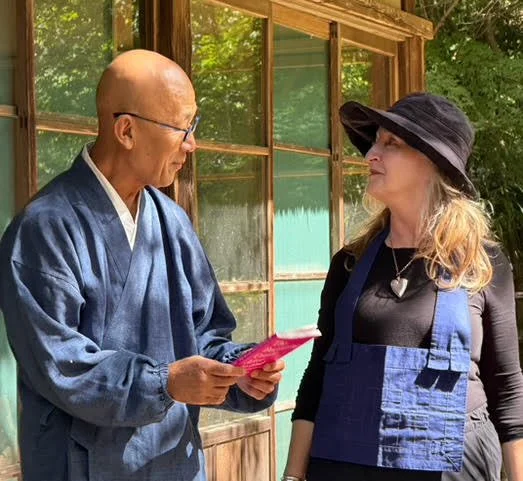
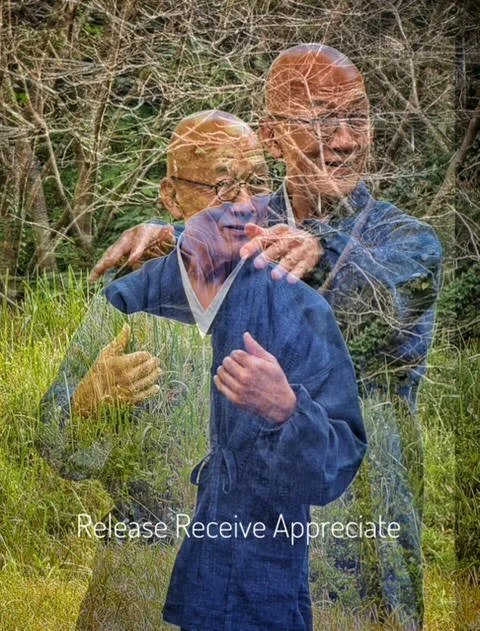
I took a few more photographs as he began to teach outdoors before we had lunch and went to his little temple for zazen and more teachings. I was playing around and made another double image because I had captured a moment of him both extending his hands and immediately turning them back toward himself. I liked the juxtaposition of these two gestures. Then later in his lecture he spoke about Dogen's three domains of practice being Release, Receive and Appreciate. Here is the image with the teachings, which he had me airdrop to him via our iPhones. A very contemporary monk!
Another full day. I hope I am not burdening you with too much. The pilgrimage is rich and deep and joyful.
With palms together,
Flint
P.S. Here is The Hawk poem which I promised. It will be part of my upcoming collection of poems, Flowers Fall, which I hope to have available by Spring. I will keep you posted on the publishing release date. I have included an endorsement which is very kind and generous. It was written by a poet many of you know. Some of you may also know that she lost her teenage son to suicide several years ago.
"With vulnerability and great courage, Flint Sparks guides us into the tender terrain of loss. I am humbled, broken open, and blessed by this book, by the honesty, the raw ache, the deep devotion, and the fierce willingness to be present while companioning a loved one through their death. So beautiful, this love. So devastating, this grief. So human, so real, so generously shared, this story."
— Rosemerry Wahtola Trommer, author of The Wonderment and host of The Poetic Path
The Hawk
The hawk arrived
as he was leaving.
With flared wings,
talons reaching
for the perch,
it came to rest
as if having been called
by his ragged breathing.
A magnificent
and mysterious
meeting.
Perched as a steadfast
witness on the crown
of the larkspur pine
outside the north facing window,
the great bird held vigil,
the embodiment of
attentive stillness.
Indigenous wisdom
tells of the hawk
accompanying the soul
from this world
to the next.
And so it seemed.
Waiting patiently,
the hawk silently departed
as everyone gathered
at the bedside
and he took
his final breath.
On graceful wings,
disappearing into
the late morning sky,
Erin followed into
the great mystery.
Two elegant feathers
were left behind
at the base of the tree.
Totems of the great leap.
Two more visits
completed the holy trinity.
His ashes were interred
and a graveside memorial
observed three months later.
The hawk appeared,
circling the old church
and family burial grounds
as we spoke our final words
and the remains entered the earth.
Another three months passed.
The family gathered once again,
this time to dedicate
the elegant stone
marking his ashes site.
High above, the hawk appeared,
gliding effortlessly on invisible
currents as if circumambulating
a sacred altar.
Three graceful arcs were inscribed,
as silent testimony
to the passing
of a great being;
the final consecration
of a beautiful life.
Dear Ones,
Today was very full. We checked out of our hotel Thursday morning and took a very nice bus to Sensō-ji, Tokyo’s oldest temple. Here is part of the founding story which is quite interesting. In March, 628, Hinokuma Hamanari and his brother Takenari were fishing in the Sumida River. Bringing in their net, they were surprised to see that it held one statue . They realized they had somehow snagged a statue of Avalokitesvara Bodhisattva, also called Kannon or Kanzeon in Japan. After this, Hinokuma devoted himself to Buddhism. He made his house into a temple and devoted the rest of his life to worship and holding memorial services for this statue. In 645, a Buddhist priest named Shokai came to this region and built a hall for the Kannon. Following a revelation he received in a dream, Shokai decided to hide the statue from view. Since that time, it has remained and has never unveiled. It was thought that revealing the statue in a public way was a kind of violence against it, so it continues to be held in a sacred vault in the main temple.
Today, we were allowed inside the temple, into places visitors do not usually go, and we were taken through some of the beautiful gardens one the ground of the temple.It was a powerful experience to all stand in front of the enormous altar, behind which was the vault holding the sacred statue, and chant the Enmei Jukku Kannon Gyo. The Buddha Hall was spectacular. We were not allowed to photograph inside the temple, but here are a few random images that ight interest you and with will give you a feel for the temple grounds. There are many images online if you want to see more.
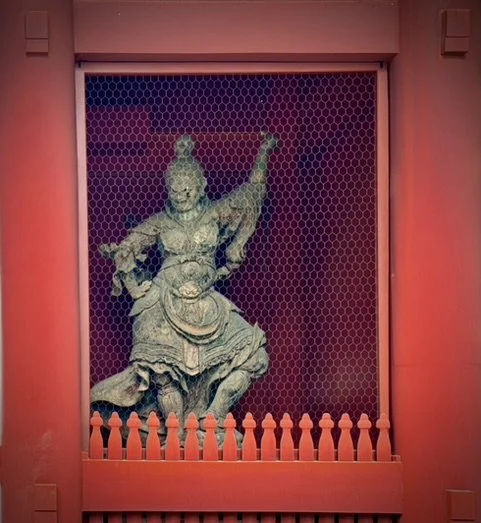
One of the fierce protectors at the main gate.
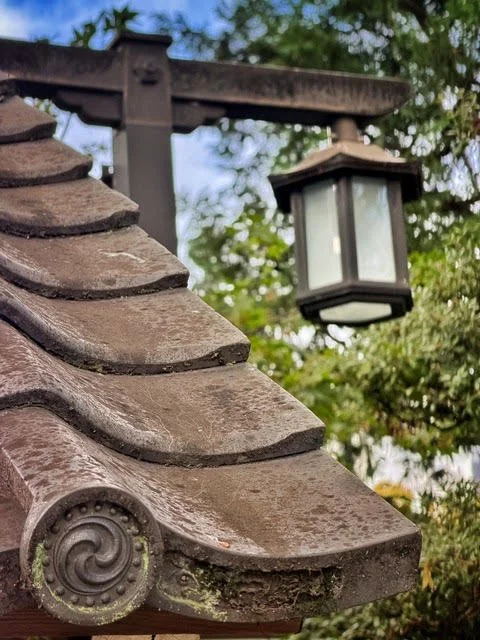
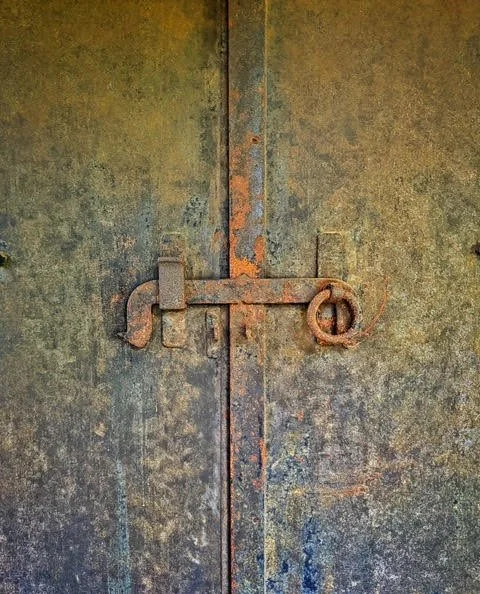
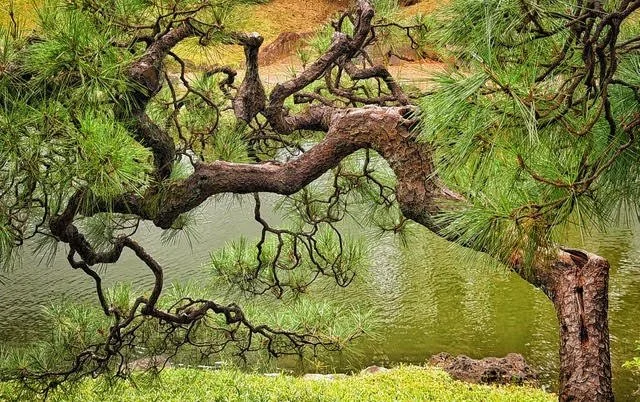
There were so many architectural and garden details that caught my eye.
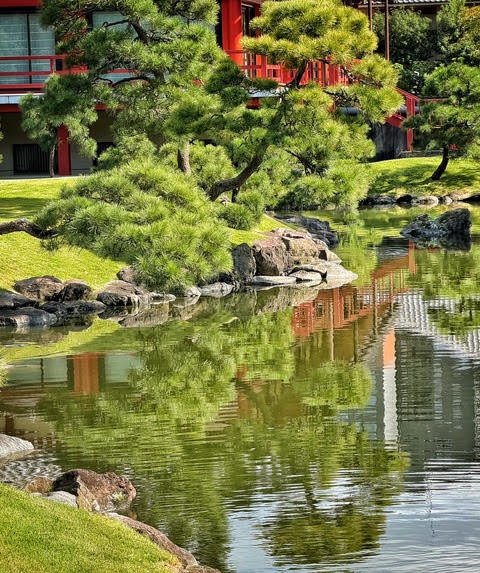
The gardens were astonishingly beautiful.
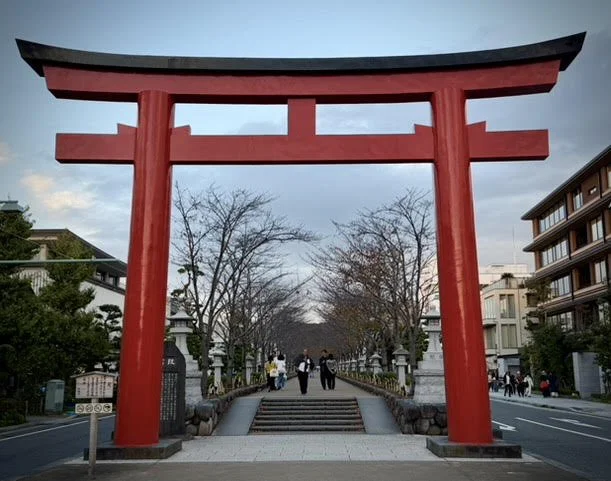
We then re-boarded the bus for a 90 minute drive to Kamakura, the place where Zen arrived in Japan. After checking into our hotel we all waked to the Tsurugaoka Hachimangū, the spiritual and physical center of Kamakura. Again, there are beautiful pictures and descriptions of the temple and shrine online. The approach is interesting, a raised path called the Dankazura, built by one of the early powerful leaders of Japan, as a prayer for his wife. It subtly narrows as it goes toward shrine, an old trick of forced perspective that makes the shrine look farther away and the walk seem longer. We were deliberately slowed down, and we made the walk at dusk, the traditional way pilgrims meet Kamakura. Here are some impressions I captured on our walk.
The entry to the Dankazura, the walkway to the shrine.
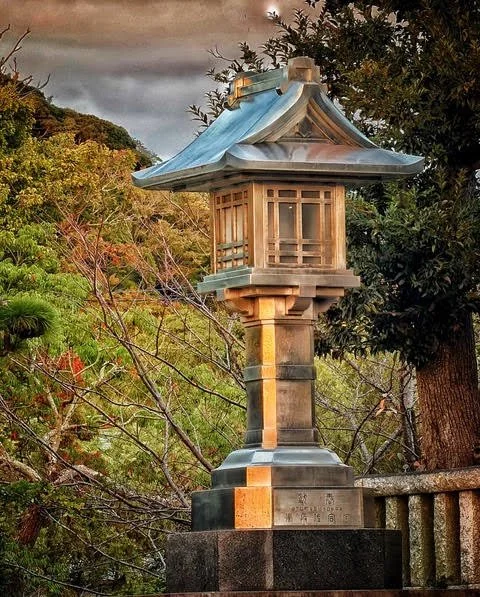
Evening sun reflected in one of the great lanterns at the entry to the shrine
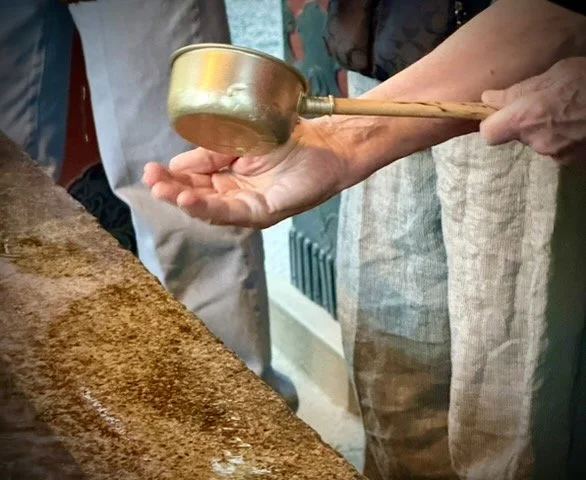
Roshi Joan leads us in the purification ritual done before entering the shrine
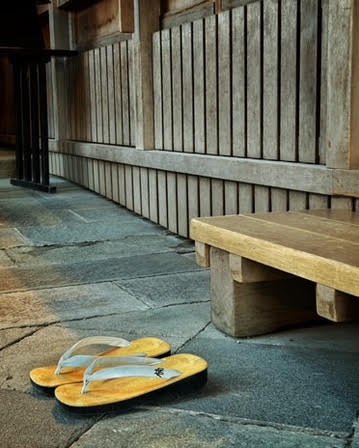
Sandals waiting for the monk to return
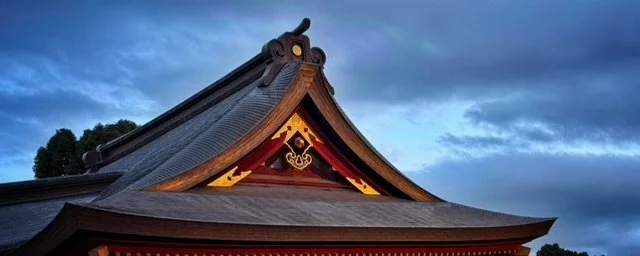
Evening architectural detail
I hope these small descriptions and reflections help you feel like you are participating in the pilgrimage. There is more to come. We meet the Great Buddha of Kamakura tomorrow, cast in the mid-thirteenth century.
With a warm bow,
Flint
Dear Ones,
On our first full day we plunged into a contemporary world of art and technology which reflected the deepest and most ancient teachings. I am going to transcribe some copy from our "Pilgrimage Companion" book about the exhibit. To know more about the place we visited you can go online to teamLab.
From our Pilgrimage Companion…
teamLab Planets Tokyo
Opened in 2018 as a temporary exhibition and repeatedly extended by demand, teamLab Planets holds the Guinness record as the most-visited museum devoted to a single artist or collective. It has become one of the most visited art spaces on earth. It is currently scheduled to run through the end of 2027. It is a collective of artists, engineers, mathematicians, animators, and architects, and their governing idea is stated plainly in their work: the boundary between the viewer and the artwork is a fiction, and so is the boundary between one artwork and another. They call the pieces here "body-immersive." You enter barefoot. You wade through water to the knee. You walk on a floor of mirrors, then cross a room filled with enormous spheres, and the space deforms around your body while your body deforms the space for everyone else in it.
The intellectual claim underneath this is not decoration. teamLab has said, in various forms, that modern life has trained us to move through flat, hard, rectilinear surfaces until we forget that the body has a consciousness of its own. The installations are designed to give that consciousness back to you by making the ground uncertain: water, mirror, softness, light that responds.
What to notice: In Floating Flower Garden, the orchids rise as you approach and descend behind you, so that you are always standing in a small clearing that exists only because you're there. In the water room, the koi are generated in real time and dissolve into flowers when they touch you; nothing is on a loop, and nothing you see will happen again. If you want a Dogen entry point, that's it: this one, unrepeatable, and then gone.
The resonance: Placing a digital art museum on day two of a Zen pilgrimage is a deliberate move, and a good one. "To forget the self is to be actualized by the myriad things" is not a metaphor here; it is more or less the operating instruction for the building. The ancient wooden temples later in the trip make the same argument with different technology.
My experience: It is hard to put into words. The exhibit asks you to surrender your body to the experience you enter and to relinquish thinking while, at the same time, maintaining uprightness and respect for the others immersed in the experience around you. Sound familiar? It is dazzling, mesmerizing, de-centering and brilliant. As always, here are a few images.
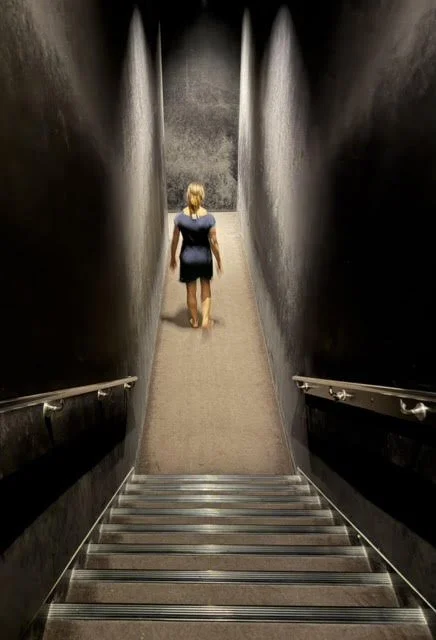
Descending into a new world. The practice of descending into the dark.

Wading through water that responds to your movement with beautiful and colorful movement of its own. Your colorful waves then interact with the waves of the others; mutual causality.
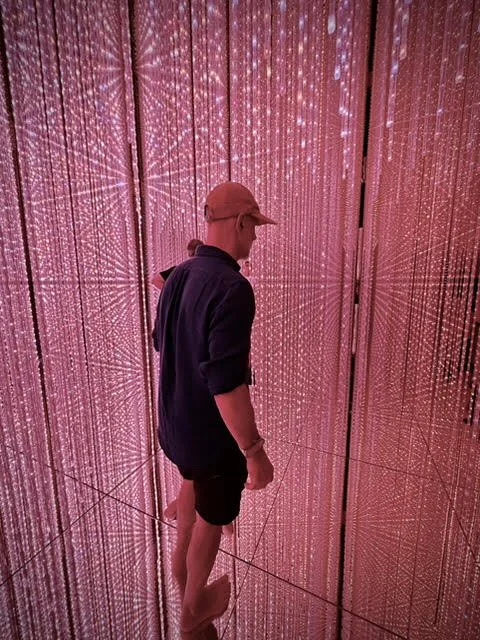
A cathedral of infinite points of light (long LED strings in an immense labyrinth with mirrored floors). You can't quite tell where the edges are and yet you are spellbound as the light changes and the perceived immensity of the space swallows you.

A cathedral of infinite points of light (long LED strings in an immense labyrinth with mirrored floors). You can't quite tell where the edges are and yet you are spellbound as the light changes and the perceived immensity of the space swallows you.

The spheres respond to your touch, changing colors and position as everyone moves through the space.
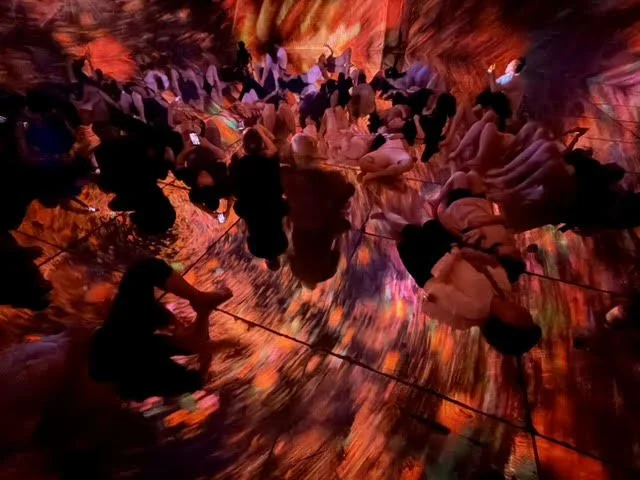
It was very difficult to walk in this room. You see people sitting or lying on the floor. The room was perfectly stable, but your perception was that it is moving. What is the truth?
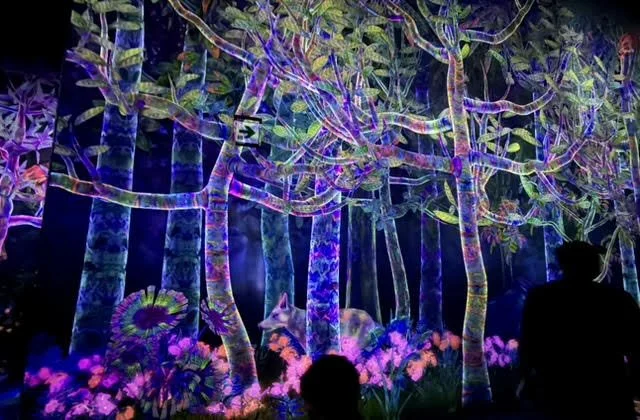
Prehistoric animals prowl the forest in which you walk.
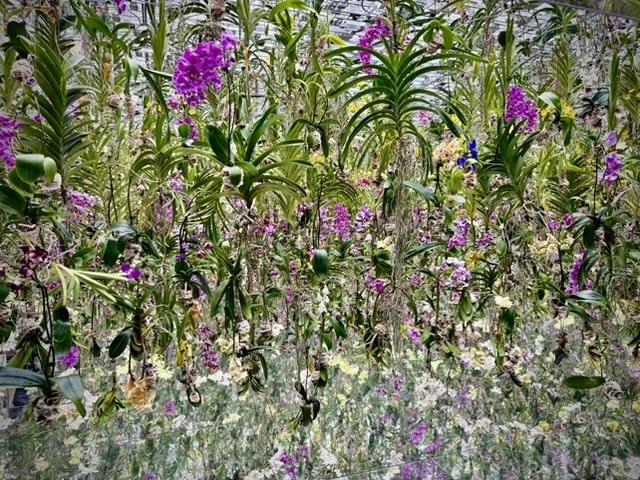
The living orchid garden you walk through rises up slowly in response to your slow walking, like kinhin, making space for you if you don't rush. The floors and walls are mirrored, so the garden is immense. It was Erin's heaven.
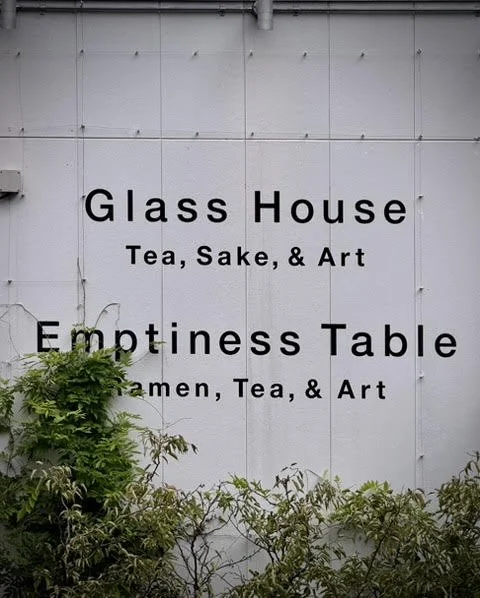
Resting and having something to eat and drink at the end. Not disparaging others ("glass houses!") and sitting at the Emptiness Table, being nourished by the world.
With palms together, Flint
Dear Ones,
After a relaxing time in the ofuro early this morning and some enthusiastic shopping with friends in the Ginza, I took a brief nap and then wrote in my journal. On our shopping excursion I was introduced to Itoya, a store like nothing I have ever seen. There were 12 stories of stationery, writing instruments and desktop objects. Very dangerous for those of us who love these kinds of beautiful things. I didn’t get in too much trouble but found a new fountain pen and a special mechanical pencil. There is a picture below of the entrance to the building.
Today everyone has finally arrived, and in less than an hour we all gather for the first time to officially begin the pilgrimage. This is what came this afternoon, writing with my new pen.
The Pilgrimage of No Beginning and No End
We say we gather tonight to begin,
a circle of beings outside of body time,
both weary and joyful,
known and unknown to each other,
preparing to take our first shared steps.
But are these really the first steps?
Is this our true beginning?
So many of us having been shaped
by prior shared experiences,
and many of us formed by practices
handed down through the
succession of ancestors —
the true pilgrims of the past.
Were they our beginning?
Whatever path we've taken along the way,
our eyes may have been opened a bit,
hidden places in our hearts revealed,
renewed — even healed —
but would we say all of that came before?
Or were those moments the true beginning — of Now?
Our practice of stillness and silence
has no beginning and no end,
one breath simply follows another,
until there is no breath at all.
Would no-breath be the end?
Was our first breath the beginning?
Or was that cry the end of
everything that came before?
No matter, we've been given this gorgeous, unfathomable life,
the true pilgrimage with no beginning and no end.
Still embodied, we vow to take the next step — together.

Dear Ones,
To sustain oneself on an extended journey, being able to rest and recover are both essential. I am not so good at this, so I am meeting a personal edge which, if practiced in a wholesome manner, allows for restoration of body and mind. I arrived a day earlier than most people in order to recover from the travel and be ready to enjoy what the pilgrimage has to offer.
Our group is gathering at the LaVista Tokyo Bay Hotel to officially begin the pilgrimage on Tuesday, October 13. It is already getting dark here on Monday evening around 6PM as I type this message. I have a beautiful view from my room, one that is helping me simply sit and enjoy looking out over the city and the bay. I’ve been taking long walks and short naps, enjoying the great weather, and eating such amazing sushi. We are next door to the Tokyo fish market, the largest in Japan, so the fish is as fresh as you can get.
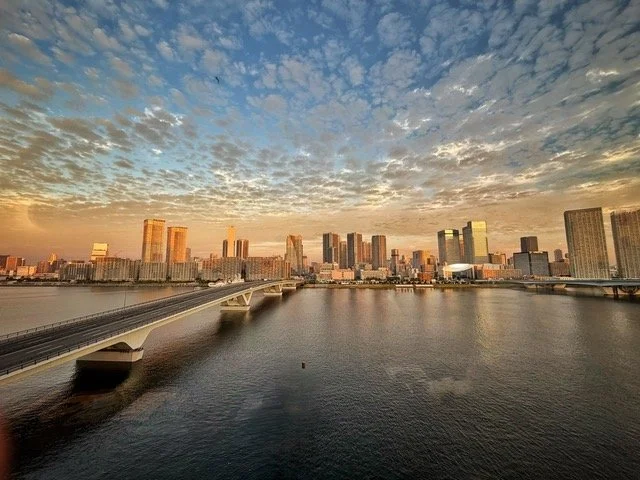
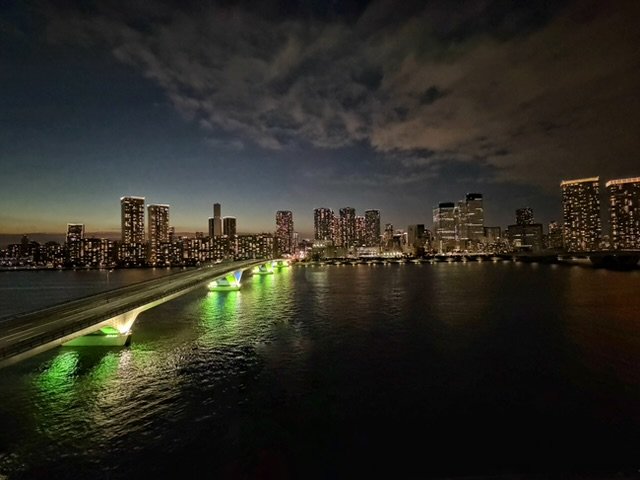
I took a picture early this morning and another just now from my window in the hotel. The pictures aren’t the main thing, but they are reminders of the cycles that make up our impermanent, interdependent lives — night and day, inhaling and exhaling, birth and death, light and dark. Each day of pilgrimage will have its own cycle and as a group we will find our rhythm, a temporary chosen sangha.
Once we are all here and begin our shared journey tomorrow, I am not sure how much time I will have to send messages like this, but for now I want to send my love and show you the view — both from very early this morning (5AM) and now just over 12 hours later, in the evening. This is where I have been sitting.
With love,
Flint
Dear Ones,
Yesterday was the beginning — a long travel day from New Mexico to California to Japan. Everything was on time and went smoothly. I am now sitting in my hotel, very early in the morning, although my body thinks it is afternoon, taking time to let you know the pilgrimage has begun. I have one small poem, written in the Admirals’ Club in Los Angeles before boarding the flight to Tokyo, and one image I was surprised to get as we approached for landing at Haneda airport.
My very best to all my companions on the Way,
Flint
Stepping off the Curb
— 10-10-26, LAX
Standing quietly at the curb
in the stillness and chill
of early morning darkness,
with my luggage as my only companions,
I waited for my ride.
What I may have forgotten
is simply forgotten.
One has to eventually commit,
despite the inevitable uncertainties.
What is to come has yet to arrive.
Then stepping off the curb,
as if pulled by an invisible force
from the headlights of the approaching car
that will take me to the airport —
it was time.
Such an ordinary, everyday step.
And yet…
Every real pilgrimage begins
with an ordinary, human step
through an invisible threshold
in the night.
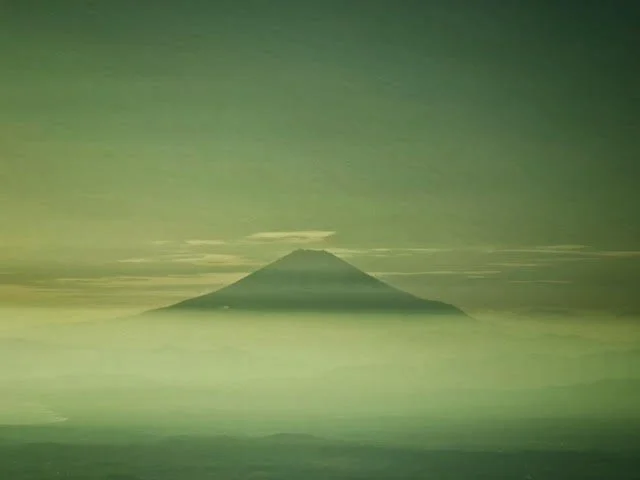
Mt. Fuji appearing through the clouds…
Double-click to edit...