
Dear Ones,
We are saying goodbye to Japan tomorrow. Today (Sunday) is our last full day and the day is divided into two beautiful experiences. In the morning is a calligraphy demonstration and in the afternoon we are going to Sanjūsangen-dō, the temple of 1,001 Kanzeons (Avalokiteshvara). This may be my favorite temple because of the experience that it evokes.
The morning calligraphy demonstration featured both Kaz Tanahashi and Yoko Keisho Nishina. Many of you know Kaz and his work. He is a national treasure himself. Yoko is truly remarkable and will be coming to Upaya early next year with Kaz and they will be teaching together. In the primary demonstration they used a process in which one of them would write something, usually a noun, and then pass the little 4x4 shikishi board to the other person and they would write an action verb or description in response to what they had received. They went back and forth — sometimes Kaz would begin and Yoko would finish. Then they would reverse, ultimately making one calligraphy for every person to take with them. The calligraphers were working from inside, calling forward the thing they wanted to write and responding intimately in the moment to what their partner offered them. When they were finished and the calligraphy shikishi were all laid out each participant could choose which one they would like to keep.
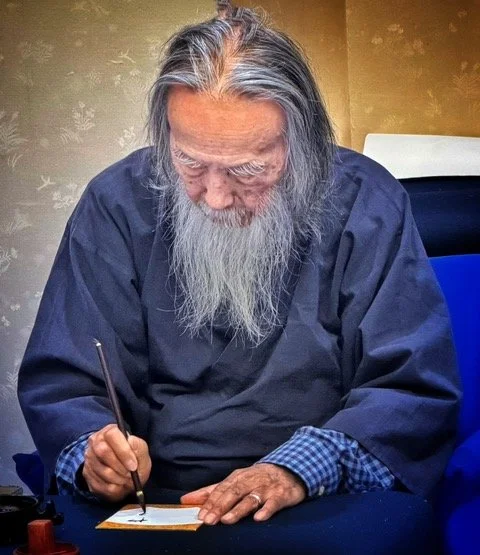
Kaz
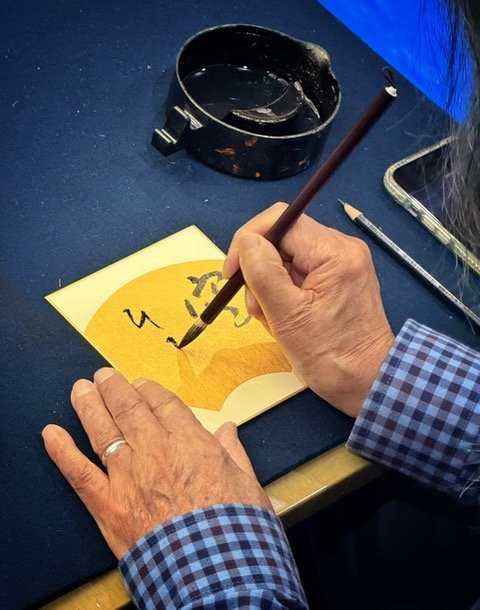
Kaz
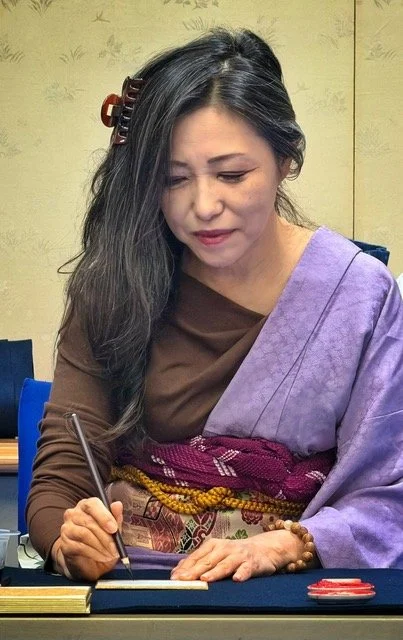
Yoko
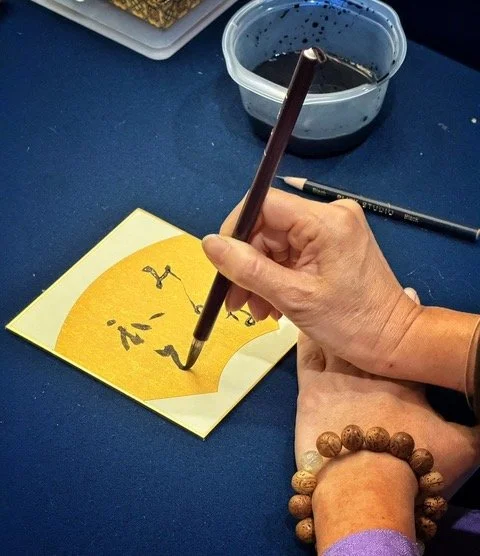
Yoko
Late in the demonstration they asked if there were any special requests. I came forward and showed them the title of my poetry collection, Flowers Fall, and asked if they would produce something related. Yoko began and wrote "falling petals." She passed the piece to Kaz and he thought for a moment and wrote, "climbs the tree." I was surprised and confused. What could this mean? There are, of course, the images of falling and rising, birth and death, in and out breath, all of which work poetically. There are even old stories of broken branches flowering magically in the Spring. Then it hit me. Erin had so many stories of climbing the huge cottonwood tree in front of the ranch house. There was a treehouse which I have seen and actually been in. In addition, his older brother had made the urn for his ashes from a branch of another tree in their childhood home that had fallen in a storm. It was a cedar branch and his brother said this was a branch that Erin would swing on as a kid. Esoteric, historic, poetic — all moved together and then moved me very deeply. You never know how these things will appear and then how they will land when they do. A mystery in response to the mystery.
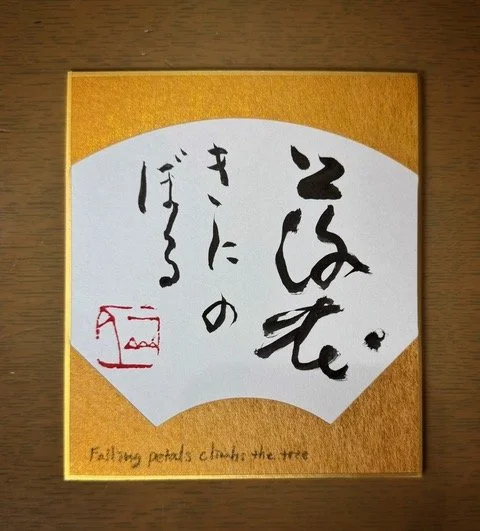
Here is a picture of the card with the calligraphy.
Afterwards the two calligraphers each produced a large piece. I don't actually remember what they represent because I was so captivated by watching them move along the floor working with the bigger brushes and the long strips of paper. If you ever get a chance to participate in a calligraphy workshop with either of them don't hesitate.
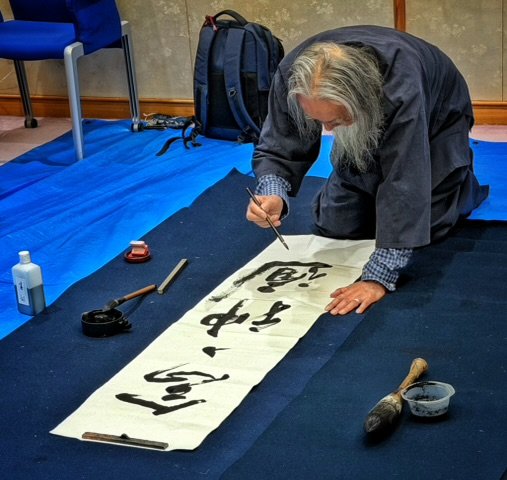
Kaz
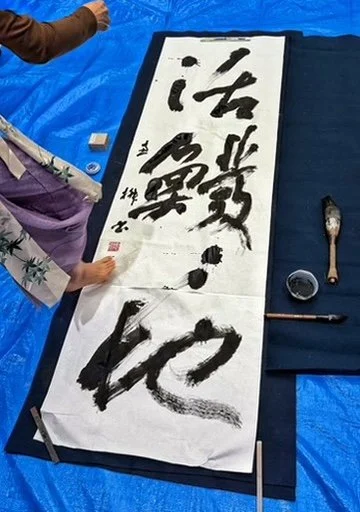
Yoko
After lunch and a rest, we traveled to Sanjūsangen-dō as a group and entered one of the most extraordinary places I have ever visited. The building is the longest wooden building in Japan. Photography is not allowed inside, so here are some images from the exterior to give you a feel for what it is like in the temple surroundings. Founded in 1164, the original burned in 1249. The present hall was rebuilt in 1266 and has stood for over 750 years.
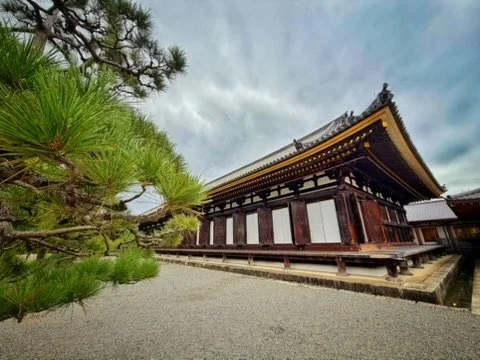
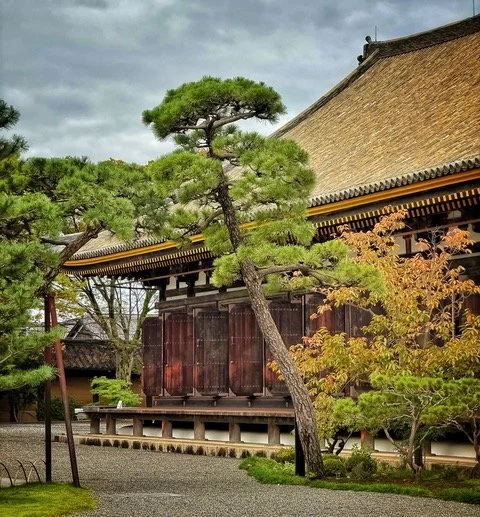
Counting the spaces between the supporting pillars on the inside you come up with thirty-three, because in the Lotus Sutra, Kanzeon manifests in thirty-three forms to reach beings who are in need: a monk, a child, an emperor, a woman, a merchant, or a god. The list goes on. The building represents this part of the Lotus Sutra constructed out of wood.
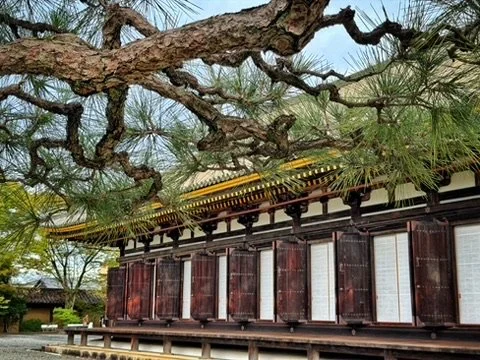
What I could not photograph, and I would have had trouble capturing anyway, are the astonishing, life-size Kanzeons with a large seated Kannon bodhisattva in the center, called the Thousand-Armed Kannon. This large piece was carved by the head of the school associated with the temple when he was eighty-two years old. On either side of the huge central figure are ten tiered rows. Imagine a huge choir standing on risers all facing in the same direction. Each figure was carved from cypress and covered in gold leaf. About 124 of them survived the 1249 fire and the remainder were carved by special craftsmen, each statue bearing the signature of the artist who made them.
I don't think I have used any screenshots in this record of the journey thus far. However, this one is worth sharing. You enter through the back of the long gallery. Turning the corner into the main part of the building this is what you see, and what you are seeing in this image is basically half of the figures. You come face to face with an army of mercy.
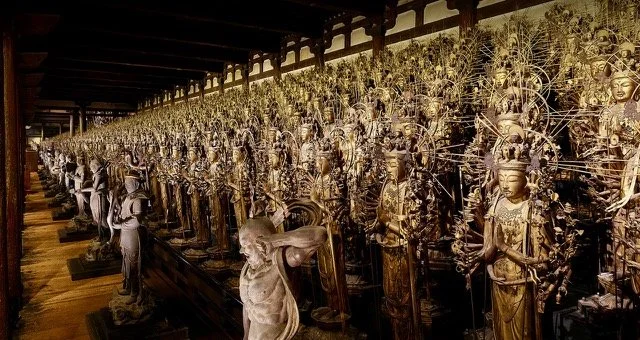
Each figure has forty-two arms. Two are joined in prayer, and each of the other forty saves twenty-five worlds. Forty times twenty-five is one thousand, the number associated with the serving arms of the Bodhisattva of Compassion. Each hand holds various implements — a rope, a wheel, a skull, a bow, a lotus, a sun, a moon, a jar. None of them are identical. Every face was carved by a specific person in the thirteenth century, and each one is different. It is said that among the 1001 faces, you will find the face of someone you have lost. You can imagine who I saw. And I wept with overwhelming love.
Moving back and forth along the building is a wonderful way to do slow walking meditation. No need to appear special or conspicuous. The place is full of tourists, but they are shockingly quiet. There seems to be no defense against this army. You might remember that at Ryōan-ji something was hidden. There was always one stone you could not see, no matter which perspective you took. But here the effect is reversed. Rather than something being withheld (the one stone), you are confronted with more than you can hold, infinitely receding into gold dimness at both ends. A thousand and one figures is this tradition's way of saying uncountable or innumerable.
You can also see the guardian protectors in front of the figures and each of them has a story. The bodhisattvas need protecting so they can do their work, just like we all do. And, like all of the temples and shrines we have visited, they have beautiful gardens and grounds.
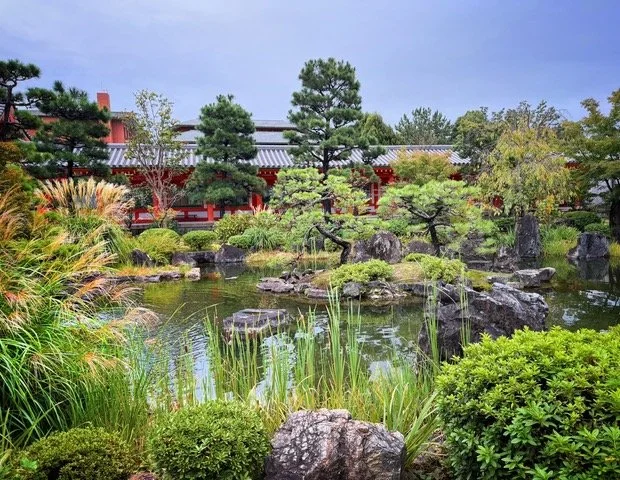
Best wishes from here. I hope to be home with ease and safety. Thank you for following along. There will be another farewell and integration post tomorrow so stay tuned.
With love,
Flint
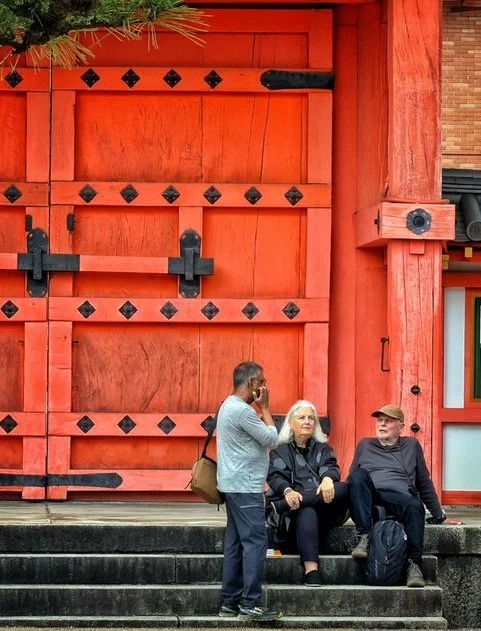
Parting shots… because the orange doors were so wonderful in the evening light.
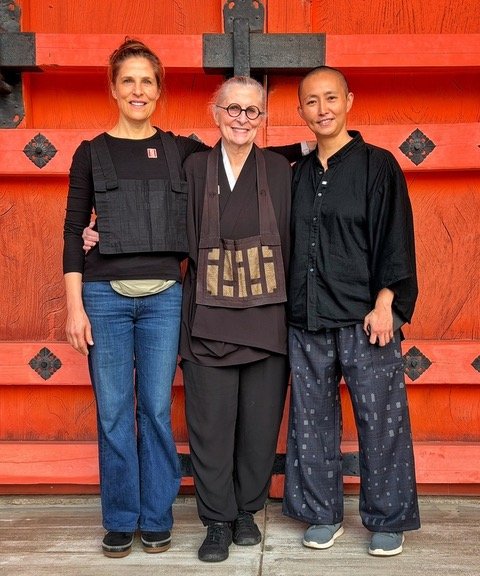
Rajnit, Terry and Brooke hanging out before leaving the temple.