Dear Ones,
I have never been to the city of Nara and have only heard about The Great Buddha there. I had no idea about any of the history of the city and the temple where the Buddha is housed. In certain ways, it was like nothing else we have seen on this trip. Everything here was before the samurai and before Zen. Everything at Tōdai-ji is older than everything else we have seen by four to five hundred years.
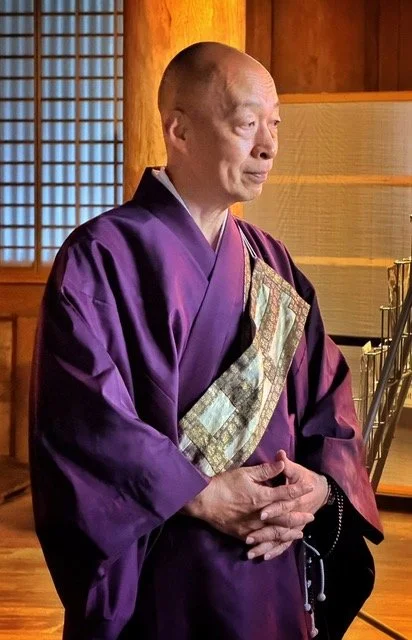
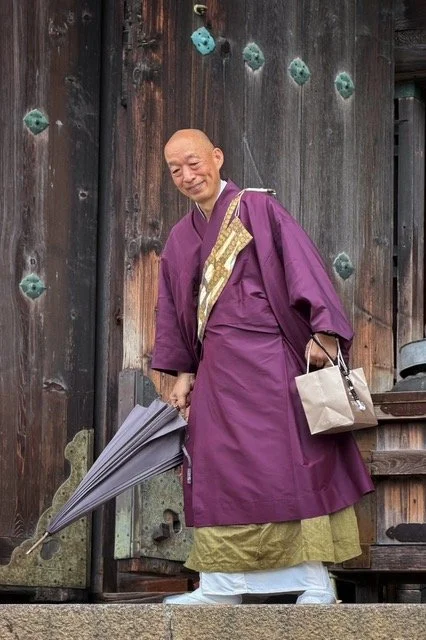
We were met by the Chief Abbot of Tōdai-ji, Rev. Hashimura, and we were invited to sit zazen in a hall that contained immense figures, some of them quite fierce, surrounding the altar. Sitting on the tan facing these figures was a powerful experience. Of course they did not move. Their stillness supported ours, and yet they were dynamic energetically, as we are in our practice. We could not take photographs in that part of the building.
I hope you can see the kindness and humble nature in his face. He is a very important abbot and cares for a huge temple complex.
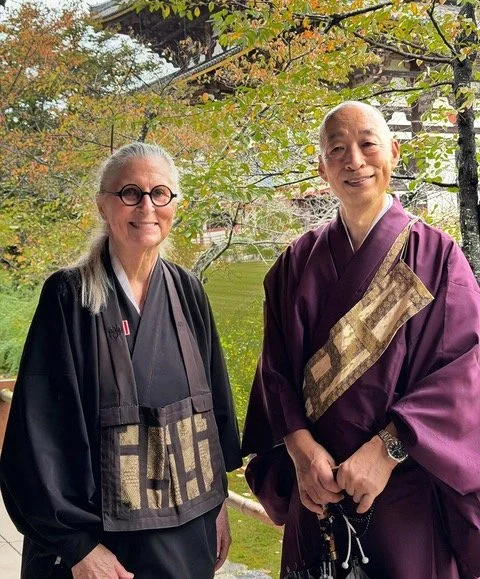
After sitting zazen we chanted the Enmei Jikku Kannon Gyo followed by the Heart Sutra. We then took a long walk to the great hall and were ushered into a side door by the Abbot.
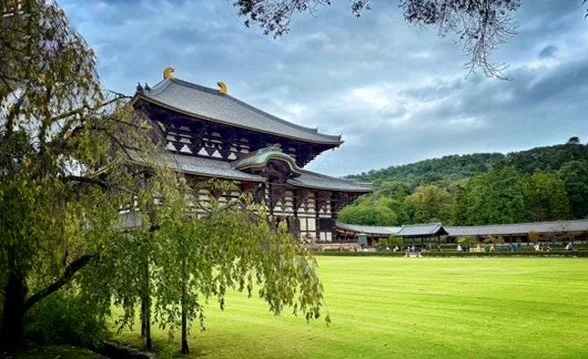
Rev. Hashimura took us personally to the upper platform surrounding the Buddha. Most people do not get to go up to this level and are not allowed to be this close to the Buddha statue. We were allowed to take a few pictures which you will see here. I felt overwhelmed and dwarfed by the figure. I will say more about the meaning of this experience below. We were each invited to offer incense at the altar and, as a group, we circumambulated the statue chanting one of the chants of the Kegon sect. It was also odd to look down and see hundreds of people below taking pictures of the Buddha statue.
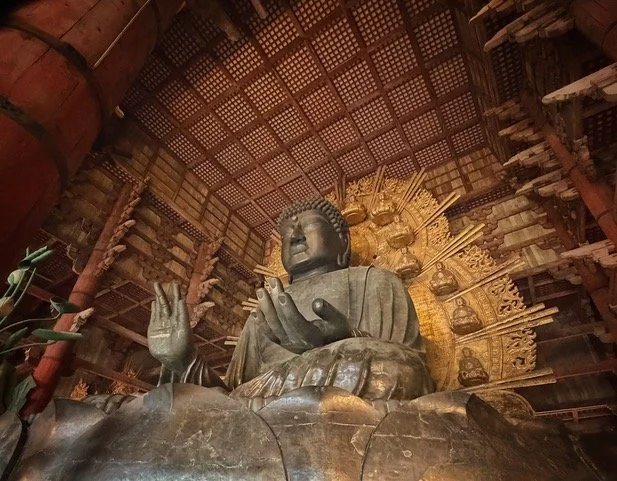
Some history: The Great Buddha of Nara was cast between 747 and 751, making it nearly 1,300 years old. It was commissioned by the Emperor after a devastating smallpox outbreak, a failed rebellion, famine and drought. This shared effort - with hundreds of thousands of people contributing to its creation - began to reunite the country and make Tōdai-ji a very important temple and Nara a powerful city.
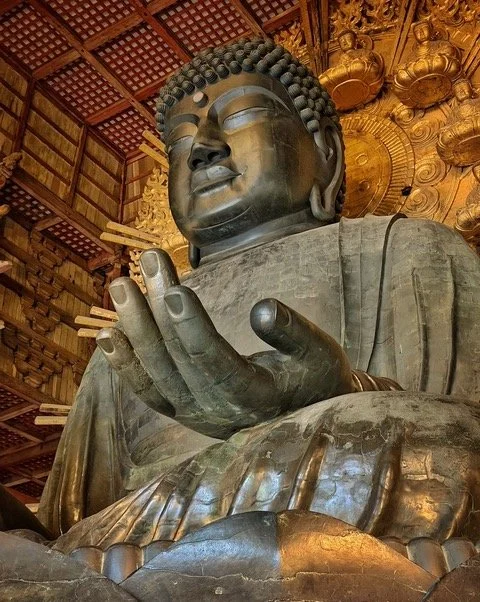
The image is not of Shakyamuni Buddha, but Vairocana Buddha of universal light. It is 49 feet tall and weighs about 500 tons. This is the cosmic buddha of the Kegon school and it is the central image in Indra's Net, the infinite net with a jewel at every knotted juncture, reflecting all the other jewels, endlessly. It is an image of profound interconnection. Nothing exists independently. Everything is constituted out of everything else. This means that one of the largest religious statues in the world was built to embody the notion that nothing has a separate self. Religious leaders came from all over the eastern world to participate in the "eye opening" ceremony in 752.
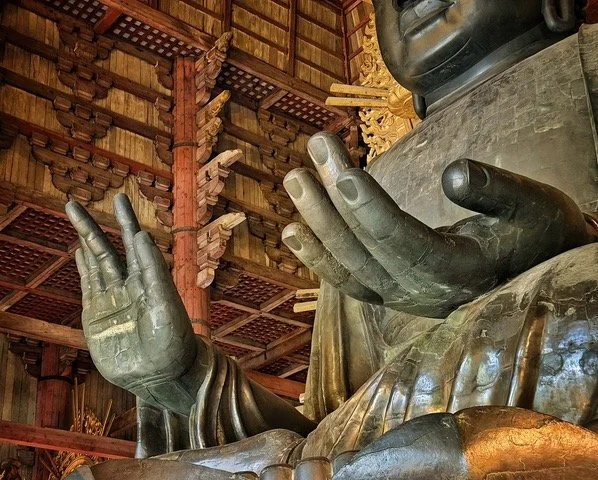
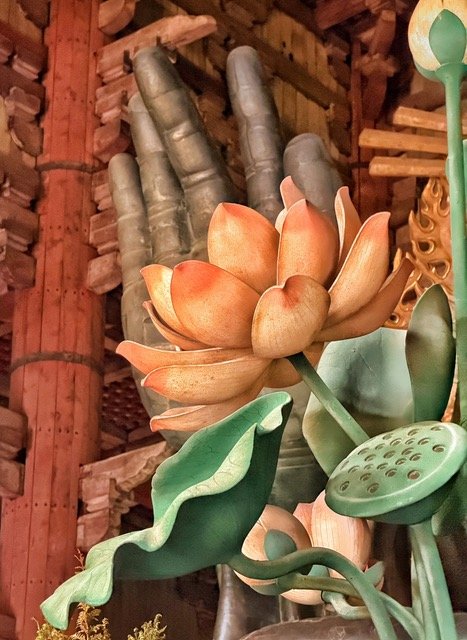
The Daibutsuden - the great hall - remains one of the largest wooden buildings on earth. It is hard to describe the scale of these grounds and the buildings. This is a very tiny peek at a vast complex of buildings and lakes and parks.
The gate leading to the building that holds one of the largest bells in the world, cast at the same time as the Buddha. It has hung here for nearly 1,300 years and weighs 26.3 tons.
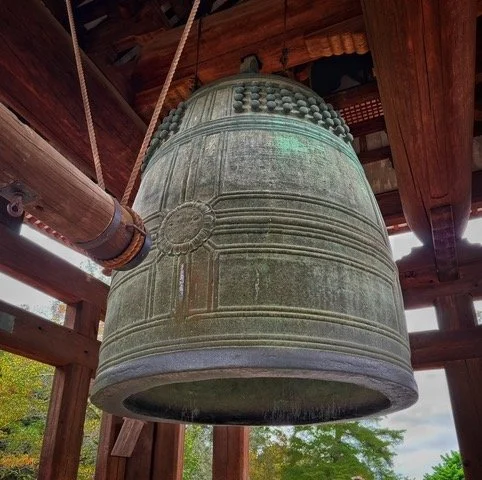
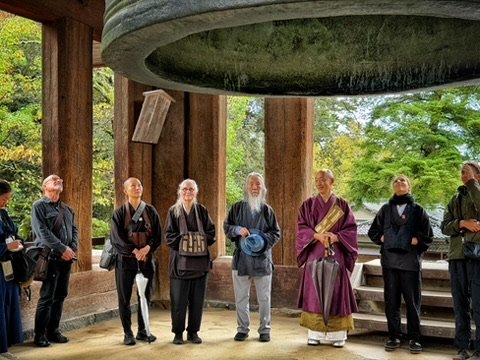
This may give you a feel for the size of the bell.
All of these descriptions and photos are not just to sound impressive (although it is!), but to point out something more important. The Kegon school is founded on the Avatamsaka Sutra, one of the most important Mahayana scriptures in Asia. In English translation it is over 1,600 pages long, another very big number. It is extravagant and almost psychedelic in its description of reality, a reality that is inconceivable and vast, so the imagery is designed to be beyond anything you could hold in your awareness so it literally blows your mind. This temple embodies that teaching. Everything about it is beyond comprehension and opens a person to the vast, interdependent scope of ultimate reality. Now back to the human scale.
After our time together, Rev. Hashimura said goodbye and we headed into old Nara for an art gallery experience.
One more thing to know about Nara, which we encountered as soon as we arrived, is the presence of sika deer. They are everywhere. Like pigeons in a square in Venice or squirrels in a Chicago park, they are right there with humans, begging for food. They are fed well and completely protected, but they kind of overrun things. When we got off the bus to have a bio break and something to drink before going to see the Buddha, we couldn't even get to the bathroom without encountering these ubiquitous animals.
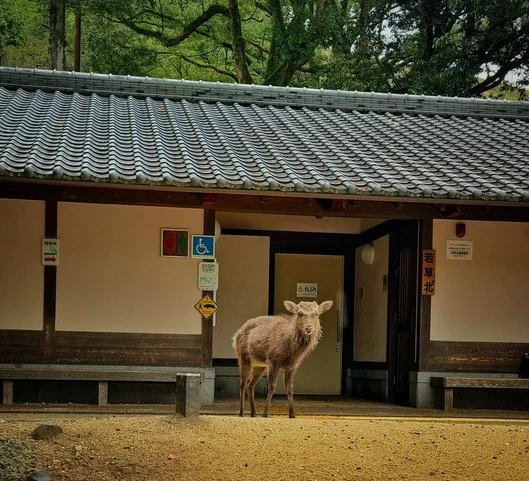
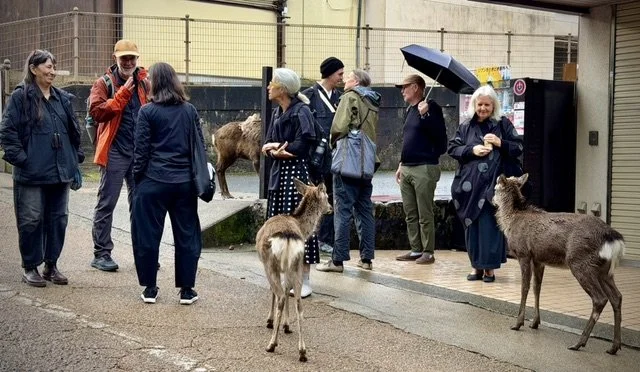
They hang around as if they hoped to get a latte or a soft drink.
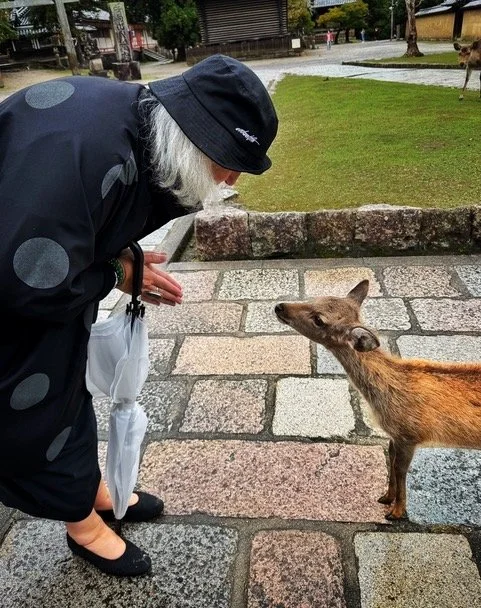
Terry loved them and bowed to each one if they approached her.
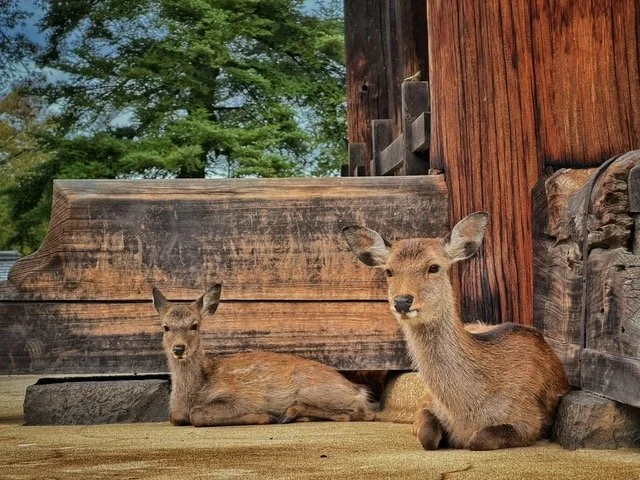
They lounge everywhere, including the platform for the large bell.
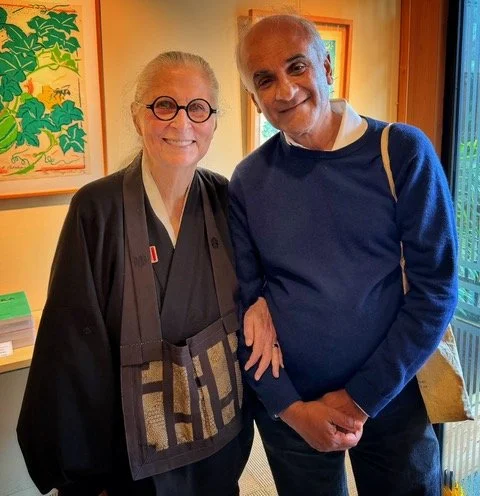
We finally left the temple grounds and visited a gallery owned by a friend of Roshi's. Among other artists, he had many prints by Mayumi Oda, whose work some of you may know. There was also an exhibit of very special tea bowls. We were all enjoying looking at everything when another old friend of Roshi, Rebecca, and Terry showed up — Pico Iyer. If you have not read anything by him I would suggest it. You will sometimes see his essays in popular Buddhist magazines like Tricycle. He has lived in Nara for many years.
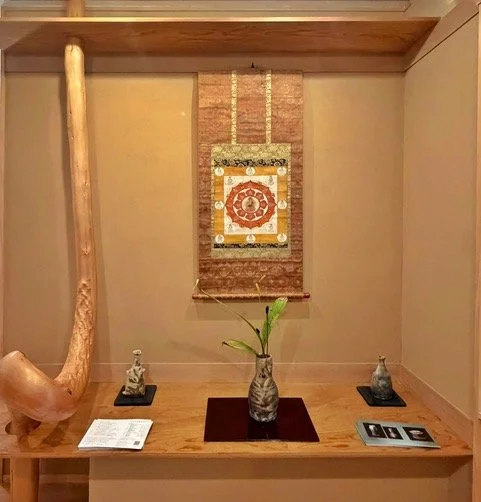
Following our time at the gallery and old Nara, we went into the countryside to a place called Toyouke no Mori, a sustainable farm and retreat environment. It was founded by Mayumi Oda and Hiro Minato, the gallery owner. There is also a small gallery space there and three rooms that guests can rent, beautifully designed in a contemporary Japanese style. You can see some of the style in this beautiful tokonoma. Usually found in a tea house, a tokonoma is “a slightly raised, built-in recessed alcove that serves as the spiritual and aesthetic focal point of the entire room. Rather than being a functional storage space, it functions as a curated sanctuary where the host subtly communicates the season, theme, and underlying intent of the tea gathering.” Here it is a place to display examples of the particular ceramic art being featured at the time.
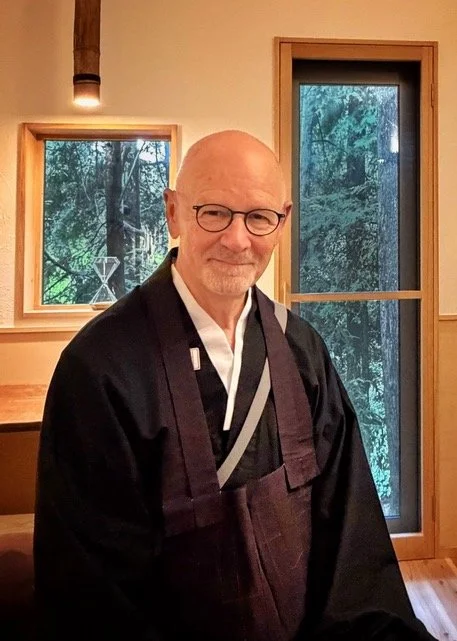
As I sat in one of the guest rooms quietly relaxing, Rebecca Solnit did what I have been doing for two weeks. She took my picture. So there is one of me.
The staff and volunteers had prepared a banquet for us, so we ate our lunch and enjoyed the day in the country. We had a circle check-in before returning to Kyoto by bus. Tomorrow is our last full day so now I am going to get some rest.
With love,
Flint
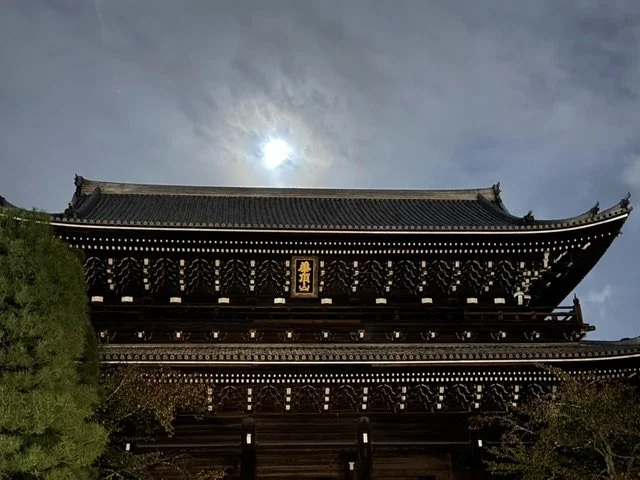
P.S. As a few of us walked to dinner in Kyoto this evening I noticed the moon rising behind the clouds and over a temple we were passing…