
Dear Ones,
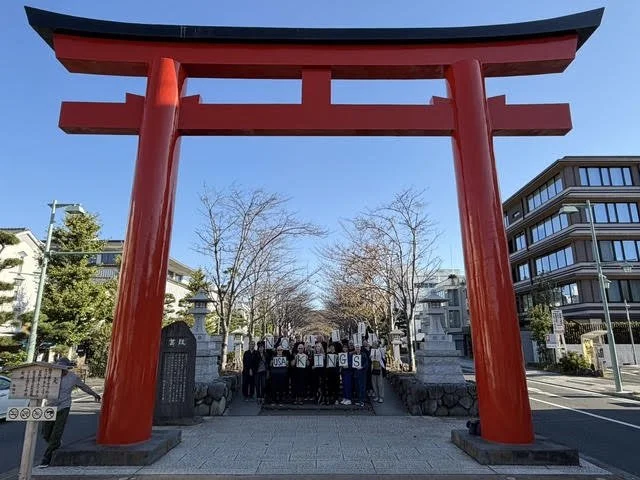
We remained in Kamakura for another day and planned visits to two very old temples led by two very contemporary teachers with innovative ideas. But first, Rebecca Solnit invited all of us to participate in the “No Kings” demonstration from Japan. We met at the large Torii Gate just outside our hotel and took some photos to post back to the US, letting people know we were supporting the activities of the day. Several Japanese people stopped to cheer us on. Rebecca knows how and where to post these things so we followed her lead. These are a couple of the images.
Here is how large the gate is. We are dwarfed under it.
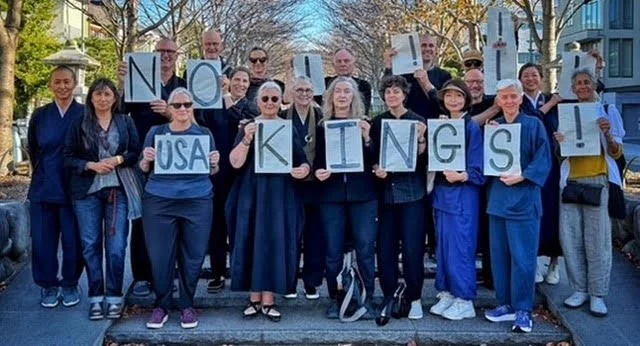
Here we are lined up. Terry Tempest Williams is holding the “K” and Rebecca Solnit is holding the “I.” Roshi Joan is between and just behind them. Molly Crockett is holding the “N” and the “G” is held by Kimiko Bokura, our organizer and teacher of mindful leadership for Google and other companies both in Japan and the US. You can see me peeking above the “O.”
Now, back to the previously scheduled pilgrimage. We began with a walk to Kenchō-ji, the oldest Zen training monastery in Japan. Interestingly, the founding abbot was a Chan master from Sichuan (in China) who came to Japan in 1246 and never went home. So Japan's first proper Zen monastery was founded by a Chinese immigrant, at the invitation of a Japanese warlord, using a Chinese blueprint, in a foreign language. Zen in Japan began as a transplant.
We were told that the layout is the teaching. The temple is built on a strict Song-dynasty axis: the outer gate, then the Sanmon (“Mountain Gate” or main gate within the temple), then the Butsuden (Buddha Hall), then the Hatto (Dharma Hall), then the abbot's quarters, all in a straight line up the valley. Almost every Japanese temple is arranged around a courtyard or scattered on a slope. This one is a spine. We could stand at the bottom and look up at it all before walking it. Something special is met right away as you enter.
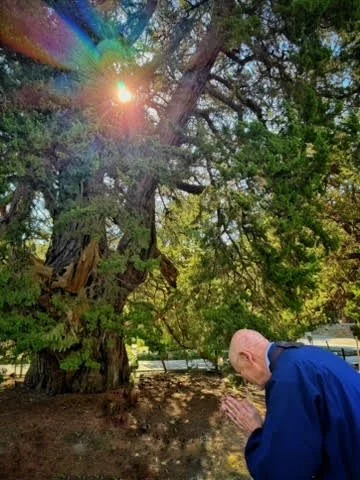
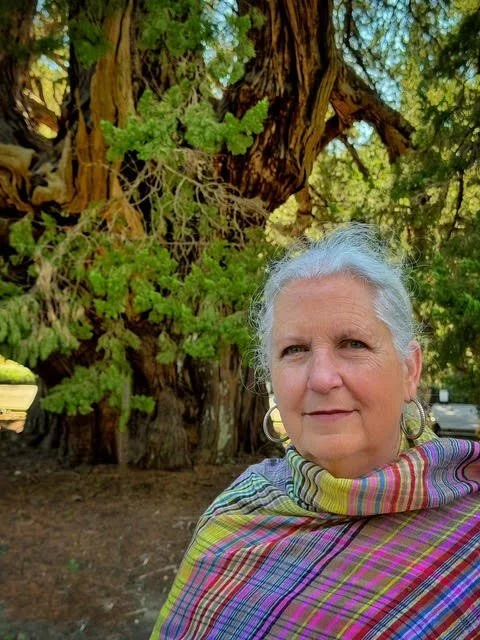
There are juniper trees in front of the Buddha Hall, grown from seeds which were brought from China by the founder in his monk's bag. The trees are around 750 years old and stand as buddhas themselves, hence the bow from me. There is a second photo of the tree with Terry Tempest Williams. Please read her latest book, The Glorians: Visitations from the Holy Ordinary, and you will know why these trees caught her eye (and mine). It has to do with the controversy surrounding the removal of the "Divinity Oak" at Harvard Divinity School where she taught for many years.
We were there to meet Rev. Fujito, the abbot at a small temple close by and a man revered by Kenchō-ji's own abbot. He is cherished in Japan for sitting with people contemplating suicide. This is important because Kenchō-ji, the monastery, stands on a former execution ground and enshrines Jizō in the Buddha Hall — not Shakyamuni Buddha — as the figure on the main altar. Jizō is the bodhisattva who declines to remain in comfortable heaven and instead walks down into hells, not to remove anyone out of their suffering, but to keep them comfortable inside it. This is a description of the job that is done regularly by the monk who was hosting us. Here is Roshi Joan introducing us to Rev. Fujito.
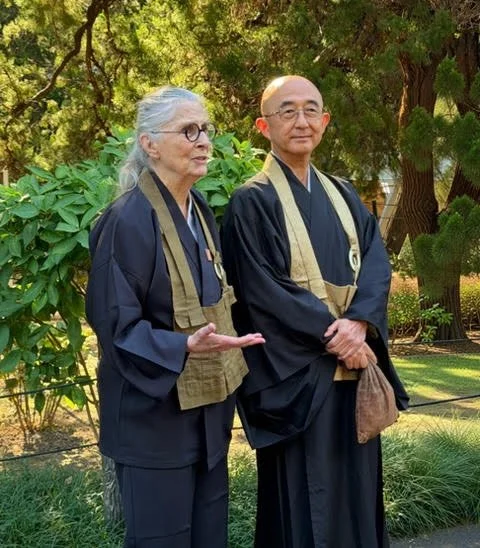
Rev. Fujito spent most of the morning talking about his work with all kinds of people approaching death, and demonstrating the embodied practices that he uses with these people for whom zazen is not an appropriate or possible practice. Like Issho Fujita the day before, he was about embodiment.
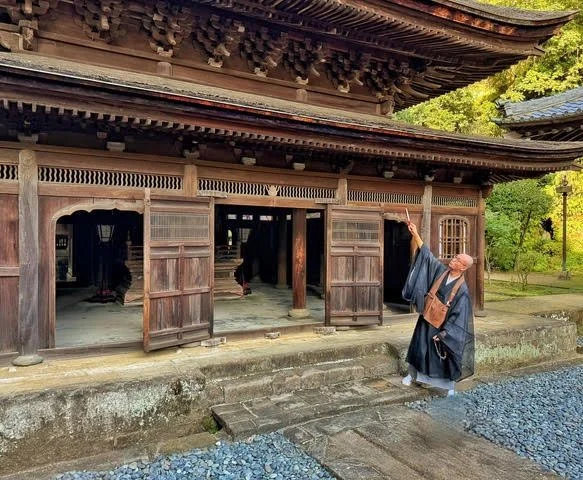
We then walked to Engaku-ji, founded by another Chinese master in 1282. We were taken through the entire complex, with special access to places that not all of the monks are permitted to go. One of those places is the Relics Hall, a National Treasure, and the finest surviving example of the Chinese-derived Zen architecture. Here, one of the senior monks is pointing out details of this very old and very special building.
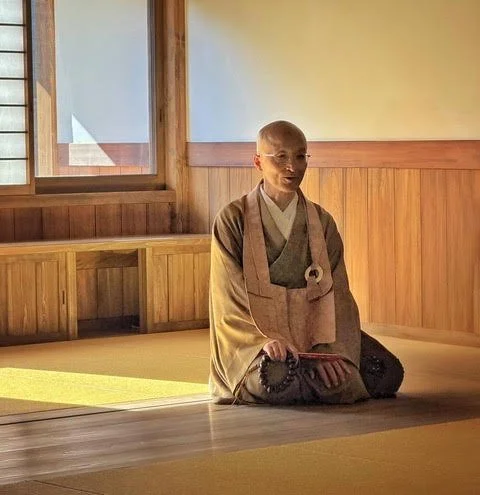
We also were shown the house where D. T. Suzuki and his wife lived. Suzuki is buried on the grounds of the temple as well. The Abbot of Engaku-ji, Nanrei Yokota Roshi, was a delightful man, very flexible in his training methods, open to change, and yet upright and clear about real training. Here he is sitting in a bit of light in the new zendo which is still under construction. I just happened to capture the moment.
Tomorrow we leave early for Eihei-ji on the Shinkansen — the Bullet Train. When we arrive at Dogen's temple we will join the monks for practice and sleep in the training quarters for one night.
For now, the light is fading as we depart Engaku-ji and it is time to return to the hotel, have dinner and pack for Eihei-ji.
My best to everyone,
Flint