
Dear Ones,
Today we left our hotel early in small buses to visit the bronze Amida Buddha of Kamakura, which was cast around 1252, the year before Dogen's death. It is about 44 feet tall and weighs around 121 tons. It was originally housed in a great hall which was destroyed more than once, and around the end of the 15th century the rebuilding stopped and the Buddha has since sat in the open air for over 500 years. As a result, it sits in a magnificent space rather than in a dim building, and has developed a patina that is lovely.
This is how the Buddha appeared today.
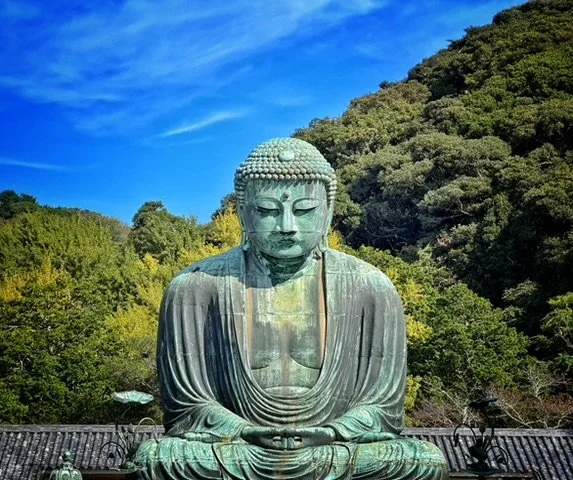
We were invited to notice certain things. The face is angled slightly down, so the gaze meets you at standing height as you approach. The proportions are subtly distorted, with the head being oversized and the torso compressed, corrected for the human view from below. Roshi Joan said, "It is a piece of engineering designed around your body's position, seven hundred years before you got there."
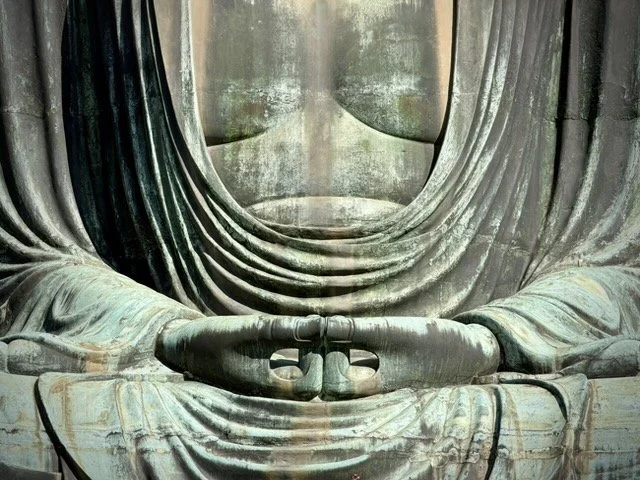
The hands are another thing we were instructed to notice. The mudra is the meditation gesture, thumb tips touching, and the whole posture is one of settled downward weight. This image is not in the act of teaching or doing anything else. It is just sitting, a prelude to what we were to experience in the afternoon.
This is what it looked like as I got closer.
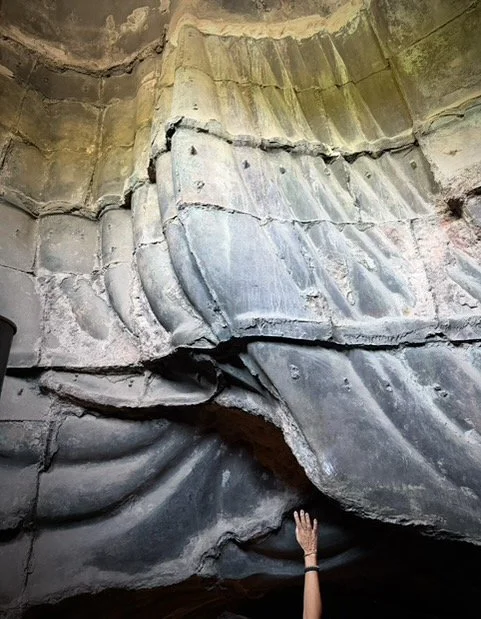
We discovered that you can actually go inside the great statue. It is quite another world inside. Very industrial, and you can see all the seams which were used to piece together all of the sections of the great bronze statue, as well as reinforcements which were added after a major earthquake in 1923. It is a hollow bronze shell, another part of the teaching we received. Roshi Joan said before we scattered to enjoy the entire complex, "You might want to go inside the buddha, although we are always with Buddha, and the Buddha is in us. The image is a shell which you can enter, but you are the living being of the Buddha."
Here is a glimpse inside as one of our group reached up to touch the heavy bronze.
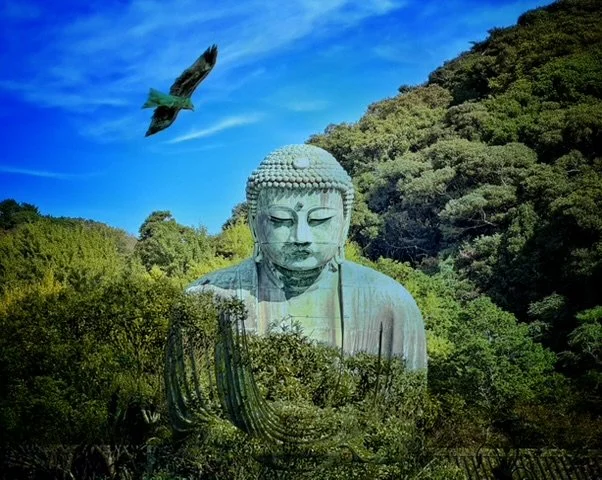
On a very personal note, many of you are aware of the appearance of a hawk that was significant around Erin's death. I will copy my poem about it below if you are not familiar with the stories. As I approached the Great Buddha, a hawk appeared and began circling high above the statue and the adjoining hillside. I was stunned to see it. It made several passes and then departed, an auspicious sign for me. I was able to capture one image of the hawk and I overlaid it with the image of the Buddha (double "exposure"). This is the result:
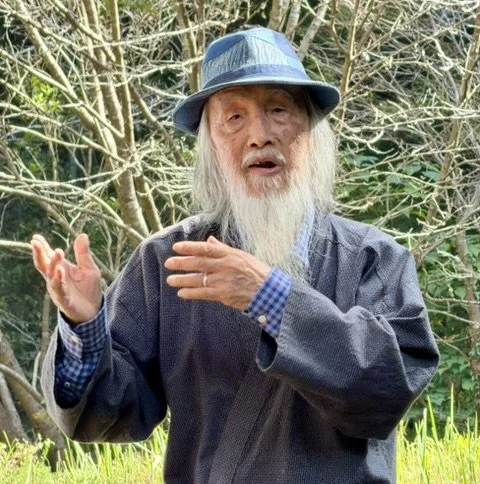
While we were still in the shadow of the Great Buddha, Kaz Tanahashi explained more of the history of where we were at the moment.
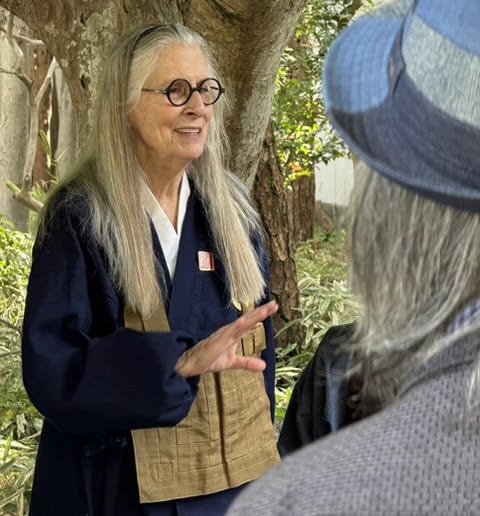
Roshi Joan then gave us a preview of where we were going next and the wonderful monk we were about to meet.
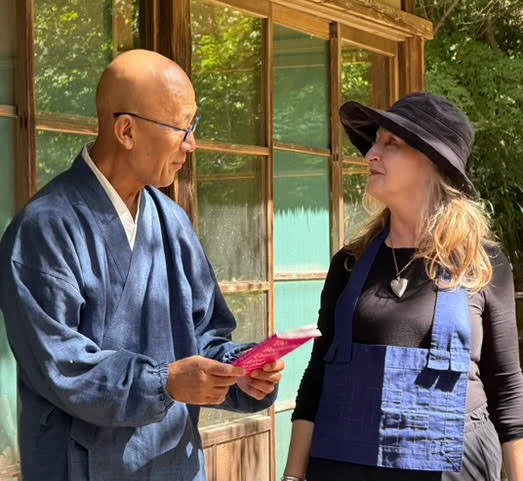
We loaded up again and traveled to a private rural retreat of Rev. Issho Fujita, a dharma brother of Shohaku Okumura, whose work many of you know. They were both students of Uchiyama Roshi, whose book, Opening the Hand of Thought, is very familiar to many of us.
This is what we were told to expect. "The thing to know walking in is that he has spent decades teaching shikantaza to Westerners, which has forced him to articulate things more traditional Japanese teachers don't speak about in an embodied way. He is adamant that zazen is not a method for producing enlightenment; zazen is enlightenment taking the shape of a person sitting. This is straight Dogen. The literal translation of shikantaza is 'hitting the mark of sitting, nothing but.' No object of concentration. No breath counting. No koan. Nothing to do and no way to check whether you are really doing it. It is the most austere practice in Zen and the one most likely to make a new practitioner feel they are likely failing. You are not failing. There is no exam."
Issho-san is lively and funny. Upon arrival, Rebecca Solnit was standing with the group and he looked over and said, "Oh, you are Rebecca Solnit!" She replied, "How did you know who I am?" He immediately said, with a great laugh, "Because you are famous (in his thick Japanese accent) and I have read your books." She had come prepared to gift him with her latest book. This was the moment.
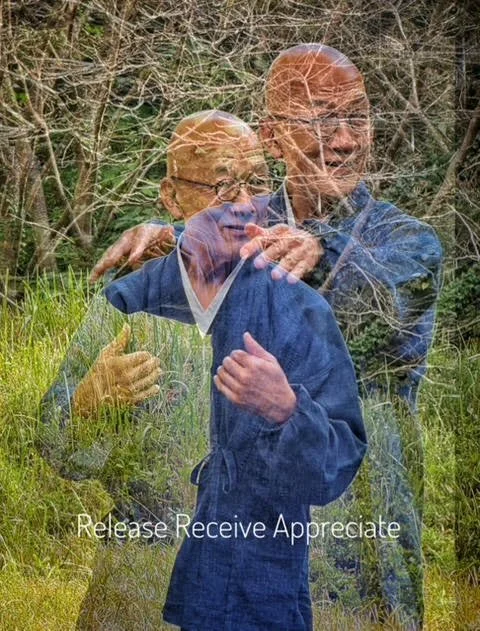
I took a few more photographs as he began to teach outdoors before we had lunch and went to his little temple for zazen and more teachings. I was playing around and made another double image because I had captured a moment of him both extending his hands and immediately turning them back toward himself. I liked the juxtaposition of these two gestures. Then later in his lecture he spoke about Dogen's three domains of practice being Release, Receive and Appreciate. Here is the image with the teachings, which he had me airdrop to him via our iPhones. A very contemporary monk!
Another full day. I hope I am not burdening you with too much. The pilgrimage is rich and deep and joyful.
With palms together,
Flint
P.S. Here is The Hawk poem which I promised. It will be part of my upcoming collection of poems, Flowers Fall, which I hope to have available by Spring. I will keep you posted on the publishing release date. I have included an endorsement which is very kind and generous. It was written by a poet many of you know. Some of you may also know that she lost her teenage son to suicide several years ago.
"With vulnerability and great courage, Flint Sparks guides us into the tender terrain of loss. I am humbled, broken open, and blessed by this book, by the honesty, the raw ache, the deep devotion, and the fierce willingness to be present while companioning a loved one through their death. So beautiful, this love. So devastating, this grief. So human, so real, so generously shared, this story."
— Rosemerry Wahtola Trommer, author of The Wonderment and host of The Poetic Path
The Hawk
The hawk arrived
as he was leaving.
With flared wings,
talons reaching
for the perch,
it came to rest
as if having been called
by his ragged breathing.
A magnificent
and mysterious
meeting.
Perched as a steadfast
witness on the crown
of the larkspur pine
outside the north facing window,
the great bird held vigil,
the embodiment of
attentive stillness.
Indigenous wisdom
tells of the hawk
accompanying the soul
from this world
to the next.
And so it seemed.
Waiting patiently,
the hawk silently departed
as everyone gathered
at the bedside
and he took
his final breath.
On graceful wings,
disappearing into
the late morning sky,
Erin followed into
the great mystery.
Two elegant feathers
were left behind
at the base of the tree.
Totems of the great leap.
Two more visits
completed the holy trinity.
His ashes were interred
and a graveside memorial
observed three months later.
The hawk appeared,
circling the old church
and family burial grounds
as we spoke our final words
and the remains entered the earth.
Another three months passed.
The family gathered once again,
this time to dedicate
the elegant stone
marking his ashes site.
High above, the hawk appeared,
gliding effortlessly on invisible
currents as if circumambulating
a sacred altar.
Three graceful arcs were inscribed,
as silent testimony
to the passing
of a great being;
the final consecration
of a beautiful life.