
Dear Ones,
This morning (Wednesday the 21st), we took a bus to the neighboring town of Hakusan, where the famous female poet Chiyo-ni was born and is now buried. Our destination in Hakusan was a temple of Shinshū Ōtani-ha (the Higashi Honganji branch) in the Pure Land school of Buddhism. Shin Buddhism had its roots in the 15th century, and the temple we visited was originally built in 1898. The eleven buildings on the grounds are Registered Tangible Cultural Properties of Japan.
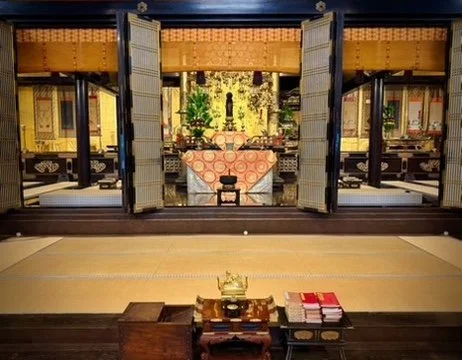
This is the main hall, where we gathered to spend some time with the Abbot, learning a bit about the Pure Land school.
Most of Chiyo-ni's personal effects and a substantial collection of her surviving brushwork are housed here. She lived from 1703 to 1775, and there is a natural stone carved with her death poem, put in place in 1799 on the twenty-fifth anniversary of her death. Her famous death poem translates:
I also saw the moon
as for this world
ah — goodbye.
In her verse, the moon symbolizes spiritual awakening and enlightenment, while her parting words reflect a peaceful, graceful acceptance of death rather than fear.
On the bus over to today's site, Kaz and Roshi Joan read some of her poetry to us. Kaz had translated many of the poems this week, so he read the original in Japanese, and then Roshi read his English translation twice. It was a lovely way to enter Chiyo-ni's former home. One thing I learned is that the death poem ends with the word kashiku. This was a conventional way for a woman of her era to sign off a letter. Here she was, facing the most consequential moment of her life, and she closes it with the ordinary courtesy of everyday correspondence, the way she might end a note to a personal friend.
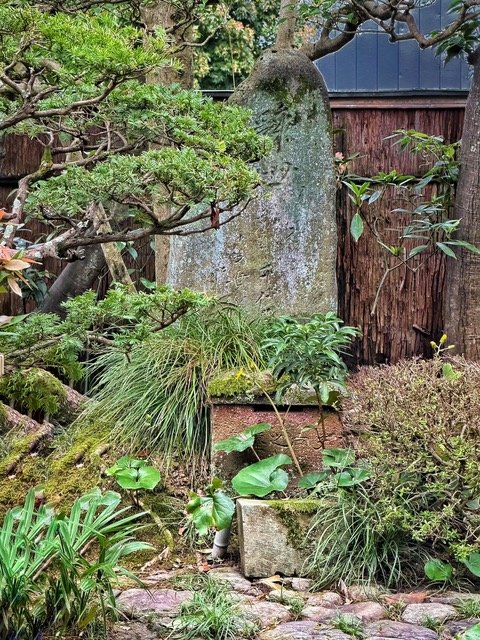
Why she matters: she built a first-rank reputation as a woman, in a form and a literary establishment overwhelmingly run by men. She also did it from the provinces (Kaga), not Kyoto or Edo. Kaz and Roshi wrote, "The work itself has an exactness so unforced that it can make some of her more famous contemporaries look like they are visibly trying."
Her best-known poem is about discovering one morning that a morning glory vine had taken over the well bucket during the night. She ended up going to the neighbor's to ask for water rather than tear away the vine. Again, Roshi: "At first the reader hears sentiment. It isn't. The poem turns entirely on choosing to be inconvenienced, and on the fact the inconvenience is never framed as sacrifice. She just goes and asks for water. Nothing is renounced. Something is noticed, and the noticing rearranges the morning."
The morning glory became her signature, and it is now the official flower of Hakusan City, which holds the Chiyo-ni Morning Glory Festival every year, where citizens compete for the loveliest flower.
One translation of the famous poem:
The morning glory!
It has taken the well bucket,
I must seek elsewhere for water.
The one that speaks to me:
morning glory!
the well bucket entangled,
I ask for water
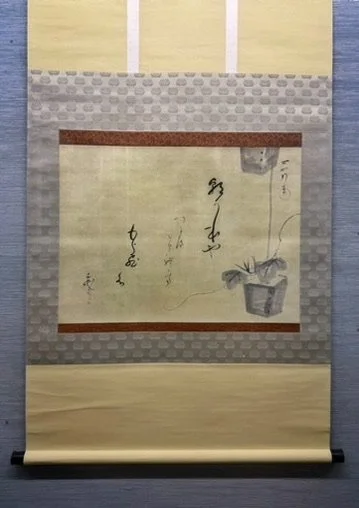
This is a scroll with an image and the poem, done by an artist at the time it was written. It is not her calligraphy, but it is contemporaneous with the poem and is among her archives. We also saw her monk's bag, in which she carried her writing instruments, some personal effects, and the hat she wore when traveling on foot.
She wrote something like 1,900 poems, a body of work that has never been fully translated into English. Her poems were not officially haiku. That word, I just found out, was coined by Masaoka Shiki in the 1890s and then applied backward to poets writing in a certain style. Chiyo-ni wrote hokku, the word for the opening verse of a linked sequence. She also wrote the sequences themselves, haikai no renga, composed collaboratively with other poets. This is important as well, because we usually think of the solitary nun with a flower, but her work was much more social: linked verse composed in a room with other people, each verse answering the one before it, under strict rules of season and image. She was not alone. She was a professional operating within a network of creativity.
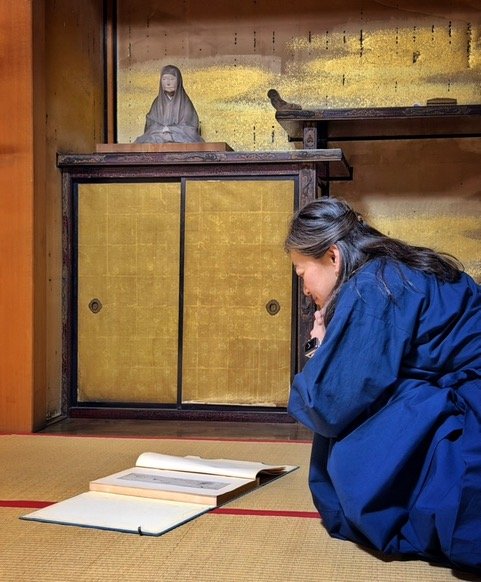
Gayle, one of our pilgrims, looking through ancient texts with the figure of Chiyo-ni sitting above her.
I loved this description of her poems by Roshi Joan: "These are shikantaza with a text. No object, no method, nothing to attain. You put your attention on something and decline to do anything with it." She suggested that if our daily sitting has made any sense to us, then the poems will as well.
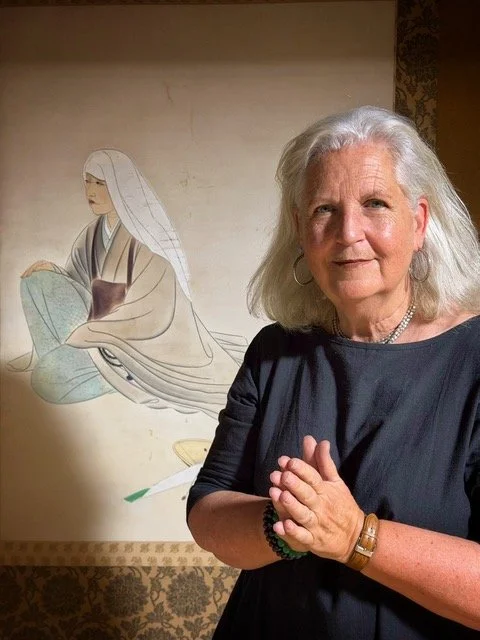
Terry Tempest Williams is here with a famous painting of Chiyo-ni: white hair to white hair. Two important women writers of vastly different times and genres, but their work has resonances. Here is a description of Terry's latest book, The Glorians: "They are not distant deities, but the ordinary, often overlooked presences—animal, plant, memory, moment—that reveal our shared vulnerability and interconnectedness with the natural world." A sister to Chiyo-ni.
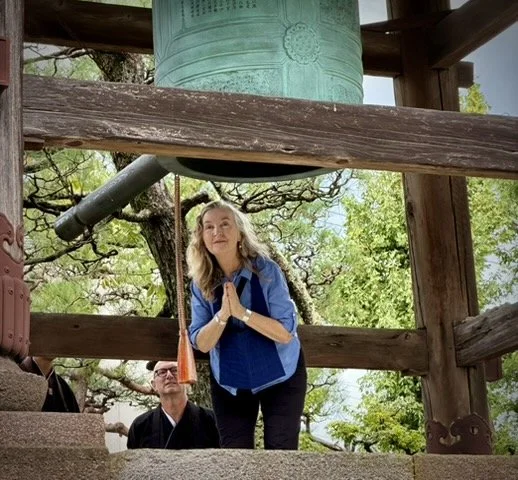
Another influential woman writer is Rebecca Solnit, who pushes outside of tradition and convention, ringing the bell of wakefulness through her writing and speaking. Here at the temple, she literally prepares to ring the bell. Her words and work send out powerful calls. Remember the temple bell poem from Eihei-ji?
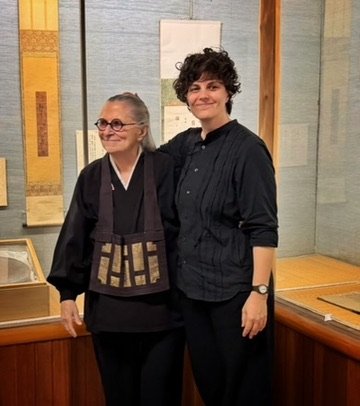
One more important woman, since I am featuring women in this post. Molly Crockett is not a writer in the usual sense but a scientist of the first degree, pushing the envelope in the study of ethics, knowledge, and power, areas that are literally of survival value at the moment. She surpasses any man I know in the cognitive sciences. She is now at Princeton, having trained at Oxford and taught at Yale. Her postdoctoral work was with economists and neuroscientists at the University of Zurich and University College London.
All these women are making a difference, and all were called together by Joan Halifax, another woman still making a difference. I bow to them all.
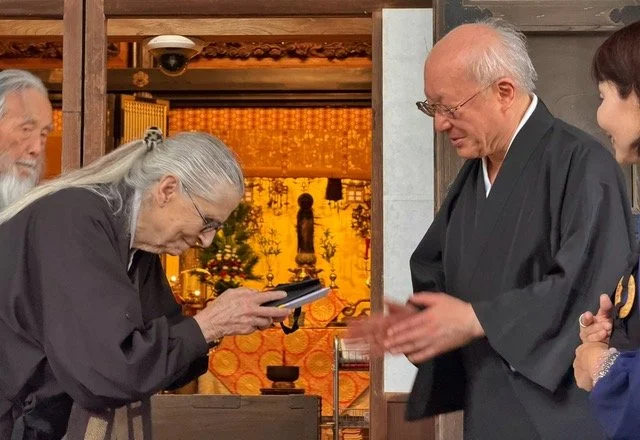
Eventually we finished our visit and had lunch. As we were leaving, there was the requisite Japanese tradition of bestowing gifts on the host. Here we see Kaz and Kimkio Bokra, our trip coordinator and translator, along with Roshi and the Abbot.
Tomorrow we check out of our hotel in Kanazawa and head to Kyoto. There are several stops along the way to take in more beauty and cultural heritage, more history, and as-yet-undiscovered surprises.
With love,
Flint
P.S. from the Upaya website
There are several stories about the powers invested in Chiyo-ni's haiku. According to one, the governor of Kaga had heard about Chiyo-ni's fame and once asked her to write haiku as gifts for some Korean envoys. Later, when he needed her to revive his garden's most beautiful cherry tree, which was ailing, he invited her to the palace. There she spontaneously composed this haiku:
spring will come again—
without flowers
you'll be firewood
To no one's surprise, the tree began to bloom again.
Excerpted from Chiyo-ni: Woman Haiku Master by Patricia Donegan and Yoshie Ishibashi.